


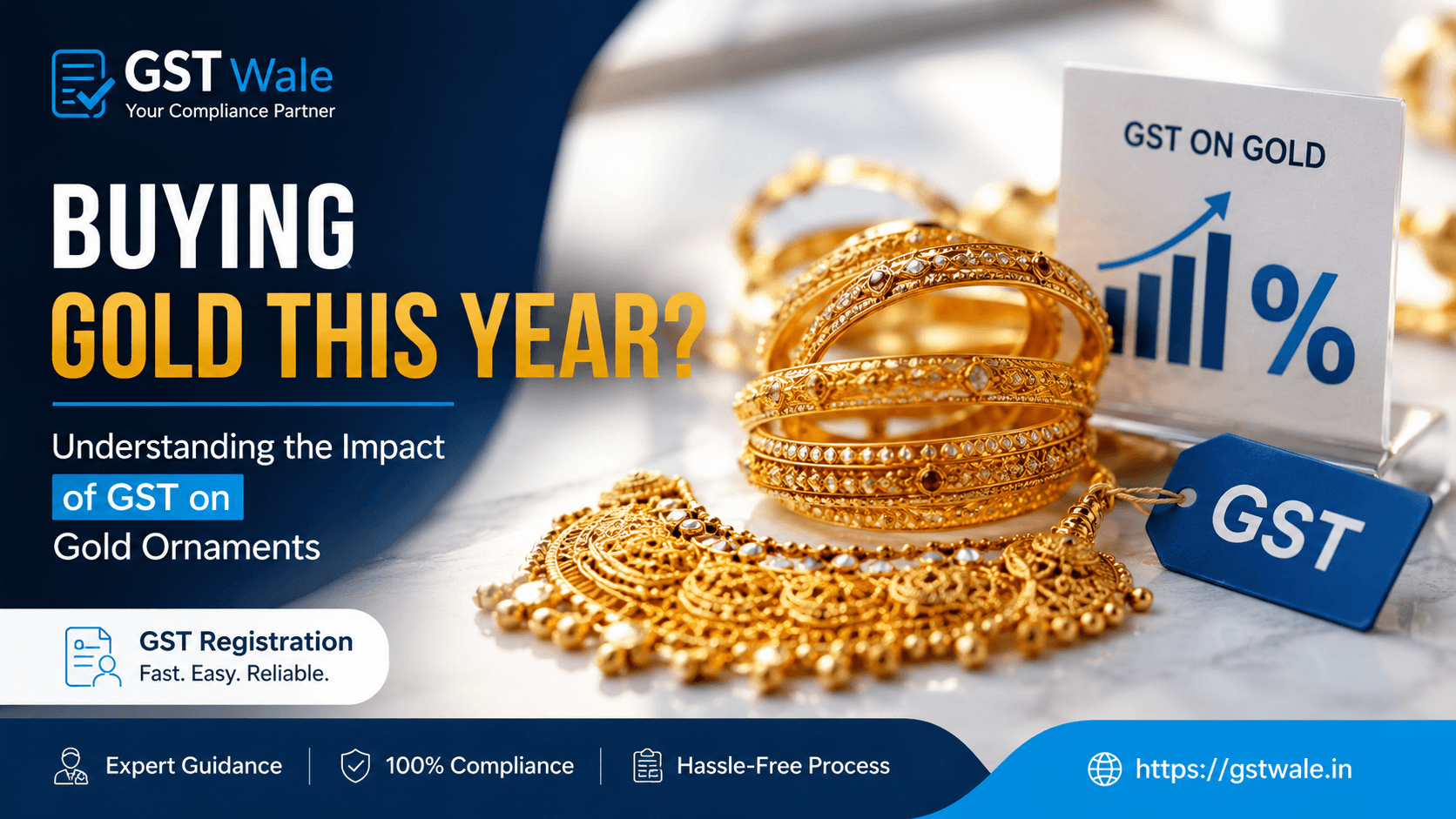
Buying Gold This Year? Understanding the Impact of GST on Gold Ornaments
Buying Gold This Year? Understanding the Impact of GST on Gold Ornaments
Hello there! As a practicing Chartered Accountant in India, I regularly sit down with clients, family, and friends who have questions about the taxes involved in purchasing their favorite yellow metal. In our country, buying gold isn\'t just a simple financial transaction; it\'s an emotion. It is deeply tied to our weddings, festive occasions like Dhanteras, and traditional long-term investments. But before you excitedly walk into a jewelry showroom, it is crucial to understand how the gst for gold impacts your final bill. Whether you are an aspiring business owner looking into compliance or an individual shopper planning a family wedding, staying informed is the best way to save money and avoid surprises. For businesses dealing in jewelry or any other taxable supply, getting the right GST Registration is the first fundamental step to ensure smooth operations and strict compliance with government norms.
Here at GST Wale, we believe in making taxation simple, transparent, and easy to digest for everyone. So, let’s break down the exact mathematics of taxes on your ornaments, step by step, so you never have to guess the final price tag again.
The Basics: What Are the Current GST Rates on Gold?
Before the Goods and Services Tax was introduced in 2017, the taxation system for gold was a bit of a maze. We had a mix of Value Added Tax (VAT) and excise duties that varied from state to state. Today, the system is beautifully streamlined and transparent.
The standard gst for gold is currently set at a flat 3%. This means that whether you are buying raw gold, coins, or beautifully crafted jewelry, you will pay a 3% tax on the value of the metal. If you are comparing different commodities, it’s helpful to know that this 3% applies across the board as the standard gst on precious metals, which also includes silver and platinum.
The Role of Customs Duty
As an expert tip, I always remind my clients that India imports most of its gold. Therefore, before the 3% GST is even calculated, a basic customs duty and an Agriculture Infrastructure and Development Cess (AIDC) are applied when the gold enters the country. These import duties dictate the base \"market rate\" of gold for the day. The 3% GST is then calculated on this inclusive market rate.
Unpacking the Gold Jewellery Tax: The Hidden Impact of Making Charges
This is where the math gets a little tricky, and where many buyers get confused looking at their invoices. When you buy a necklace, a bangle, or a ring, you aren\'t just paying for the raw metal. You are paying for the artisan\'s intricate effort and skill—commonly known as making charges.
While the base gst in gold itself is 3%, the making charges gst is levied at a completely different rate of 5%. This is a crucial distinction! Under the tax laws, the jeweler is providing you with a \"service\" by crafting the ornament, and job work services attract a separate tax bracket.
A Practical Example of Your Gold Purchase Tax
Let’s look at a real-world scenario to make this crystal clear. Let’s assume you are purchasing an intricately designed gold chain for an upcoming family event.
Weight of the gold chain: 20 grams
Gold rate today: ₹6,000 per gram
Value of the pure gold: ₹1,20,000
Making charges (assuming 10% of the gold value): ₹12,000
Now, how do we calculate the gold jewellery tax?
GST on the gold value (3% of ₹1,20,000): ₹3,600
Making charges GST (5% of ₹12,000): ₹600
Total Price you pay: ₹1,20,000 + ₹12,000 + ₹3,600 + ₹600 = ₹1,36,200.
By understanding this breakdown, you can confidently cross-check the invoice provided by your jeweler and ensure you aren\'t paying 5% on the entire total amount by mistake.
Does the Gemstone Tax Rate Affect Your Gold Purchase?
Indians absolutely love studded jewelry. Kundans, Polkis, Navratnas, and diamond-studded gold rings are incredibly popular. But how does adding stones affect your bill?
The gemstone tax rate adds another interesting layer to your calculations. Precious and semi-precious stones are taxed differently depending on their state. Unworked or rough precious stones attract a tiny 0.25% GST, while cut and polished diamonds or gemstones usually attract a 1.5% GST.
However, there is a catch. When these stones are permanently embedded into a gold ornament, the entire piece is typically classified as \"jewelry,\" and the composite 3% gst for gold is applied to the combined value of the gold and the stones. To be safe, it is vital to ask your jeweler for a clear, itemized bill so you know exactly what you are being charged for the metal versus the embedded stones.
Exchanging Old Jewelry: How the Rules Apply
One of the most common practices in Indian households is exchanging old family gold for new, trendy designs. From a CA’s perspective, this is a financially smart way to upgrade your collection, but you need to know the tax rules.
When you hand over your old gold to the jeweler, it is not considered a \"supply\" of goods under GST laws, provided you are an individual doing it for personal use. Therefore, you do not pay or charge any GST on the value of the old gold you give them. You will only pay the gst for gold on the new jewelry you purchase.
If the value of your old gold covers the entire cost of the new gold, you only pay the GST on the making charges and any extra gold weight added to the new ornament. This makes exchanging jewelry highly tax-efficient!
Expert Tips from GST Wale for Buying Gold
As your trusted advisors at GST Wale, we want you to make smart, legally sound financial decisions. Keep these CA-approved pointers in mind on your next shopping trip:
Always Ask for a Proper Tax Invoice: Never buy gold without a valid, computerized GST bill. A proper invoice is your only legal proof of ownership, purity, and payment of taxes.
Check the HSN Code: Gold jewelry falls under the specific HSN (Harmonized System of Nomenclature) code 7113. Ensure this code is printed on your bill.
Demand Separated Charges: Insist that the jeweler separates the gold value and making charges on the invoice. This ensures you are billed correctly (3% on metal, 5% on making).
Verify the Hallmark: BIS hallmarking is mandatory in India. It guarantees the purity of your gold, ensuring your investment is completely safe.
Frequently Asked Questions (FAQs) on GST for Gold
1. Is the GST rate standard across all states in India?
Yes, GST is a unified national tax. The 3% gst for gold remains exactly the same whether you buy your ornaments in Kerala, Gujarat, Maharashtra, or New Delhi. State borders do not change your tax liability.
2. Do I have to pay taxes if I buy digital gold?
Absolutely. Just like physical metal, purchasing digital gold online or through apps also attracts the standard 3% tax. This amount is automatically deducted at the time of your investment.
3. Are the tax rates the same on gold coins and bars?
Yes. The tax on physical gold coins and bars is also set at 3%. However, the massive benefit here is that there are little to no making charges involved, making coins and bars a far better choice for pure financial investment purposes compared to jewelry.
4. Can I claim Input Tax Credit (ITC) on my gold purchase?
If you are an everyday consumer buying jewelry for personal use, you cannot claim ITC. However, if you are a business owner operating a jewelry store with a valid registration, you can absolutely claim ITC on the taxes paid on your raw materials and job work.
Final Thoughts on GST for Gold
Buying gold should be a joyous, celebratory occasion, not a stressful mathematical puzzle. By clearly understanding how the gst for gold works, you protect yourself from being overcharged and ensure that your hard-earned money is spent wisely. Remember the golden rule: the core tax on the metal is 3%, but you must also account for the 5% tax on making charges and understand how studded stones affect your final bill.
At GST Wale, we are deeply committed to helping you navigate the complex world of Indian taxation with absolute ease. Whether you are a jewelry business owner needing end-to-end compliance support, or an individual looking for clarity on your tax liabilities, our experienced team is here to assist. Stay compliant, stay informed, and make your next gold purchase with complete confidence and peace of mind!
 Previous