


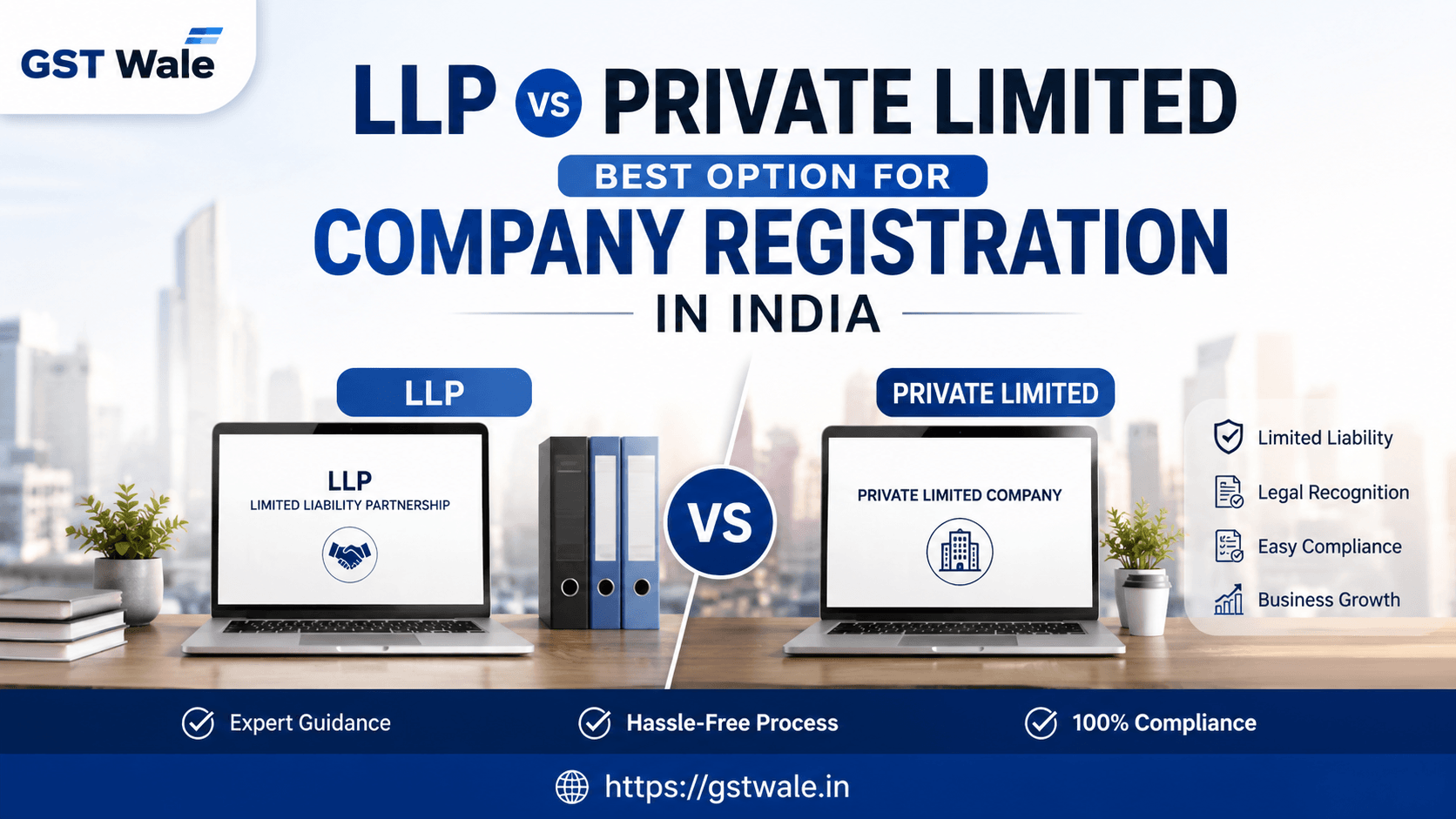
LLP vs Private Limited: Best Option for Company Registration in India
LLP vs Private Limited: Best Option for Company Registration in India
Choosing the right business structure is one of the most important decisions for any entrepreneur. Whether you are launching a startup, opening a family business, or planning to scale operations across India, your legal structure directly impacts taxation, compliance, funding opportunities, and business growth.
When it comes to Company Registration in India, most entrepreneurs usually compare two popular options — Limited Liability Partnership (LLP) and Private Limited Company (Pvt Ltd). Both structures offer limited liability protection and legal recognition, but they are suitable for different business goals.
At GST Wale, we regularly guide startups, professionals, and business owners who are confused about the right structure for their business. If you are planning Company Registration, this detailed comparison will help you make an informed decision.
Understanding LLP and Private Limited Company
Before comparing both structures, let us first understand what they actually mean.
What is an LLP?
A Limited Liability Partnership (LLP) is a business structure that combines the flexibility of a partnership firm with the limited liability protection of a company.
In an LLP:
- Partners manage the business directly
- Liability of partners is limited
- Compliance requirements are comparatively lower
- Separate legal identity exists
LLPs are commonly preferred by:
- CA firms
- Consultants
- Freelancers
- Small service businesses
- Family-owned businesses
What is a Private Limited Company?
A Private Limited Company is a separate legal entity registered under the Companies Act, 2013.
In this structure:
- Ownership is divided into shares
- Directors manage the company
- Shareholders enjoy limited liability
- Investors can easily invest through equity
Private Limited Companies are widely used by:
- Startups
- Tech companies
- Scalable businesses
- Fundraising ventures
- E-commerce businesses
For many startups planning serious Company Registration in India, Pvt Ltd becomes the preferred option because of investment flexibility.
LLP vs Pvt Ltd India: Major Differences
Understanding the practical difference llp and company india is crucial before making a decision.
Legal Structure
LLP
- Governed by LLP Act, 2008
- Managed by partners
- Flexible internal operations
Private Limited Company
- Governed by Companies Act, 2013
- Managed by directors
- More structured governance
Number of Members Required
LLP
- Minimum 2 partners
- No maximum limit
Private Limited Company
- Minimum 2 shareholders
- Maximum 200 shareholders
Compliance Requirements
This is where many businesses carefully evaluate their options during Company Registration in India.
LLP Compliance
- Annual filing is simpler
- Audit mandatory only after crossing turnover limits
- Lower compliance costs
Pvt Ltd Compliance
- Mandatory annual ROC filings
- Board meetings required
- Statutory audit compulsory
- Higher compliance burden
For small businesses, LLP usually feels easier to manage.
Funding and Investment Opportunities
LLP
- Limited funding options
- Venture capital investors generally avoid LLPs
Pvt Ltd
- Easy to raise investment
- Shares can be issued
- Better credibility among investors
If your startup plans future funding rounds, a Private Limited Company is generally a smarter choice.
Ownership Transfer
LLP
- Transfer process is comparatively difficult
- Requires agreement modifications
Pvt Ltd
- Shares can be transferred easily
- Ownership changes are smoother
Taxation Difference
Tax planning is another key factor in Company Registration in India.
LLP Taxation
- Flat tax rate applicable
- Dividend distribution tax not applicable
Pvt Ltd Taxation
- Corporate tax applicable
- Additional compliance in dividend distribution
Depending on profit structure, LLP may sometimes offer tax efficiency.
Which Business Structure is Better for Startups?
One of the most common questions entrepreneurs ask is about the best startup legal structure india.
The answer depends entirely on business goals.
Choose LLP If:
- You want lower compliance
- Your business is service-oriented
- External funding is not required
- You prefer operational flexibility
- You are starting with family or professional partners
Choose Private Limited Company If:
- You want to raise funding
- You plan aggressive business expansion
- You want higher market credibility
- You are building a scalable startup
- You may issue ESOPs in future
At GST Wale, we often recommend Pvt Ltd registration for startups planning long-term growth.
LLP Benefits India: Why Many Small Businesses Prefer LLP
Despite the popularity of Pvt Ltd companies, LLPs continue to remain highly relevant.
Here are some major llp benefits india business owners should know.
Lower Compliance Costs
LLPs involve fewer legal formalities and reduced annual filing expenses.
Limited Liability Protection
Partners are protected from personal liability beyond their agreed contribution.
Flexible Management
Unlike companies, LLPs allow operational flexibility without complicated corporate procedures.
No Mandatory Audit in Small Cases
Smaller LLPs can avoid mandatory audits if turnover stays below prescribed limits.
Suitable for Professional Services
Law firms, architects, consultants, and CA firms commonly choose LLPs.
For many professionals considering Company Registration in India, LLP provides the perfect balance between legal protection and operational simplicity.
Business Structure Comparison India: Practical Example
Let us understand this with a simple real-world example.
Example 1: Digital Marketing Agency
Suppose two friends start a digital marketing agency.
Their priorities are:
- Low setup cost
- Simple compliance
- No external funding requirement
In this case, LLP may be the better choice.
Example 2: Technology Startup
Now consider a SaaS startup planning:
- Angel funding
- Venture capital
- Employee stock options
- National expansion
Here, Private Limited Company becomes the ideal structure.
This business structure comparison india clearly shows that the “best” option depends on future business plans, not just current setup costs.
Cost of Registration: LLP vs Pvt Ltd
During Company Registration in India, cost also becomes an important factor.
LLP Registration Cost
Generally lower because:
- Lower government fees
- Fewer compliance requirements
- Simplified documentation
Private Limited Registration Cost
Usually higher because:
- More documentation
- DSC and DIN requirements
- Additional compliance setup
However, higher initial cost often becomes worthwhile for scalable businesses.
Documents Required for Registration
Common Documents
For both LLP and Pvt Ltd registration, you generally need:
- PAN card
- Aadhaar card
- Address proof
- Passport-size photo
- Business address proof
Additional Documents for Pvt Ltd
- MOA and AOA
- Director details
- Shareholding pattern
Professional guidance makes the entire Company Registration in India process smoother and faster.
Common Mistakes While Choosing a Business Structure
Many entrepreneurs select the wrong structure due to incomplete understanding.
Avoid these mistakes:
- Choosing LLP only because it is cheaper
- Registering Pvt Ltd without scalability plans
- Ignoring compliance costs
- Not considering future investors
- Failing to understand taxation impact
Always evaluate both present and future business goals before registration.
FAQs
Is LLP better than Private Limited Company?
It depends on your business goals. LLP is better for small service businesses, while Pvt Ltd is better for startups seeking funding and expansion.
Which structure is cheaper for Company Registration in India?
LLP is generally cheaper due to lower compliance and registration costs.
Can an LLP raise funding from investors?
LLPs face limitations in raising equity funding. Most investors prefer Private Limited Companies.
Is audit mandatory for LLP?
Audit is mandatory only after crossing prescribed turnover or contribution limits.
Which is better for startups in India?
For scalable startups seeking investment, Private Limited Company is usually the preferred structure.
Selecting the right structure is the foundation of long-term business success. Both LLP and Private Limited Company offer unique advantages, but the ideal choice depends on your business vision, compliance capacity, funding plans, and growth strategy.
If you want operational simplicity and lower compliance, LLP may work perfectly. But if your goal is scaling, investor funding, and stronger business credibility, Private Limited Company is usually the better option for Company Registration in India.
At GST Wale, we help entrepreneurs choose the most suitable legal structure based on practical business requirements — not just legal theory. From documentation to registration and ongoing compliance, our experts ensure a smooth and hassle-free experience.
 Previous