


What is Section 143(1) Intimation and What Does It Mean for Your ITR Online Status?
What is Section 143(1) Intimation and What Does It Mean for Your ITR Online Status?
Filing your income tax return is only the first step in the tax compliance process. Once you submit your return through the itr online portal, the Income Tax Department processes it and sends a communication known as the Section 143(1) Intimation. Many taxpayers become anxious after receiving this notice because they assume it is a tax demand or scrutiny notice. In reality, that is not always the case.
At GST Wale, we regularly assist taxpayers who file income tax return online and receive Section 143(1) intimations. If you need professional assistance with ITR Filing, expert guidance can help you avoid errors and ensure complete compliance with tax laws.
This article explains what Section 143(1) Intimation is, why you receive it, what it means for your itr online status, and the steps you should take after receiving it.
What is Section 143(1) Intimation?
Section 143(1) of the Income Tax Act, 1961 provides for preliminary processing of your income tax return after it has been successfully filed. During this stage, the Income Tax Department performs automated checks to verify the information submitted in your return.
The department compares the information available in your return with details received from employers, banks, financial institutions, Form 26AS, Annual Information Statement (AIS), and Taxpayer Information Summary (TIS).
After verification, an electronic communication called the Section 143(1) Intimation is sent to the taxpayer.
If you regularly check your itr online status, you may notice that your return has been processed even before receiving the intimation email.
Why Do You Receive Section 143(1) Intimation?
Receiving this intimation is a normal part of the tax return process. It does not automatically indicate a problem.
The Income Tax Department issues this communication to inform you about the processing outcome of your return.
Generally, one of the following situations occurs:
- Your return is accepted without any changes.
- Certain adjustments are made to your return.
- Additional tax is payable.
- A refund is approved.
- No refund and no tax demand arise.
For taxpayers using incometax return online services, receiving this communication is an expected step after return processing.
How Does Section 143(1) Affect Your ITR Online Status?
Many taxpayers wonder why their itr online status changes after filing.
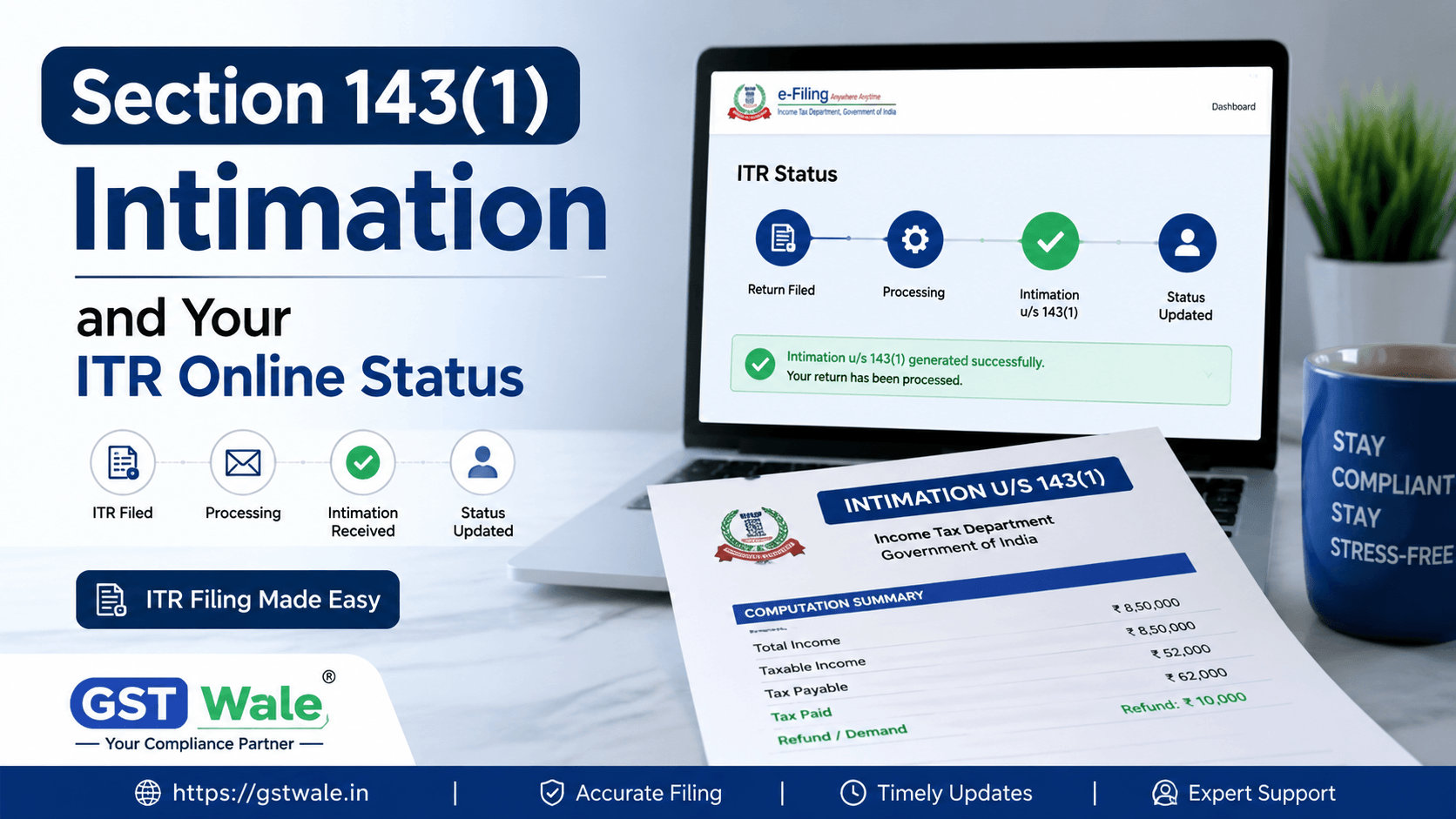
The processing status generally follows these stages:
- Return Successfully Filed
- Return Verified
- Return Under Processing
- Return Processed
- Refund Issued (if applicable)
- Demand Outstanding (if applicable)
Once your return is processed under Section 143(1), your itr online status is updated accordingly.
For example:
- If your calculations match the department's records, your status may simply show "Processed."
- If a refund is due, the status will eventually change to "Refund Issued."
- If discrepancies exist, the portal may display a tax demand.
Therefore, checking your itr online status periodically helps you stay informed about your return.
What Information is Included in Section 143(1) Intimation?
The intimation contains several important details, including:
- Total income as per your return
- Income computed by the department
- Deductions claimed
- Tax paid
- Tax liability
- Interest calculation
- Refund amount (if applicable)
- Additional tax demand (if applicable)
Always compare these figures carefully with your filed return.
Possible Outcomes of Section 143(1) Processing
Return Accepted Without Changes
This is the ideal situation.
The Income Tax Department agrees with your calculations, and no further action is generally required.
Your itr online status will simply reflect that the return has been processed successfully.
Refund Approved
If excess tax has been deducted through TDS or advance tax, the department may issue a refund.
Once approved, the refund is credited directly to your validated bank account.
Tax Demand Raised
Sometimes the department may calculate a higher tax liability due to:
- Incorrect deduction claims
- Mismatch in TDS
- Unreported income
- Calculation errors
- Incorrect tax credits
In such cases, your itr online status may show a demand.
Adjustments Made
The department can make adjustments for:
- Mathematical mistakes
- Incorrect claims evident from available records
- Disallowance of certain deductions
- Mismatch in information reported
These adjustments are clearly mentioned in the intimation.
Common Reasons for Differences in Section 143(1)
Several practical situations may lead to differences between your return and the department's computation.
Some common reasons include:
- Missing interest income from savings accounts
- Incorrect TDS entries
- Employer's revised Form 16
- Mismatch with AIS or Form 26AS
- Wrong deduction under Chapter VI-A
- Incorrect selection of the itr form
- Errors during it filing
For example, a salaried employee may claim TDS based on an old Form 16 while the employer later revises the TDS details. During processing, the Income Tax Department considers the updated records, resulting in a difference.
What Should You Do After Receiving Section 143(1) Intimation?
Do not panic.
Instead, follow these practical steps.
Step 1: Read the Intimation Carefully
Compare every figure with the return you originally filed.
Focus on:
- Income
- Deductions
- Tax payable
- Refund
- Interest calculation
Step 2: Verify Supporting Documents
Check:
- Form 16
- Form 26AS
- AIS
- TDS certificates
- Bank interest details
These documents help identify any mismatch.
Step 3: Check Your ITR Online Status
Log in to the income tax portal and review your itr online status.
Ensure that the processing details match the intimation received.
Step 4: Respond if Necessary
If you disagree with the adjustments, you may:
- File a rectification request
- Submit an online response
- File an updated return where applicable
- Seek professional assistance
Respond within the prescribed timelines to avoid unnecessary complications.
Can Section 143(1) Lead to Scrutiny?
One of the biggest misconceptions is that every Section 143(1) Intimation leads to scrutiny.
This is incorrect.
Section 143(1) is only an automated processing mechanism.
A scrutiny assessment under Section 143(2) is a separate process initiated only in selected cases based on specific risk parameters.
Therefore, receiving a Section 143(1) Intimation alone does not mean your return has been selected for detailed scrutiny.
Tips to Avoid Problems During ITR Processing
Before you file it returns online, consider these expert recommendations:
- Select the correct itr form.
- Verify PAN, Aadhaar, and bank details.
- Match Form 26AS with AIS.
- Report every source of income.
- Verify TDS entries carefully.
- Claim deductions with proper documentation.
- Validate your bank account for refunds.
- Complete return verification promptly.
- Review every figure before final submission.
These simple precautions significantly reduce the chances of adjustments during processing.
Frequently Asked Questions
Is Section 143(1) Intimation a notice?
No. It is primarily an intimation informing you about the processing outcome of your income tax return. It is a routine communication sent after your return has been processed.
How long does it take to receive Section 143(1) Intimation?
The processing time varies depending on the filing season and workload of the Income Tax Department. Some returns are processed within a few weeks, while others may take longer.
Can I ignore Section 143(1) Intimation?
No. You should always read the intimation carefully. If there is any tax demand or adjustment, timely action is important to avoid future disputes.
What if my refund is less than expected?
Compare the computation provided in the intimation with your filed return. If you believe the adjustment is incorrect, you can submit a rectification request or respond through the income tax portal.
Why should I keep checking my ITR online status?
Your itr online status provides real-time updates about processing, refund issuance, or tax demand. Regular monitoring helps you take prompt action whenever required.
Understanding Section 143(1) Intimation is essential for every taxpayer who files returns through the itr online system. In most cases, it is simply a confirmation that your return has been processed. However, if adjustments, refunds, or tax demands arise, reviewing the intimation carefully and checking your itr online status can help you respond appropriately and avoid unnecessary issues.
At GST Wale, our experienced tax professionals assist individuals, salaried employees, freelancers, and businesses with accurate return preparation, compliance, and post-filing support. Whether you need help with it filing, choosing the correct itr form, or resolving issues after processing, GST Wale is committed to making your income tax journey simple, accurate, and hassle-free. Contact GST Wale today for reliable tax solutions and complete peace of mind.
 Previous