


How to Efficiently Fill Schedule FA (Foreign Assets) in ITR 2 Without Errors
How to Efficiently Fill Schedule FA (Foreign Assets) in ITR 2 Without Errors
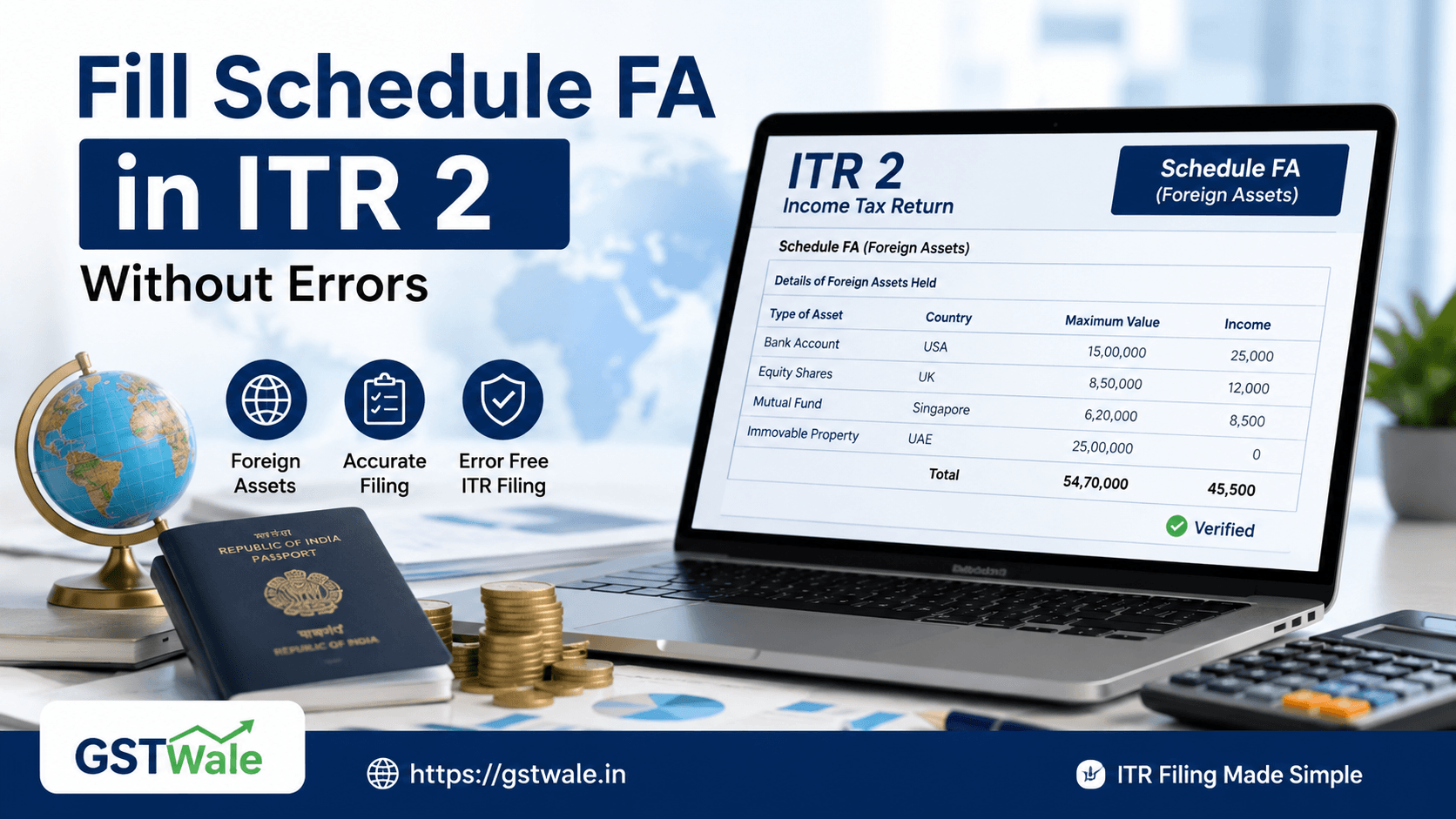
If you are required to file itr 2 and own any foreign assets or have financial interests outside India, completing Schedule FA correctly is one of the most important parts of your income tax return. Even a small mistake or omission can attract notices from the Income Tax Department and may lead to penalties under the Income Tax Act.
At GST Wale, we regularly help taxpayers complete itr 2 accurately while ensuring all disclosure requirements are met. If you are looking for professional assistance with ITR Filing, expert guidance can help you avoid unnecessary errors and ensure timely compliance.
In this guide, we explain how to efficiently fill Schedule FA in itr 2, the information you need to collect, common mistakes to avoid, and practical tips based on real-life filing experiences.
What is Schedule FA in ITR 2?
Schedule FA (Foreign Assets) is a section of itr 2 where resident taxpayers are required to disclose their foreign assets and financial interests held outside India during the relevant financial year.
The purpose of Schedule FA is to improve transparency and ensure that overseas assets are properly reported. It is important to understand that disclosure does not always mean additional tax. In many cases, it is simply a reporting requirement under the income tax return form.
If you are filing itr 2, carefully determine whether Schedule FA applies to you before submitting your income tax return form.
Who Needs to Fill Schedule FA in ITR 2?
Generally, Schedule FA is applicable to Resident and Ordinarily Resident (ROR) taxpayers who hold foreign assets.
You may need to disclose:
- Foreign bank accounts
- Foreign equity shares
- Foreign mutual funds
- Foreign retirement accounts
- Foreign insurance policies
- Financial interests in overseas companies
- Foreign trusts
- Foreign immovable property
- Any beneficial ownership in overseas assets
If you are a Non-Resident (NRI) or Resident but Not Ordinarily Resident (RNOR), the disclosure requirements may differ. Always verify your residential status before filing itr 2.
Why Correct Disclosure in ITR 2 is Important
Many taxpayers assume that if no income is earned from a foreign asset, there is no need to report it. This is one of the most common misconceptions.
Schedule FA focuses on disclosure, not just taxation.
Incorrect reporting in itr 2 may result in:
- Income Tax Department notices
- Delay in processing the return
- Additional scrutiny
- Penalties in applicable cases
- Future compliance issues
Being transparent while filing your income tax return form helps maintain proper tax compliance.
Documents Required Before Filling Schedule FA in ITR 2
Before starting itr 2, collect all necessary information.
Keep the following documents ready:
- Foreign bank statements
- Investment statements
- Shareholding certificates
- Property purchase documents
- Brokerage statements
- Foreign tax documents
- Passport details, if relevant
- Exchange rate information where applicable
Preparing these documents in advance makes completing itr 2 much easier and reduces the chances of mistakes.
Step-by-Step Process to Fill Schedule FA in ITR 2
Step 1: Identify All Foreign Assets
Prepare a complete list of all foreign assets owned during the reporting period.
Include:
- Direct ownership
- Joint ownership
- Beneficial ownership
- Financial interests
Avoid relying only on memory while filing itr 2.
Step 2: Categorise Each Asset Correctly
Schedule FA contains different reporting categories.
For example:
- Foreign bank account
- Custodial account
- Equity interest
- Immovable property
- Trust
- Other capital assets
Choose the appropriate category for each asset in itr 2.
Step 3: Mention Country Details
Enter the correct country where the asset is located.
For example:
- United States
- United Kingdom
- Canada
- Singapore
- Australia
Incorrect country information may create inconsistencies during verification.
Step 4: Report the Peak Value or Required Financial Information
Different asset categories require different information.
You may need to provide:
- Date of acquisition
- Cost of acquisition
- Peak balance
- Closing balance
- Income earned
- Nature of ownership
Always verify figures from official documents before entering them into itr 2.
Step 5: Verify Income Disclosure
If income has been earned from foreign assets, ensure it is disclosed under the appropriate schedule in the income tax return form.
Examples include:
- Interest income
- Dividend income
- Capital gains
- Rental income
Cross-check that the income and corresponding asset disclosures match.
Step 6: Review Every Entry Before Submission
Before submitting itr 2, review:
- Country names
- Account numbers
- Dates
- Asset values
- Ownership details
- Income reporting
A careful review can prevent unnecessary notices later.
Common Errors While Filling Schedule FA in ITR 2
Many taxpayers unknowingly make avoidable mistakes.
Some common errors include:
- Forgetting inactive foreign bank accounts
- Not reporting jointly held assets
- Wrong acquisition dates
- Incorrect asset category
- Missing foreign investments
- Currency conversion mistakes
- Incorrect residential status
- Mismatch between income and asset disclosure
Double-checking every section of itr 2 significantly reduces these risks.
Practical Example
Suppose Mr. Sharma worked in the United Kingdom for a few years and later returned to India.
He still has:
- A UK savings account
- Shares purchased through an overseas broker
- Small dividend income from those shares
While filing itr 2, he must determine his residential status first. If he qualifies as a Resident and Ordinarily Resident, these assets may need to be disclosed in Schedule FA, even if the account balance is relatively small.
Proper reporting helps avoid future tax compliance issues.
Best Practices for Error-Free ITR 2 Filing
Experienced tax professionals generally recommend the following:
- Maintain records throughout the year.
- Keep copies of overseas investment statements.
- Download annual bank statements before filing.
- Match disclosures with supporting documents.
- Verify residential status carefully.
- Review every Schedule before final submission.
- Preserve documentation for future reference.
These simple habits make itr 2 filing much smoother.
ITR 2.0 and Digital Filing
With increasing digitisation, taxpayers are becoming familiar with terms like itr 2.0, online validation, and pre-filled information.
Although pre-filled data simplifies filing, it should never be accepted without verification.
Always compare:
- Bank records
- Investment statements
- Foreign asset details
- Income records
Remember, the responsibility for accurate reporting ultimately rests with the taxpayer, even when using online utilities to file it returns online.
Choosing the Correct Income Tax Return Form
Many taxpayers confuse different return forms.
Selecting the correct itr form depends on:
- Nature of income
- Capital gains
- Residential status
- Foreign assets
- Multiple house properties
- Other eligibility conditions
Using the wrong income tax return form can delay processing and may require filing a revised return.
FAQs
Who should disclose foreign assets in itr 2?
Resident and Ordinarily Resident taxpayers holding foreign financial assets or overseas interests generally need to disclose them in Schedule FA while filing itr 2, subject to applicable provisions of the Income Tax Act.
Is disclosure required even if the foreign asset earned no income?
Yes. In many situations, Schedule FA requires reporting of foreign assets even if they did not generate income during the financial year. The reporting obligation should be evaluated based on the applicable rules.
What happens if I forget to disclose a foreign asset?
Non-disclosure may result in notices, additional scrutiny, penalties, or other consequences depending on the facts of the case. It is always advisable to review your return carefully before submission.
Can I revise itr 2 if I discover a mistake?
Yes. If permitted under the applicable provisions and timelines, you may file a revised itr 2 to correct genuine errors or omissions.
Is professional assistance recommended for Schedule FA?
Yes. Since Schedule FA involves detailed reporting requirements and multiple disclosure fields, seeking professional guidance can help reduce errors and improve compliance during it filing.
Completing Schedule FA accurately in itr 2 requires careful planning, proper documentation, and attention to detail. From identifying foreign assets to reporting the correct financial information, every step should be handled with accuracy. Even minor mistakes can create avoidable complications, making it essential to review your income tax return form thoroughly before submission.
At GST Wale, we assist individuals and businesses with itr 2, tax compliance, foreign asset reporting, and complete it filing support. Whether you are filing for the first time or need expert guidance to avoid errors, our experienced professionals are here to make the entire process simple, accurate, and stress-free. Contact GST Wale today and file your return with confidence.
 Previous