


Demystifying Section 80G: How to Claim Charity and Donation Deductions in Your ITR Form
Demystifying Section 80G: How to Claim Charity and Donation Deductions in Your ITR Form
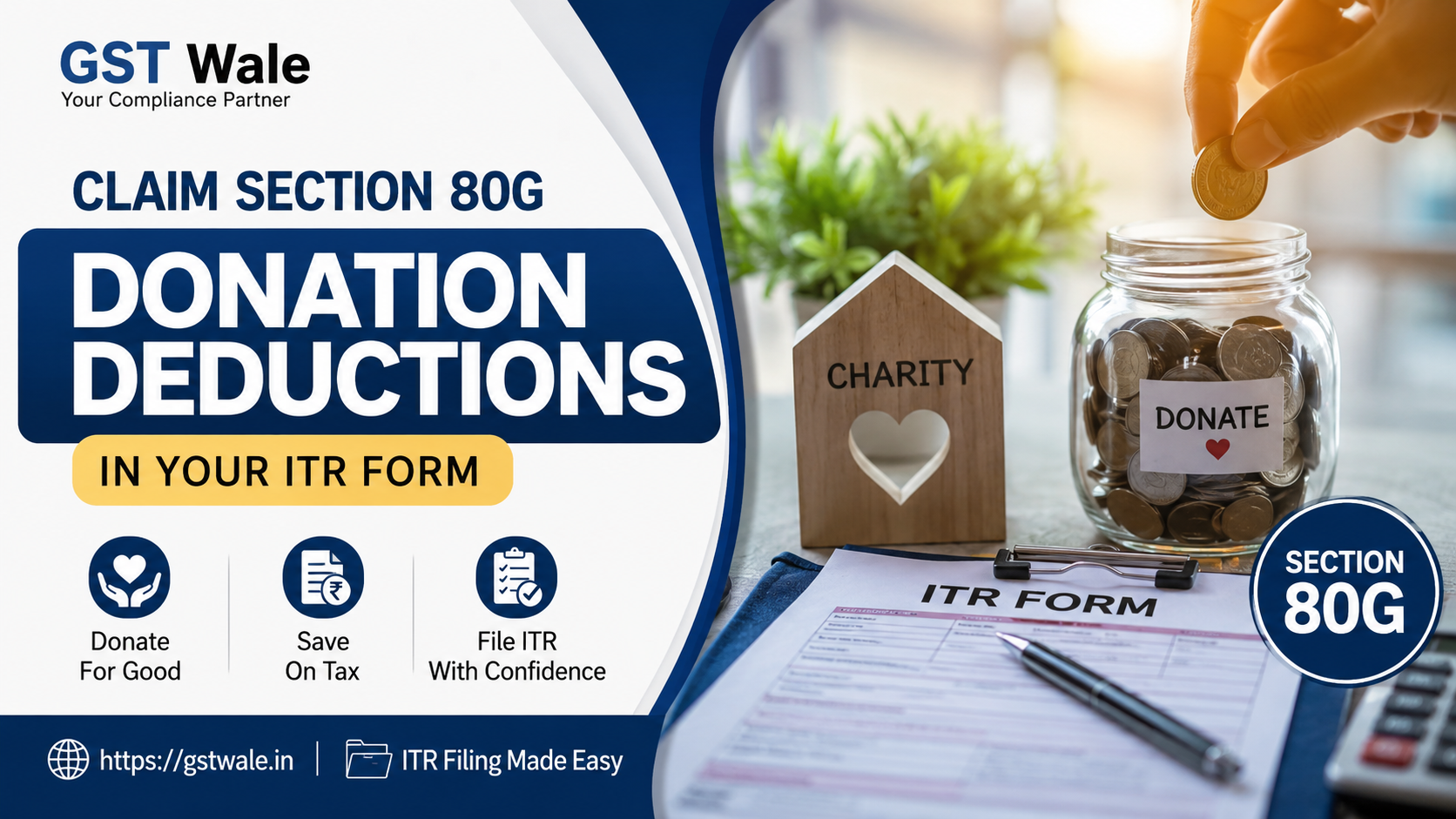
Paying taxes is a legal responsibility, but making the most of available deductions is equally important. One of the most valuable tax-saving provisions available to taxpayers in India is Section 80G of the Income Tax Act. If you have donated to eligible charitable institutions, you may be able to reduce your taxable income while filing your itr form.
At GST Wale, we regularly help individuals, professionals, and business owners claim legitimate deductions without unnecessary complications. If you need professional assistance with ITR Filing, our experts can guide you through every step to ensure your return is accurate and compliant.
Understanding how Section 80G works can help you avoid mistakes, maximise tax benefits, and complete your itr form with confidence.
What is Section 80G in the ITR Form?
Section 80G allows taxpayers to claim deductions for donations made to eligible charitable funds, trusts, and institutions. While filing your itr form, you can reduce your taxable income by claiming these eligible donations, subject to prescribed conditions.
The objective of this provision is simple—it encourages individuals and businesses to contribute towards social welfare while providing tax benefits.
Whether you are completing an income tax return form yourself or taking professional assistance, understanding Section 80G is essential for accurate it filing.
Who Can Claim Section 80G Deduction?
Almost every taxpayer can claim deductions under Section 80G, provided the donation meets the prescribed conditions.
Eligible taxpayers include:
Salaried employees
Self-employed professionals
Business owners
Partnership firms
Companies
Hindu Undivided Families (HUFs)
If you are filing your itr form, you should always review your donations before submitting your return.
Donations Eligible Under Section 80G
Not every donation qualifies for tax deduction. Only contributions made to approved institutions are eligible.
Examples include:
Prime Minister's National Relief Fund
National Defence Fund
Approved charitable trusts
Educational institutions approved under the Act
Government-approved relief funds
Certain NGOs registered under Section 80G
Before entering donation details in your itr form, always verify whether the organisation has valid 80G registration.
Types of Deductions Available Under Section 80G
The deduction available depends on the organisation receiving the donation.
100% Deduction Without Qualifying Limit
Certain donations qualify for a full deduction without any upper limit.
Examples include:
Prime Minister's National Relief Fund
National Defence Fund
50% Deduction Without Qualifying Limit
Some approved institutions allow a deduction of only 50% of the donated amount.
100% Deduction Subject to Qualifying Limit
Certain donations qualify for full deduction but are restricted based on your adjusted gross total income.
50% Deduction Subject to Qualifying Limit
Some charitable donations qualify for only half the donated amount, subject to the prescribed limit.
Knowing the correct category ensures your itr form is filed accurately.
Conditions to Claim Deduction in the ITR Form
Before claiming deduction, remember these important conditions:
Donation must be made to an approved institution.
Cash donations exceeding ₹2,000 are not eligible.
Donations should preferably be made through banking channels.
Keep valid donation receipts.
PAN of the trust should be available wherever applicable.
Receipt should contain registration details.
Failure to satisfy these conditions may lead to rejection of the deduction while processing your itr form.
Documents Required While Filing the ITR Form
Proper documentation makes tax filing much easier.
Keep the following documents ready:
Donation receipt
Name and address of the charitable institution
PAN of the trust (where applicable)
Section 80G registration number
Donation amount
Payment mode
Bank transaction proof
These documents help ensure smooth itr online filing and reduce the chances of notices.
Step-by-Step Process to Claim Section 80G in Your ITR Form
Claiming the deduction is easier than many taxpayers think.
Step 1: Collect Donation Receipts
Verify that every receipt contains the required information.
Step 2: Check Eligibility
Confirm that the organisation is registered under Section 80G.
Step 3: Calculate Eligible Deduction
Determine whether your donation qualifies for 50% or 100% deduction and whether any qualifying limit applies.
Step 4: Enter Donation Details
While completing your itr form, enter the donation information under the deduction schedule.
Step 5: Verify Before Submission
Cross-check all entries before you file income tax return online.
Practical Example
Suppose Mr. Raj has a taxable income of ₹9,00,000 before deductions.
During the financial year, he donated ₹30,000 to an approved charitable trust eligible for a 50% deduction.
Eligible deduction:
Donation = ₹30,000
Deduction allowed = ₹15,000
While filing his itr form, he claims ₹15,000 under Section 80G, reducing his taxable income accordingly.
This simple planning helps save tax while contributing to a meaningful cause.
Common Mistakes to Avoid in the ITR Form
Many taxpayers unknowingly make errors that delay refund processing or lead to notices.
Avoid these mistakes:
Claiming donations made to unregistered organisations
Entering incorrect donation amounts
Losing donation receipts
Claiming cash donations above ₹2,000
Ignoring qualifying limits
Filing incorrect deduction category
Forgetting to verify trust registration details
Careful review before submitting your itr form can prevent unnecessary issues.
Benefits of Proper Tax Planning
Claiming Section 80G correctly offers several advantages.
Reduces taxable income
Encourages charitable giving
Improves tax efficiency
Ensures legal compliance
Minimises tax liability
Makes file it returns online process smoother
Professional tax planning also helps identify other deductions available under different sections of the Income Tax Act.
Why Professional Guidance Matters
Although the Income Tax Department has simplified itr online filing, taxpayers often struggle with deduction calculations, documentation, and eligibility rules.
Professional assistance helps:
Identify eligible deductions
Avoid filing errors
Ensure compliance
Reduce the risk of notices
Maximise legitimate tax savings
An experienced tax professional can review your income tax return form thoroughly before submission.
Frequently Asked Questions
Can I claim deduction without a donation receipt?
No. A valid donation receipt is generally required to claim deduction under Section 80G while filing your itr form.
Are cash donations eligible?
Cash donations above ₹2,000 are not eligible for deduction. It is advisable to donate through banking channels for proper documentation.
Can companies claim Section 80G deductions?
Yes. Companies, firms, individuals, HUFs, and other eligible taxpayers can claim deductions if they satisfy the prescribed conditions.
Is every NGO eligible under Section 80G?
No. Only NGOs and charitable institutions registered under Section 80G qualify for tax deduction.
Can I revise my ITR if I forget to claim Section 80G?
Yes. Subject to the applicable provisions and timelines, you may file a revised itr form if you have omitted an eligible deduction.
Section 80G offers taxpayers an excellent opportunity to support charitable causes while reducing their tax burden. However, claiming the deduction correctly requires proper documentation, accurate calculation, and careful reporting in your itr form. Whether you are completing an income tax return form, planning it filing, using itr online, or looking to file income tax return online, understanding these provisions can help you maximise legitimate tax savings. Before you file it returns online, always verify your donation details and eligibility to ensure a smooth filing experience.
At GST Wale, we believe tax compliance should be simple, accurate, and stress-free. Our experienced professionals help individuals, salaried employees, freelancers, and businesses prepare and file their itr form with complete confidence. Contact GST Wale today for reliable tax filing support, expert guidance, and hassle-free compliance that helps you save both time and money.
 Previous