


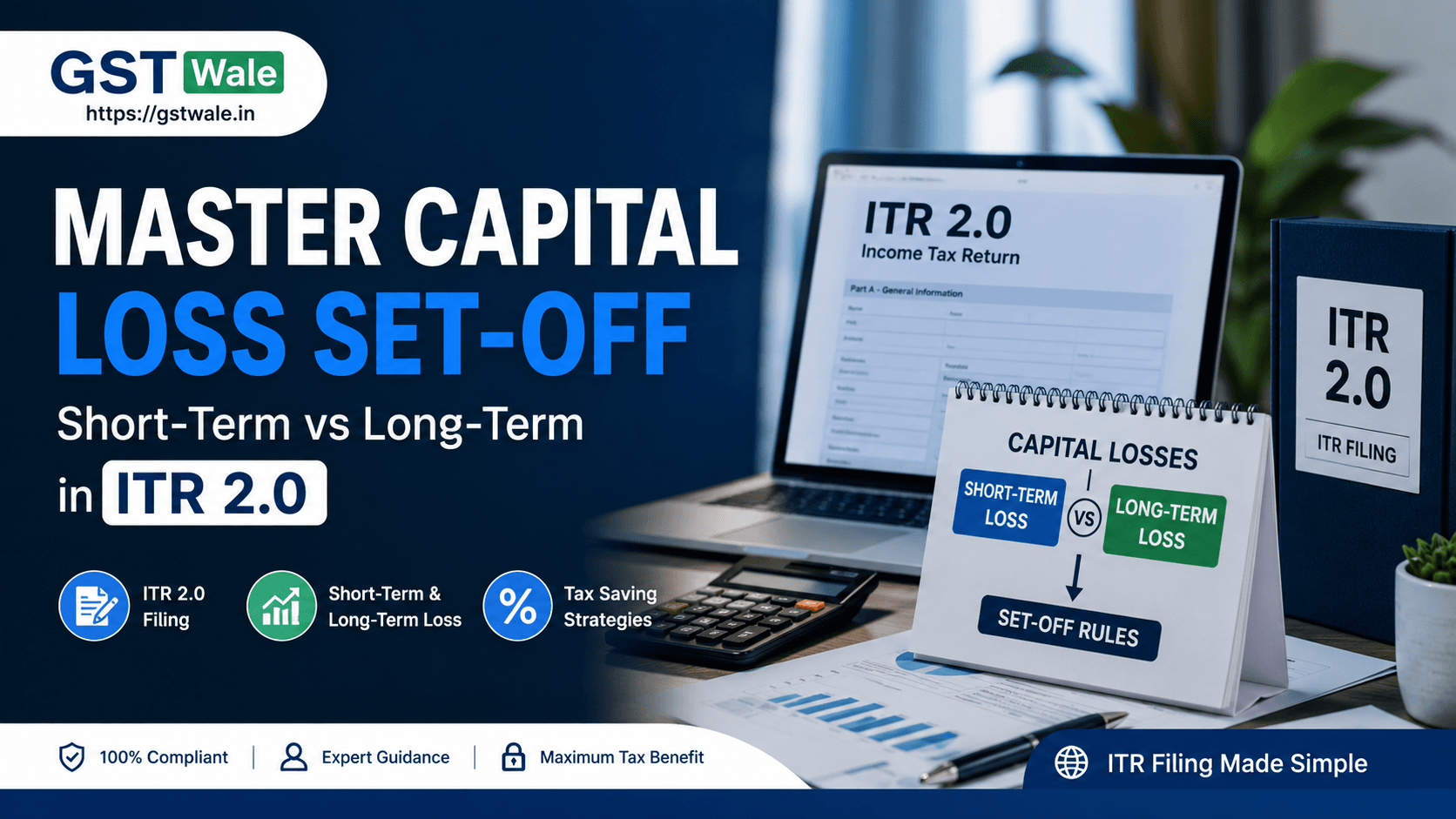
The Definitive Guide to Setting Off Short-Term vs Long-Term Capital Losses in ITR 2.0
The Definitive Guide to Setting Off Short-Term vs Long-Term Capital Losses in ITR 2.0
Capital gains and capital losses often create confusion while filing an income tax return. Many taxpayers are unsure whether they can adjust one type of capital loss against another or carry forward losses to future years. Making an error while filing itr 2.0 can lead to incorrect tax calculations or even notices from the Income Tax Department.
If you have sold shares, mutual funds, property, or other capital assets during the financial year, understanding the rules for setting off capital losses is essential. Whether you are preparing your own return or using professional assistance through <a href="https://gstwale.in/services/income-tax/itr-filing">ITR Filing</a>, knowing these rules can help you save tax legally and file with confidence.
In this comprehensive guide, GST Wale explains how short-term and long-term capital losses work, how they can be adjusted, and the common mistakes you should avoid while filing itr 2.0.
Understanding Capital Gains and Losses in itr 2.0
Before learning about set-off rules, it is important to understand the two categories of capital gains.
Short-Term Capital Gain (STCG)
A short-term capital gain arises when a capital asset is sold before completing the prescribed holding period under the Income Tax Act.
Examples include:
- Sale of listed shares held for a short duration.
- Sale of mutual funds before the qualifying period.
- Sale of certain movable or immovable assets within the specified holding period.
If the sale results in a loss instead of a gain, it becomes a Short-Term Capital Loss (STCL).
Long-Term Capital Gain (LTCG)
When a capital asset is sold after the prescribed holding period, any profit is considered a long-term capital gain. If the sale results in a loss, it is called a Long-Term Capital Loss (LTCL).
Understanding the correct classification is one of the most important steps while filing itr 2.0.
Rules for Setting Off Capital Losses in itr 2.0
The Income Tax Act provides clear rules regarding adjustment of capital losses.
Short-Term Capital Loss
A Short-Term Capital Loss is more flexible.
It can be adjusted against:
- Short-Term Capital Gains
- Long-Term Capital Gains
This flexibility makes STCL valuable for reducing your overall capital gains tax liability.
Long-Term Capital Loss
A Long-Term Capital Loss has a restriction.
It can only be adjusted against:
- Long-Term Capital Gains
It cannot be adjusted against Short-Term Capital Gains.
This distinction is extremely important while completing itr 2.0 correctly.
Simple Example to Understand Set-Off
Suppose Rahul has the following during the financial year:
- Short-Term Capital Gain: ₹2,00,000
- Long-Term Capital Gain: ₹4,00,000
- Short-Term Capital Loss: ₹1,20,000
- Long-Term Capital Loss: ₹2,50,000
The adjustment will happen as follows:
- STCL of ₹1,20,000 can be adjusted against either STCG or LTCG.
- LTCL of ₹2,50,000 can only be adjusted against LTCG.
Final taxable gains become:
- STCG after adjustment = ₹80,000
- LTCG after adjustment = ₹1,50,000
Following these rules ensures that itr 2.0 reflects the correct taxable income.
Carry Forward of Capital Losses
Not every capital loss can be adjusted in the same financial year.
If losses remain after adjustment, they may be carried forward for up to eight assessment years.
However, there is one important condition.
File Your Return Within the Due Date
To carry forward capital losses, you must file your income tax return form before the prescribed due date under Section 139(1).
A delayed return may result in the loss of this valuable tax benefit.
This is one reason why timely it filing is always recommended.
Which Taxpayers Should Use itr 2.0?
Many taxpayers wonder whether itr 2.0 applies to them.
Generally, this return is suitable for individuals and Hindu Undivided Families who have income from:
- Salary or pension
- More than one house property
- Capital gains
- Foreign assets or foreign income
- Other sources
The appropriate itr form depends on your income sources and eligibility. Selecting the correct income tax return form is just as important as reporting capital gains accurately.
Step-by-Step Process for Reporting Capital Losses
While filing itr 2.0, follow these steps carefully.
Step 1: Gather All Investment Records
Collect:
- Contract notes
- Demat statements
- Mutual fund statements
- Property sale documents
- Purchase invoices
Step 2: Calculate Capital Gains
Separate:
- Short-term gains
- Long-term gains
- Short-term losses
- Long-term losses
Step 3: Apply Set-Off Rules
Adjust losses according to Income Tax provisions.
Remember:
- STCL can adjust both STCG and LTCG.
- LTCL adjusts only LTCG.
Step 4: Verify Carry Forward Losses
If previous years' losses are available, ensure they are correctly reported.
Step 5: Verify Before Submission
Cross-check every figure before you file income tax return online to avoid unnecessary notices.
Common Mistakes to Avoid in itr 2.0
Many taxpayers make avoidable mistakes that can delay processing.
Mixing Short-Term and Long-Term Losses
One of the biggest errors is adjusting LTCL against STCG, which is not permitted.
Choosing the Wrong itr Form
Using an incorrect itr form can result in defective return notices.
Missing the Filing Deadline
Late filing may prevent carry forward of losses.
Ignoring Previous Year's Losses
Many taxpayers forget to claim eligible carried-forward losses.
Incorrect Capital Gain Calculations
Using wrong purchase values, sale values, or indexation where applicable can affect tax liability.
Documents Required
Keep these documents ready before filing:
- PAN Card
- Aadhaar Card
- Form 16 (if applicable)
- Annual Information Statement (AIS)
- Capital gain statements
- Demat account statement
- Mutual fund statement
- Property purchase and sale documents
- Bank statements
Proper documentation makes it filing much smoother.
Expert Tips from GST Wale
As experienced tax professionals, we recommend the following:
- Maintain records of every investment transaction.
- Review broker-generated capital gain statements carefully.
- Reconcile your details with AIS before filing.
- File your return well before the due date.
- Preserve supporting documents for future reference.
- Seek professional advice for complex transactions involving property, ESOPs, foreign investments, or inherited assets.
Small mistakes in itr 2.0 can lead to unnecessary tax demands or notices. Professional guidance helps ensure accuracy and compliance.
Frequently Asked Questions
Can Short-Term Capital Loss be adjusted against Long-Term Capital Gain?
Yes. Short-Term Capital Loss can be adjusted against both Short-Term and Long-Term Capital Gains according to the Income Tax Act.
Can Long-Term Capital Loss be adjusted against Short-Term Capital Gain?
No. Long-Term Capital Loss can only be adjusted against Long-Term Capital Gains.
Can capital losses be carried forward?
Yes. Unadjusted capital losses can generally be carried forward for up to eight assessment years, provided the return is filed within the prescribed due date.
Is itr 2.0 mandatory for reporting capital gains?
If you are eligible and your income includes capital gains, itr 2.0 is generally the appropriate return. However, eligibility depends on your income sources and individual circumstances.
Should I file income tax return online even if I have only capital losses?
Yes. Filing your return allows eligible capital losses to be carried forward, enabling you to claim tax benefits against future capital gains.
Understanding the difference between Short-Term Capital Loss and Long-Term Capital Loss is essential for accurate tax planning and compliance. Following the prescribed set-off rules ensures that itr 2.0 is filed correctly, your tax liability is computed accurately, and eligible losses are carried forward for future years.
At GST Wale, we help individuals, salaried professionals, investors, and business owners file their returns accurately while maximising every legitimate tax benefit. If you want a hassle-free filing experience, expert guidance, and complete compliance, trust GST Wale to make your itr 2.0 filing simple, accurate, and stress-free.
 Previous