


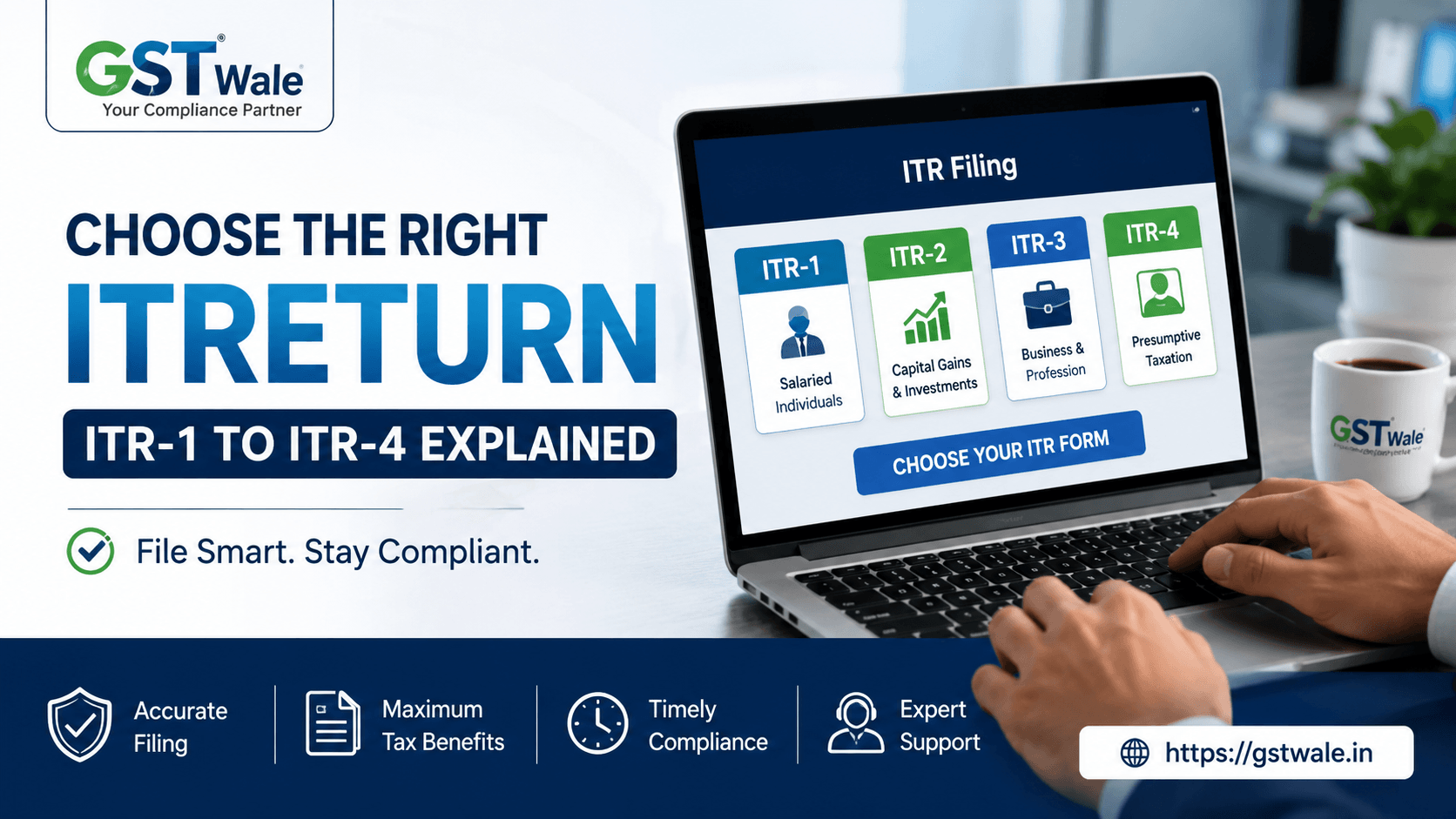
Which ITR return Form Should You Choose? ITR-1 to ITR-4 Explained
Which ITR return Form Should You Choose? ITR-1 to ITR-4 Explained
Filing your ITR return every year is not just a legal responsibility—it also helps you maintain proper financial records, claim refunds, and avoid unnecessary notices from the Income Tax Department. However, one of the biggest challenges taxpayers face is selecting the correct ITR form.
At GST Wale, we often see salaried individuals, freelancers, shop owners, and even small business owners filing the wrong ITR return form simply because they are unaware of the differences between ITR-1, ITR-2, ITR-3, and ITR-4.
If you are planning your ITR Filing, this guide will help you understand which form is suitable for your income type and tax category.
Why Choosing the Correct ITR return Form Matters
Selecting the wrong ITR return form can create multiple problems, such as:
- Defective return notices
- Delay in tax refunds
- Penalties or scrutiny
- Incorrect income disclosure
- Problems during loan or visa applications
Your ITR return form depends mainly on:
- Source of income
- Total annual income
- Type of taxpayer
- Capital gains
- Business or professional income
- Foreign assets or investments
Let us now understand each form in detail.
ITR return Form ITR-1 (Sahaj)
Who Can File ITR-1?
ITR-1, also known as Sahaj, is the simplest ITR return form meant for resident individuals earning up to ₹50 lakh annually.
ITR 1 Sahaj eligibility
You can file ITR-1 if you earn income from:
- Salary or pension
- One house property
- Other sources like bank interest
- Agricultural income up to ₹5,000
Who Cannot File ITR-1?
You cannot use this ITR return form if:
- Your income exceeds ₹50 lakh
- You have capital gains income
- You own foreign assets
- You are a company director
- You have business or professional income
Practical Example
Suppose Rahul works in a private company in Noida and earns ₹12 lakh salary annually along with savings account interest. He can easily file ITR-1.
For salaried employees with simple income structures, this is usually the easiest ITR return option.
ITR return Form ITR-2
Who Should File ITR-2?
ITR-2 is suitable for individuals and Hindu Undivided Family tax cases where there is no business income tax involved.
This form is mainly used by taxpayers having:
- Salary income
- Multiple house properties
- Capital gains income
- Foreign income or assets
- High-value investments
Best for Capital Gains Tax Return
If you sold:
- Shares
- Mutual funds
- Property
- Gold
- Crypto assets
then you likely need ITR-2 for your capital gains tax return.
Example of ITR-2 Usage
Imagine Priya is a salaried employee earning ₹18 lakh annually. During the year, she sold mutual funds and earned short-term capital gains. Since capital gains are involved, she cannot use ITR-1 and must file ITR-2.
Important Note
Many taxpayers wrongly file ITR-1 despite having stock market profits. This can trigger notices later. Always check your eligibility carefully before submitting your ITR return.
ITR return Form ITR-3
Who Should File ITR-3?
ITR-3 is designed for individuals and Hindu Undivided Family tax entities earning income from:
- Proprietorship business
- Professional practice
- Trading activities
- Freelancing
- Consultancy services
This form applies when regular books of accounts are maintained.
Suitable for Business Income Tax Cases
If you earn through:
- Shop business
- Agency commission
- Medical practice
- CA, lawyer, architect, consultant work
- YouTube or digital services
then ITR-3 may be the correct ITR return form.
Freelancer Tax Return under ITR-3
Many freelancers now earn through:
- Graphic designing
- Content writing
- Social media management
- Software development
- Digital marketing
If expenses and accounting records are properly maintained, ITR-3 is commonly used for freelancer tax return filing.
Example
Amit runs a digital marketing consultancy earning ₹22 lakh annually and maintains accounting records for expenses, invoices, and GST. He should file ITR-3.
ITR return Form ITR-4 (Sugam)
What is ITR-4?
ITR-4 is meant for taxpayers opting for presumptive taxation under Sections 44AD, 44ADA, or 44AE.
This form simplifies tax filing for small businesses and professionals.
Understanding Presumptive Taxation
Under presumptive taxation, the government assumes a fixed percentage of income as profit, reducing compliance burden.
For example:
- Small businesses can declare 6% or 8% profit
- Professionals can declare 50% income as profit
This removes the need for detailed bookkeeping in many cases.
Who Can File ITR-4?
You can use this ITR return form if:
- Total income is up to ₹50 lakh
- You opt for presumptive taxation
- You run a small business
- You are a freelancer or professional under 44ADA
Freelancer Tax Return under ITR-4
Freelancers like:
- Designers
- Bloggers
- Consultants
- Coaches
- IT professionals
often prefer ITR-4 because it simplifies tax calculations.
Example
Neha is a freelance interior designer earning ₹18 lakh annually. Instead of maintaining detailed accounts, she opts for presumptive taxation and files ITR-4.
Quick Comparison of ITR return Forms
| ITR Form | Suitable For | Income Type |
|---|---|---|
| ITR-1 | Salaried individuals | Salary, one house property |
| ITR-2 | Investors & high-income individuals | Capital gains, multiple properties |
| ITR-3 | Business owners & professionals | Business income tax |
| ITR-4 | Small businesses & freelancers | Presumptive taxation |
How to Choose the Correct ITR Form
Step 1: Identify Your Income Sources
Check whether your income comes from:
- Salary
- Business
- Freelancing
- Capital gains
- Rental income
Step 2: Check Turnover and Income Limits
Certain ITR return forms have eligibility restrictions based on annual income.
Step 3: Review Business Structure
If you run a proprietorship business or work as a freelancer, your form selection changes significantly.
Step 4: Evaluate Capital Gains
Even a small stock market profit may require a different ITR return form.
Step 5: Consult Experts
Professional guidance helps avoid notices and tax complications.
At GST Wale, we always recommend reviewing AIS, Form 26AS, TDS details, and income structure before filing your ITR return.
Common Mistakes While Filing ITR return
Filing Wrong ITR Form
This is the most common issue faced by taxpayers.
Ignoring Capital Gains
Many salaried individuals forget to disclose stock market income.
Wrong Presumptive Taxation Selection
Some taxpayers choose presumptive taxation without understanding long-term implications.
Not Reporting Freelance Income
Freelancers often skip small payments received online, which may create mismatches later.
Missing Foreign Asset Disclosure
If you own foreign stocks or accounts, proper reporting is mandatory.
FAQs on ITR return Forms
Can salaried employees file ITR-4?
Yes, but only if they also have eligible business or professional income under presumptive taxation.
Which ITR return form is best for freelancers?
Freelancers generally use ITR-3 or ITR-4 depending on whether they maintain books of accounts or choose presumptive taxation.
Is ITR-1 allowed for stock market income?
No. If you have capital gains, you usually need ITR-2.
Can a business owner file ITR-1?
No. Business income tax cases cannot use ITR-1.
What happens if I file the wrong ITR return form?
The Income Tax Department may mark your return as defective and ask you to revise it.
Choosing the Right ITR return Form
Choosing the correct ITR return form is extremely important for accurate tax compliance and hassle-free filing. Whether you are a salaried employee, investor, freelancer, or small business owner, understanding the difference between ITR-1 to ITR-4 can save you from penalties and future notices.
At GST Wale, we help individuals and businesses select the right ITR return form based on their actual income structure, ensuring smooth filing and maximum compliance. If you are still confused about which form applies to you, our tax experts are ready to guide you with practical and reliable solutions tailored to your needs.
 Previous