


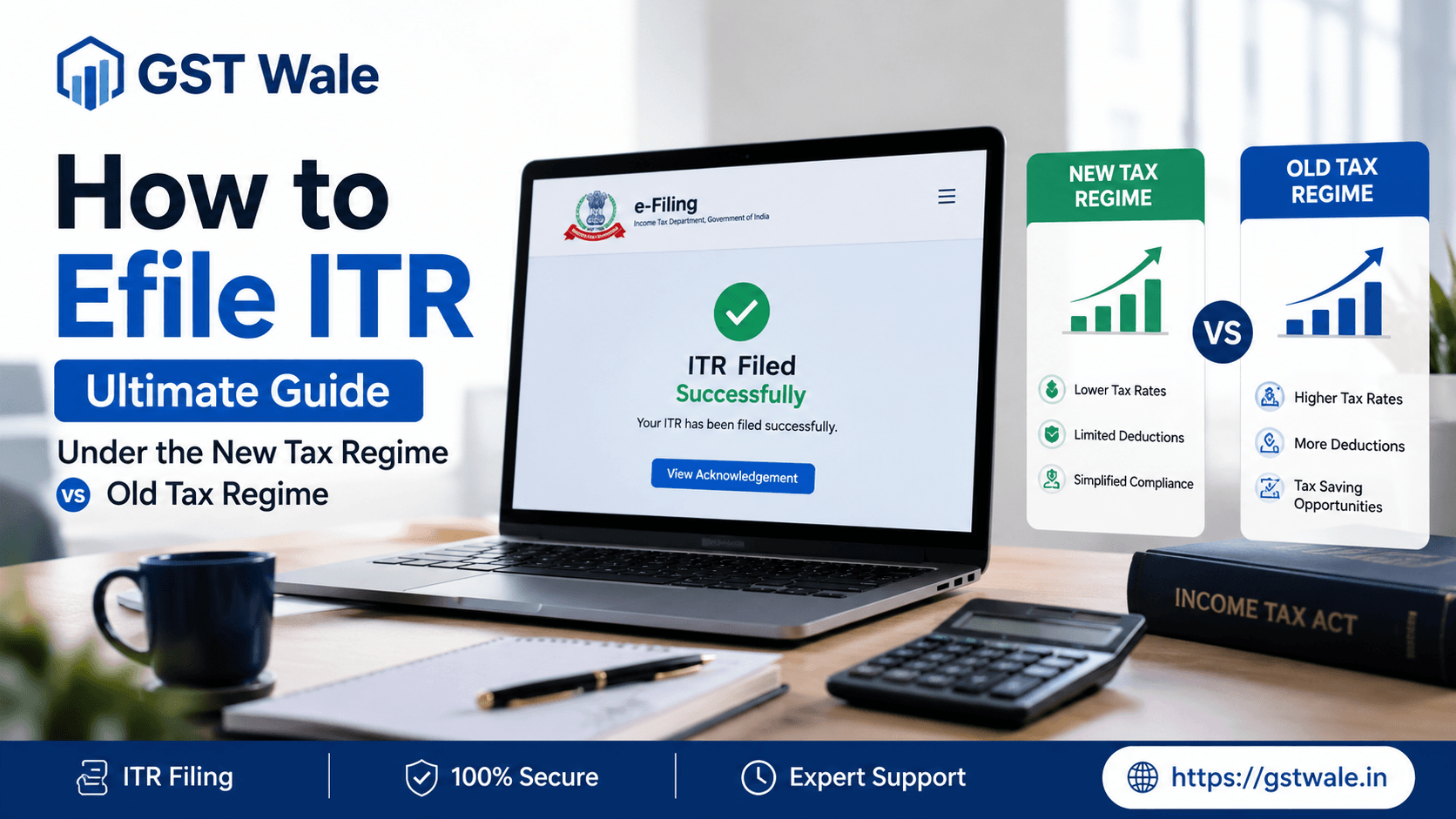
Ultimate Guide: How to Efile ITR Under the New Tax Regime vs Old Tax Regime
Ultimate Guide: How to Efile ITR Under the New Tax Regime vs Old Tax Regime
Tax season in India can feel like a high-stakes puzzle, especially when you are standing at the crossroads of two completely different tax systems. Every year, millions of taxpayers ask themselves the exact same question: "Should I switch or stay put" With recent budget updates making the new regime incredibly attractive—offering zero tax for income up to ₹12 Lakhs after rebates—making the right choice is more critical than ever.
As your trusted financial partners at GST Wale, we deal with thousands of tax returns annually. We understand that whether you are a salaried professional, a freelance creator, or a small business owner, your ultimate goal is to minimize your liability and maximize your peace of mind. To achieve this, you need to seamlessly efile ITR while matching your unique financial profile to the most rewarding tax structure. If you feel overwhelmed by the calculations, remember that professional support for your ITR Filing is always available to ensure you claim every single rupee you deserve without triggering automated tax notices.
New Tax Regime Slabs vs Old Tax Regime Slabs
Before you log onto the income tax e-filing portal to efile ITR, you must understand the current math. The government has positioned the New Tax Regime as the default option, completely restructuring the progressive tax slabs to provide major relief to the middle-class segment.
Let us break down the exact tax rates applicable for the current assessment year so you can look at the raw numbers side-by-side.
| Tax Rate | New Tax Regime Slabs | Old Tax Regime Slabs (Under 60 Years) |
|---|---|---|
| Nil | Up to ₹4,00,000 | Up to ₹2,50,000 |
| 5% | ₹4,00,001 to ₹8,00,000 | ₹2,50,001 to ₹5,00,000 |
| 10% | ₹8,00,001 to ₹12,00,000 | Not Applicable |
| 15% | ₹12,00,001 to ₹16,00,000 | Not Applicable |
| 20% | ₹16,00,001 to ₹20,00,000 | ₹5,00,001 to ₹10,00,000 |
| 25% | ₹20,00,001 to ₹24,00,000 | Not Applicable |
| 30% | Above ₹24,00,000 | Above ₹10,00,000 |
The Big Catch: Under the new tax regime slabs, a resident individual qualifies for an enhanced tax rebate under Section 87A up to ₹60,000. This means if your total taxable income stays within ₹12,00,000, your net tax liability drops straight to zero! Furthermore, salaried individuals receive a standard deduction of ₹75,000, meaning an effective income of up to ₹12.75 Lakhs can be completely tax-free.
Old Tax Regime Exemptions: What Do You Give Up?
The Old Tax Regime might look aggressive with its 20% tax rate kicking in right after ₹5 Lakhs, but it holds a massive library of deductions. If you choose the old system, you can slash your taxable income using dynamic investment wrappers.
Here are the primary old tax regime exemptions and deductions that disappear entirely if you choose the new system:
Section 80C (Up to ₹1.5 Lakhs): EPF, PPF, ELSS mutual funds, Life Insurance premiums, and National Savings Certificates (NSC).
Section 80D (Up to ₹25,000 / ₹50,000): Health insurance premiums for yourself, your spouse, children, and senior citizen parents.
House Rent Allowance (HRA): Tax exemptions on rent paid if you reside in a leased property.
Section 24(b) (Up to ₹2 Lakhs): Interest paid on a home loan for a self-occupied property.
Leave Travel Allowance (LTA): Exemptions on domestic travel expenses for yourself and family members.
If your lifestyle involves structural investments like a heavy home loan, active insurance policies, and continuous multi-year lock-in savings, the old regime might still emerge as the winner.
How to Compare Tax Regimes Before Filing
To efile ITR successfully without immediate financial regrets, you must run a comparative analysis based on your absolute deductions. The easiest way to compare tax regimes is to calculate your personal "Breakeven Point."
The breakeven point is the precise amount of deductions you need to claim under the old regime to make its tax liability exactly equal to the new regime. If your actual deductions exceed this limit, stick to the old structure. If they fall below it, the new structure will leave more disposable cash in your bank account.
A Real-World Example
Let us look at Rahul, a salaried software engineer earning a gross salary of ₹15,00,000 per annum.
Scenario A (New Regime): Rahul claims the standard deduction of ₹75,000. His taxable income becomes ₹14,25,000. Applying the progressive slices across the new tax regime slabs, his total tax liability comes out to approximately ₹96,200 (including cess).
Scenario B (Old Regime): Rahul claims a standard deduction of ₹50,000, maxes out Section 80C at ₹1,50,000, saves ₹25,000 under Section 80D, and claims ₹1,50,000 as home loan interest. His total deductions reach ₹3,75,000, dragging his taxable income down to ₹11,25,000. His tax under the old regime totals around ₹1,56,000.
In this clear scenario, even with ₹3.75 Lakhs worth of investments, Rahul saves nearly ₹60,000 by opting for the new tax regime. This proves why pre-computation is vital before you hit the final submit button.
Understanding the Income Tax Switch Option
Can you bounce back and forth between these two paths? The answer depends entirely on the nature of your income streams. The Income Tax Department provides a specific income tax switch option, but it comes with strict procedural boundaries.
Salaried Individuals & Pensioners
If your earnings consist purely of salary, house property, residual capital gains, or other sources, you enjoy ultimate flexibility. You can choose to file appropriate regime variations every single financial year. You can declare one preference to your HR corporate payroll team for monthly TDS tracking and completely change your mind on the e-filing portal when you actually sit down to efile ITR.
Business Owners, Freelancers, & Professionals
If you declare business or professional income (such as trading profits, consulting fees under presumptive taxation, or retail revenue), you do not get an annual free pass. You can exercise the income tax switch option to move out of the default new regime into the old regime exactly once in a lifetime. Once you opt back out into the new regime in any subsequent year, you are permanently locked into the new regime for all future filings.
Step-by-Step Guide to Efile ITR Correctly
Now that you have chosen your path, let us walk through the exact blueprint to efile ITR on the official government website.
1.Gather Your Core Tax Documents:
Prerequisite Phase.
Collect your Form 16 from your employer, your bank interest certificates, and capital gains statements. Most importantly, download your updated Annual Information Statement (AIS) and Form 26AS from the portal to verify all tax credits deposited against your PAN.
2.Log in to the E-Filing Portal:
Portal Access.
Navigate to incometax.gov.in. Log in securely using your PAN or Aadhaar card as the user ID along with your established password.
3.Initiate the Return Filing Process:
Form Selection.
Click on e-File > Income Tax Returns > File Income Tax Return. Select the current Assessment Year, choose the "Online" filing mode, and select your filing capacity as an Individual.
4.Select and File Appropriate Regime:
Regime Choice.
The portal will explicitly ask whether you want to opt out of the default New Tax Regime. Select 'No' to continue with the new regime, or select 'Yes' to opt into the old regime. If you have business income and want the old regime, ensure you file Form 10-IEA before proceeding.
5.Validate Pre-filled Data & Confirm Summary:
Verification & Review.
Review the auto-populated blocks covering your salary, allowances, and tax credits. Edit any missing parameters, fill in your deduction schedules, choose your primary bank account for any potential tax refund, and click 'Proceed to Tax Summary'.
6.E-Verify Your ITR:
Final Validation.
Once you pay any residual balance or view your calculated refund, submit the form. You must e-verify your return within 30 days using an Aadhaar OTP, net banking, or an Electronic Verification Code (EVC) to make your filing legally valid.
Frequently Asked Questions
Q1: What happens if I forget to e-verify my ITR within 30 days?
If you fail to e-verify your return within the mandated 30-day window, your submission is treated as completely invalid by the department. It is as if you never filed your return at all, which can attract late fees under Section 234F and hefty interest on outstanding balances.
Q2: Can I file under the Old Tax Regime if I miss the July 31st deadline?
No. If you miss the primary due date (usually July 31st for non-audit cases), you can only file a belated return up to December 31st. A major penalty of filing a belated return is that you completely lose the right to opt into the Old Tax Regime; you will be forced to file under the default New Tax Regime.
Q3: Is the ₹75,000 standard deduction available to everyone?
The standard deduction is exclusively available to salaried individuals, pensioners, and family pensioners. If you are a non-salaried freelancer or an entrepreneur declaring pure business profits under ITR-3 or ITR-4, you cannot claim this standard deduction.
Q4: Does the New Tax Regime tax PPF interest or maturity amounts?
No. Even though you cannot claim a fresh tax deduction for investing in a Public Provident Fund (PPF) under the new tax regime, the actual interest accumulated and the ultimate maturity proceeds remain 100% tax-free under both tax regimes.
Let GST Wale Handle Your Taxes Seamlessly
Choosing the perfect tax regime requires meticulous tracking of income lines, past investment cycles, and ever-evolving compliance guidelines. A single wrong selection can instantly cost you thousands of rupees in avoidable taxes or trigger tedious verification notices from the Income Tax Department.
At GST Wale, we cut through the confusing legal jargon to protect your hard-earned money. Our experienced team of tax practitioners handles end-to-end tax optimization, precise regime analysis, and error-free submissions on your behalf. Don't leave your tax compliance to guesswork this year—get in touch with GST Wale today, and let our experts handle your tax returns smoothly while you focus entirely on growing your career and business.
 Previous