


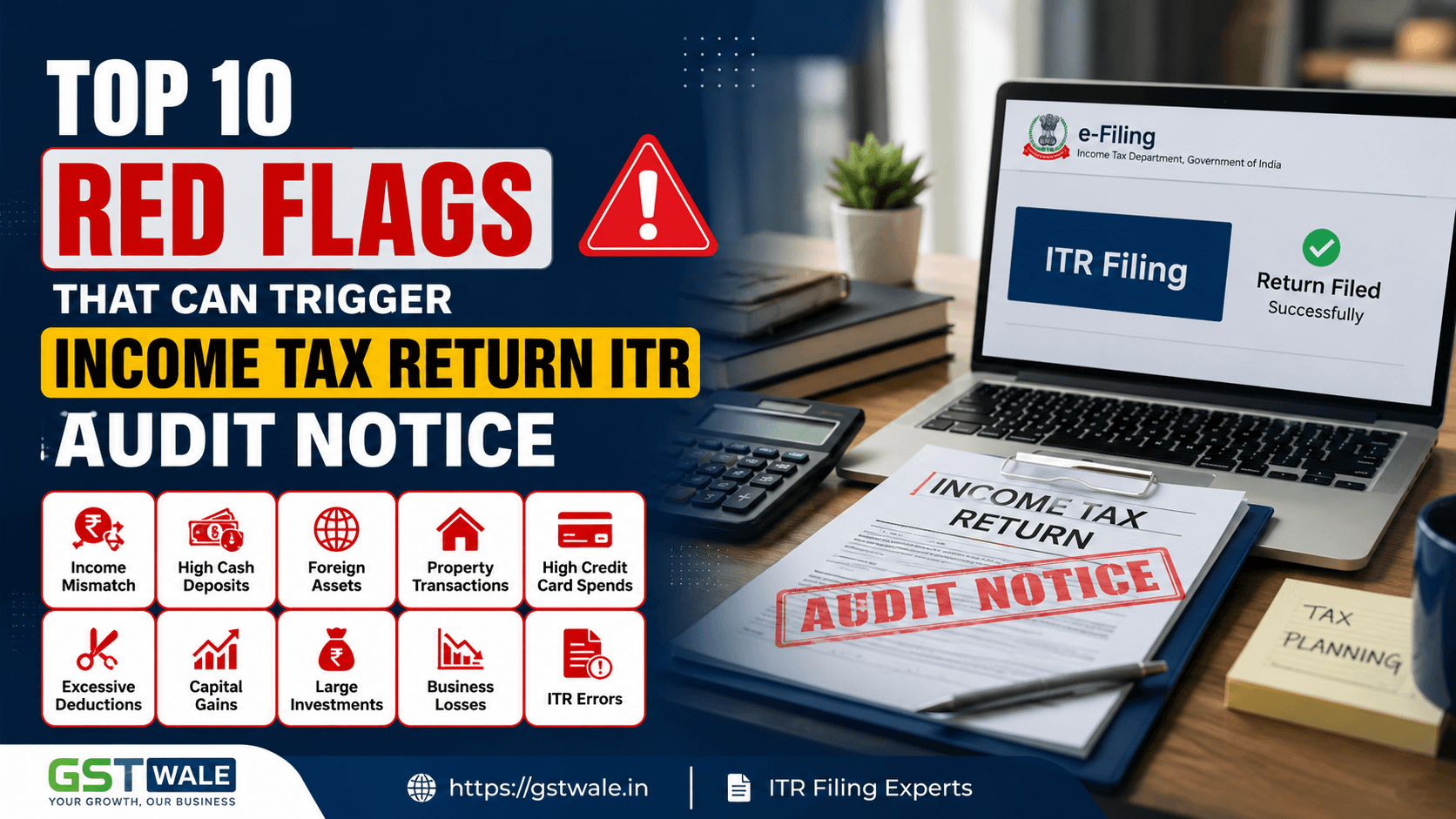
Top 10 Red Flags that Can Trigger an income tax return itr Audit Notice
Top 10 Red Flags that Can Trigger an income tax return itr Audit Notice
Filing an income tax return itr is no longer just a yearly compliance formality. With advanced data analytics, AI-based tracking systems, and direct integration between banks, GST records, PAN, Aadhaar, and financial institutions, the Income Tax Department now monitors transactions more closely than ever before.
At GST Wale, we often see taxpayers receiving notices simply because they were unaware of certain reporting requirements or made avoidable mistakes while filing their returns. Whether you are a salaried employee, freelancer, trader, or business owner, understanding the common triggers behind an audit or scrutiny notice can help you stay compliant and stress-free.
If you are planning your ITR Filing, it is important to know what attracts the department’s attention and how you can avoid unnecessary scrutiny.
In this article, we will discuss the top 10 red flags that can trigger an income tax return itr audit notice and practical ways to stay on the safer side of tax compliance.
Why Does the Income Tax Department Send Audit Notices?
The Income Tax Department sends notices when it detects unusual financial activity, inconsistencies, or possible tax evasion. In many cases, the notice comes under scrutiny notice section 143, where the department asks taxpayers to justify their income, deductions, investments, or expenses.
A notice does not always mean wrongdoing. Sometimes, even a small mismatch in income or incorrect reporting can trigger an inquiry.
Top 10 Red Flags That Can Trigger an Income Tax Return ITR Audit Notice
1. Mismatch in Income Reported
One of the most common reasons for an income tax return itr scrutiny is a mismatch in income details.
The department cross-checks your return with:
- Form 26AS
- AIS (Annual Information Statement)
- TDS records
- Bank interest details
- Employer salary records
Example
Suppose your employer reports a salary of ₹12 lakh, but your income tax return itr mentions only ₹10 lakh. This discrepancy can immediately attract a notice.
How to Avoid It
- Verify Form 26AS before filing
- Match all TDS entries
- Reconcile AIS data carefully
- Report all sources of income
2. High Credit Card Spends with Low Declared Income
If your lifestyle expenses appear much higher than your reported income, the system may flag your return.
Large expenses such as:
- Luxury shopping
- International travel
- Expensive gadgets
- Hotel bills
combined with low taxable income often raise suspicion.
Real-World Insight
We have seen cases where individuals declared annual income of ₹4 lakh but had high credit card spends exceeding ₹15 lakh. Such patterns often trigger automated scrutiny.
Expert Advice
Your declared income in the income tax return itr should reasonably justify your spending habits.
3. Large Cash Deposits in Bank Accounts
Frequent or high-value cash deposits are closely monitored, especially after digitization initiatives.
The department may question:
- Source of cash
- Business turnover mismatch
- Unaccounted transactions
This becomes more sensitive for businesses dealing heavily in cash.
Best Practice
Maintain proper books of accounts and supporting evidence for all cash transactions.
4. Claiming Excessive Deductions
Tax-saving deductions are legitimate, but unusually high claims without proper proof can become problematic.
Common sections under scrutiny include:
- Section 80C
- Section 80D
- HRA claims
- Home loan interest
- Business expenses
Example
Claiming ₹2 lakh in medical expenses without adequate documents can trigger verification.
What GST Wale Recommends
Keep:
- Insurance receipts
- Investment proofs
- Rent agreements
- Loan statements
properly organized before filing your income tax return itr.
5. Non-Disclosure of Foreign Assets
The Income Tax Department has become extremely strict regarding undeclared foreign assets.
This includes:
- Foreign bank accounts
- Overseas investments
- Foreign stocks
- Cryptocurrency held abroad
- Foreign property ownership
Failure to disclose these assets can lead to severe penalties and prosecution.
Important Note
Even if the foreign asset generates no income, disclosure may still be mandatory in your income tax return itr.
6. Incorrect Reporting of Property Transactions
Property transactions are one of the biggest audit triggers today.
The department receives direct data from:
- Property registrars
- Banks
- TDS filings
- Stamp duty authorities
If the sale or purchase value in your income tax return itr does not match official records, scrutiny may follow.
Common Mistakes
- Underreporting sale value
- Ignoring capital gains
- Wrong calculation of indexed cost
- Not reporting inherited property sales
Related Concern: Long Term Capital Gains Tax
Many taxpayers incorrectly calculate long term capital gains tax while selling property or shares. This often leads to notices.
7. Frequent High-Value Transactions
Certain financial activities automatically get reported to the Income Tax Department through the Statement of Financial Transactions (SFT).
These include:
- Large mutual fund investments
- High stock market turnover
- Big fixed deposits
- Purchase of bonds
- Cash payments above prescribed limits
If these transactions do not align with your declared income, your income tax return itr may come under review.
8. Filing Returns with Continuous Business Losses
Businesses consistently reporting losses while maintaining high operational expenses can attract attention.
The department may suspect:
- Artificial loss creation
- Fake expense booking
- Tax evasion strategies
Example
A business claiming losses for 5 consecutive years but continuing expensive expansions may face deeper scrutiny.
Practical Suggestion
Ensure every business expense is:
- Genuine
- Properly invoiced
- Accounted for in books
9. Sudden Spike in Income or Investments
A major jump in investments, turnover, or income without proper explanation can become a red flag.
For example:
- Buying property suddenly
- Investing huge sums in stocks
- Significant increase in bank balances
without proportional declared income can trigger investigation.
Tip
Maintain documentary proof for gifts, inheritances, loans, or any exceptional receipts.
10. Errors in Filing or Repeated Revised Returns
Frequent corrections and revised returns indicate carelessness or inconsistencies.
Common filing errors include:
- Wrong PAN details
- Incorrect bank account numbers
- Mismatch in TDS
- Missing schedules
- Incorrect ITR form selection
Repeated revisions increase the chances of manual scrutiny notice section 143 proceedings.
GST Wale Recommendation
Always review your income tax return itr thoroughly before final submission.
What Happens If You Receive an Audit or Scrutiny Notice?
Receiving a notice can feel stressful, but timely action is crucial.
Step-by-Step Response
Step 1: Read the Notice Carefully
Understand:
- Notice section
- Assessment year
- Information requested
- Deadline for response
Step 2: Gather Supporting Documents
Prepare:
- Bank statements
- Investment proofs
- Property papers
- GST records
- Expense invoices
Step 3: Respond Within Time
Ignoring notices can lead to penalties and further legal complications.
Step 4: Take Professional Help
Professional guidance ensures accurate replies and proper representation before authorities.
Tips to Keep Your Income Tax Return ITR Safe from Scrutiny
Here are some practical precautions every taxpayer should follow:
- Report all income honestly
- Avoid fake deductions
- Match AIS and Form 26AS
- Maintain proper records
- Disclose foreign assets correctly
- Calculate long term capital gains tax carefully
- File returns before deadlines
- Avoid suspicious cash transactions
Transparency is always safer than aggressive tax planning.
Frequently Asked Questions (FAQs)
Can a salaried employee receive a scrutiny notice?
Yes. Even salaried individuals can receive notices due to mismatch in income, incorrect deductions, or high-value transactions.
What is scrutiny notice section 143?
It is a notice issued by the Income Tax Department for detailed examination of your return and financial records.
Do high credit card spends always trigger scrutiny?
Not always. However, if your spending pattern is inconsistent with your declared income, it may attract attention.
Is non-disclosure of foreign assets serious?
Yes. Undeclared foreign assets can lead to heavy penalties and prosecution under Indian tax laws.
Can revised returns increase audit chances?
Frequent revisions may raise suspicion, especially if major financial details are changed repeatedly.
An income tax return itr audit notice is often triggered by inconsistencies, unusual financial patterns, or reporting mistakes. In today’s digital tax environment, almost every high-value transaction is traceable. The best way to stay protected is to maintain transparency, proper documentation, and accurate reporting.
At GST Wale, we help individuals, professionals, and businesses file accurate returns while minimizing the risk of notices and penalties. Whether it is income reporting, property transactions, long term capital gains tax calculations, or responding to scrutiny notices, our experts ensure complete compliance and peace of mind.
If you want error-free tax filing support and professional guidance, connect with GST Wale today and file your income tax return itr with confidence.
 Previous