


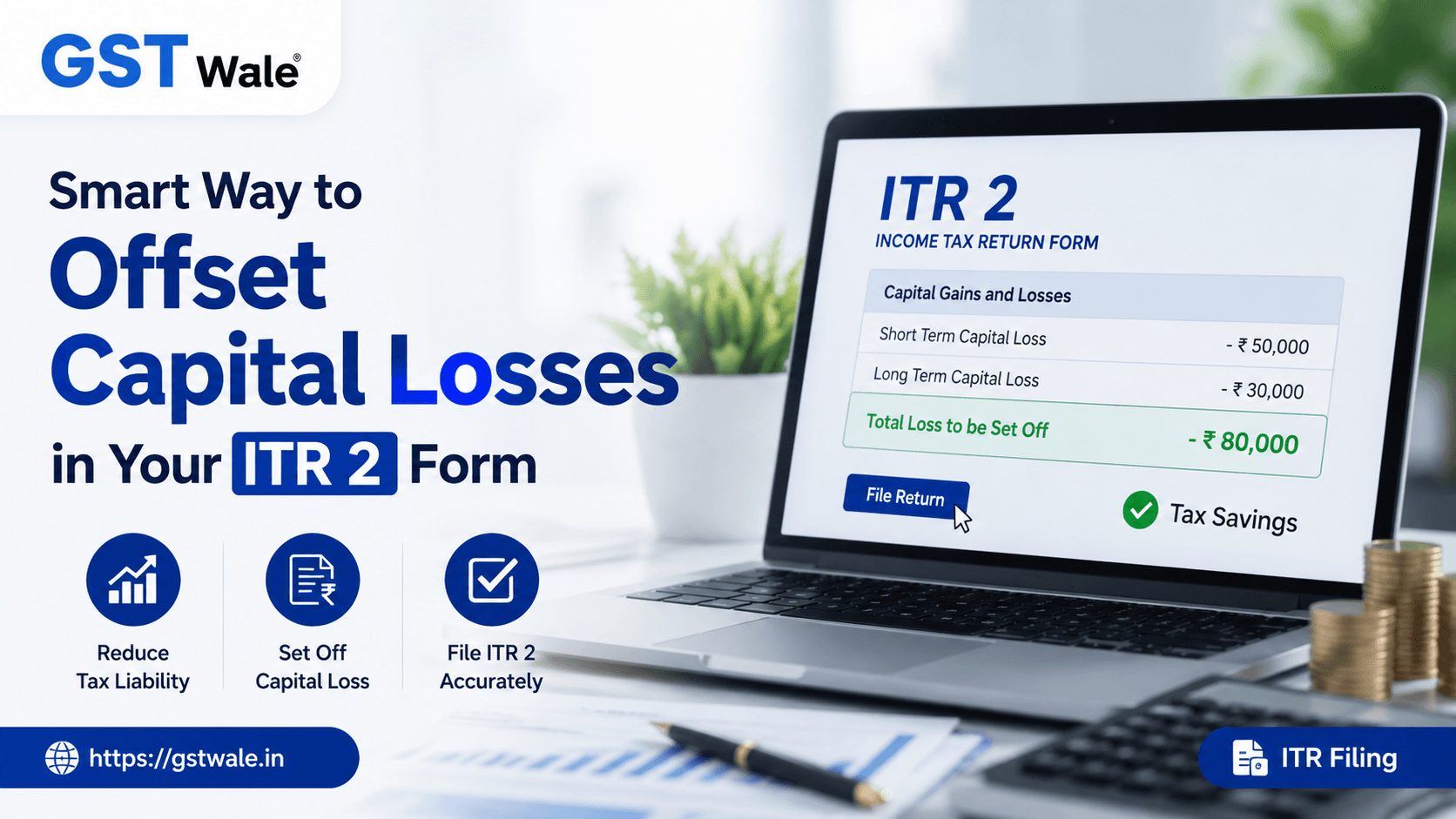
The Smart Way to Offset Capital Losses in Your ITR 2 Form
The Smart Way to Offset Capital Losses in Your ITR 2 Form
It is that time of the year again when the stress of tax season starts creeping into our daily lives. If you have been active in the stock market or real estate, you likely have a mix of gains and losses, and figuring out how to balance these can be quite the puzzle. If you are preparing your tax documents, you need to understand that choosing the right itr 2 is essential for accurately reporting these financial events. At GST Wale, we simplify the complexities of tax compliance, and if you are currently looking for professional assistance, our ITR Filing services are designed to ensure your income tax return form is error-free and tax-efficient.
Filing your taxes correctly is not just about compliance; it is about keeping more of your hard-earned money. Many taxpayers miss out on significant savings because they do not fully understand how to set off their losses against their gains. Let’s dive into how you can use the itr form to your advantage.
Understanding Capital Gains and Losses
Before we get into the "how-to," let’s clarify the basics. When you sell an asset—like shares, mutual funds, or property—for a price lower than what you paid, you incur a capital loss. Under the current tax laws, you are allowed to offset these losses against capital gains, which effectively lowers your overall tax liability.
However, the specific rules for set-off and carry-forward depend heavily on the type of capital asset. This is why selecting the correct form, specifically the itr 2, is a critical step for individuals who have income from capital gains, multiple house properties, or foreign assets.
The Smart Strategy: Setting Off Losses in ITR 2
The Income Tax Department has structured the itr 2 to accommodate complex financial profiles. When you file it returns online, you need to ensure that your Schedule CG (Capital Gains) is populated correctly.
Key Rules for Set-Off
Short-Term Capital Loss (STCL): You can set this off against both Short-Term Capital Gains (STCG) and Long-Term Capital Gains (LTCG).
Long-Term Capital Loss (LTCL): This can only be set off against Long-Term Capital Gains. You cannot use a long-term loss to offset a short-term gain.
The Eight-Year Rule: If you cannot set off all your losses in the current financial year, you are allowed to carry forward the remaining loss for up to eight subsequent assessment years, provided you file your return on time.
Why Accuracy Matters in Your ITR Form
When you prepare your itr 2, even a minor error in reporting can lead to a scrutiny notice from the tax department. Many taxpayers mistakenly believe that if they have a net loss, they do not need to it filing. That is a major oversight! To carry forward these losses to future years, filing your return by the due date is mandatory.
If you are transitioning from older systems to the modern itr 2.0 digital interface, the automation makes it easier to track these entries, but it also means the system flags inconsistencies much faster. As experts at GST Wale, we always recommend verifying your Form 26AS and AIS (Annual Information Statement) before hitting the submit button.
How to Handle Carry-Forward Losses
If your total capital loss exceeds your gains for the year, don't worry. This is where the carry-forward provision saves the day. By properly documenting these losses in your itr 2, you create a "tax shield" for future years. If you make a profit in 2027 or 2028, you can use these carried-forward losses to reduce that future tax burden.
Steps to Follow:
Gather your contract notes: Ensure you have all brokerage statements.
Classify your assets: Clearly distinguish between equity and debt instruments.
Check the dates: Ensure you have the correct holding period to distinguish between short-term and long-term.
Validate in ITR 2: Ensure Schedule CYLA (Statement of income after set off of current year losses) is filled out precisely.
Frequently Asked Questions
Can I set off capital losses against salary income?
No. Capital losses can only be set off against capital gains. They cannot be used to reduce your salary or business income.
What happens if I forget to file my return?
If you miss the deadline, you lose the right to carry forward your capital losses to future years. This is why timely it filing is non-negotiable.
Does the itr 2 cover all types of investors?
Yes, the itr 2 is suitable for individuals and HUFs having income from capital gains, house property, or more than one house property, provided they do not have income from a business or profession.
Is the process the same for itr 2.0?
While the interface of itr 2.0 is more user-friendly, the underlying tax laws remain the same. The logic for setting off and carrying forward losses remains consistent.
Partner with GST Wale for Stress-Free Compliance
Navigating the nuances of the itr 2 can be daunting, especially with changing tax slabs and complex reporting requirements. Why take the risk of a notice or missed savings when you can have an expert in your corner? At GST Wale, we take the headache out of tax season, ensuring that every loss is recorded, every gain is reported, and your tax liability is optimized.
 Previous