


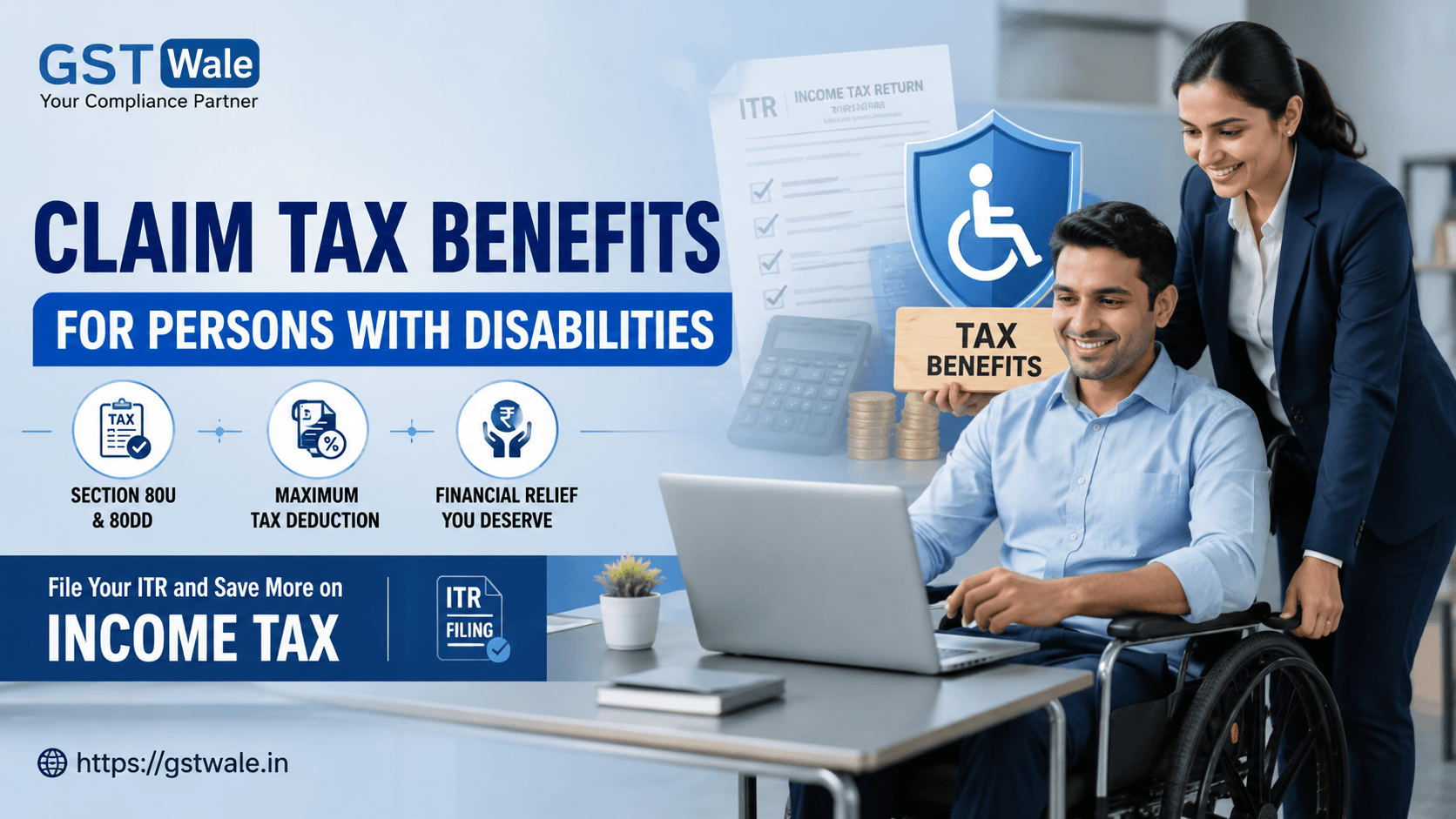
How to Claim Tax Benefits for Persons with Disabilities
How to Claim Tax Benefits for Persons with Disabilities
Understanding Income Tax Benefits for Persons with Disabilities
When it comes to financial planning, many taxpayers are unaware that the Indian Income Tax Act provides special deductions for persons with disabilities and for families supporting disabled dependents. These provisions are designed to reduce the financial burden associated with medical care, rehabilitation, and day-to-day support.
At GST Wale, we often notice that eligible taxpayers miss out on valuable Income Tax deductions simply because they do not understand the rules properly or fail to maintain the required documents. Whether you are filing your own return or taking professional help for ITR Filing, understanding these benefits can help you save a significant amount of Income Tax legally.
In this article, we will explain how persons with disabilities and their families can claim deductions under Section 80U and Section 80DD, the documents required, eligibility criteria, and practical tips to avoid rejection during assessment.
Why Disability-Related Income Tax Benefits Matter
Healthcare and support expenses for disabled individuals can be substantial. From medical treatment and rehabilitation to special training and assistive devices, the costs can increase over time. To provide relief, the government allows fixed Income Tax deductions under specific sections of the Income Tax Act.
These deductions are available irrespective of the actual expenses incurred, provided the taxpayer fulfills the prescribed conditions.
The two most important provisions are:
- Section 80U – For disabled individuals themselves
- Section 80DD – For taxpayers supporting a dependent disability
Understanding the difference between these sections is extremely important while filing your Income Tax return.
Income Tax Deduction Under Section 80U
Section 80U provides an Income Tax deduction to individuals who are suffering from a disability themselves.
Who Can Claim Section 80U?
An individual taxpayer can claim deduction under Section 80U if:
- They are a resident individual in India
- They are certified as a person with disability by a recognized medical authority
- They have at least 40% disability
This deduction is not available to HUFs or companies.
Amount of Deduction Under Section 80U
The Income Tax deduction allowed is fixed and does not depend on actual expenditure.
Normal Disability
- Disability of 40% or more but less than 80%
- Deduction allowed: ₹75,000
Severe Disability
- Disability of 80% or more
- Deduction allowed: ₹1,25,000
Disabilities Covered Under Section 80U
The following disabilities are generally covered:
- Blindness
- Low vision
- Hearing impairment
- Leprosy-cured persons
- Locomotor disability
- Mental retardation
- Mental illness
- Autism
- Cerebral palsy
- Multiple disabilities
Income Tax Deduction Under Section 80DD
Section 80DD applies when a taxpayer incurs expenses for the maintenance or medical treatment of a disabled dependent.
This section is commonly used by parents, spouses, or guardians supporting a family member with disability.
Who Can Claim Section 80DD?
The following taxpayers can claim this Income Tax deduction:
- Resident individuals
- Hindu Undivided Families (HUFs)
The deduction is available if they spend money on a dependent disability.
Who Is Considered a Dependent?
For an individual taxpayer, dependents include:
- Spouse
- Children
- Parents
- Brothers or sisters
For HUFs, any member of the HUF can qualify.
Deduction Amount Under Section 80DD
The deduction structure is similar to Section 80U.
Normal Disability
- 40% or more disability
- Deduction: ₹75,000
Severe Disability
- 80% or more disability
- Deduction: ₹1,25,000
Again, this is a fixed Income Tax deduction and not linked to actual expenses.
Difference Between Section 80U and Section 80DD
Many taxpayers confuse these two sections while filing Income Tax returns. Here is a simple comparison.
| Particulars | Section 80U | Section 80DD |
|---|---|---|
| Who claims deduction? | Disabled individual | Person supporting disabled dependent |
| Eligible taxpayer | Resident individual | Resident individual or HUF |
| Based on whose disability? | Taxpayer’s own disability | Dependent disability |
| Need actual expenses? | No | No |
| Medical certificate required? | Yes | Yes |
Understanding this distinction helps avoid mistakes during Income Tax filing.
Importance of Medical Certificates
One of the most important requirements for claiming disability-related Income Tax deductions is proper documentation.
Required Medical Certificates
The disability must be certified by an authorized medical authority such as:
- Neurologist
- Civil surgeon
- Chief Medical Officer
- Government hospital specialist
The certificate should clearly mention:
- Nature of disability
- Percentage of disability
- Whether it is severe disability
- Validity period
Without proper medical certificates, the Income Tax department may reject the deduction claim.
When Renewal Is Required
Some certificates are permanent, while others have an expiry date. If the certificate has expired during the financial year, taxpayers should renew it before filing the Income Tax return.
Step-by-Step Process to Claim Disability Tax Deduction
Claiming disability-related Income Tax benefits is straightforward if you follow the correct process.
Step 1: Obtain Medical Certificate
Get the disability certified from an authorized medical practitioner.
Step 2: Keep Supporting Documents
Maintain records of:
- Medical certificates
- Insurance premium receipts
- Rehabilitation expense records
- PAN and Aadhaar details
Step 3: Select Correct Section
- Use Section 80U for self-disability
- Use Section 80DD for dependent disability
Step 4: Report Deduction in ITR
Enter the deduction details correctly while filing your Income Tax return.
Step 5: Preserve Documents
Even if documents are not uploaded during filing, keep them safely for future verification by the Income Tax department.
Common Mistakes Taxpayers Should Avoid
At GST Wale, we frequently come across errors that delay refunds or trigger notices.
Claiming Both Sections for Same Person
A taxpayer cannot claim both Section 80U and Section 80DD for the same disabled person.
Using Expired Medical Certificates
Always check the validity before filing the Income Tax return.
Incorrect Disability Percentage
The deduction amount depends on the certified disability percentage. Ensure accurate reporting.
Lack of Documentation
Even though fixed deductions are allowed, supporting medical certificates are mandatory.
Practical Example for Better Understanding
Suppose Mr. Sharma has a son with 70% disability and spends money on his treatment and rehabilitation.
Even if his actual expenditure is ₹40,000, he can still claim a fixed Income Tax deduction of ₹75,000 under Section 80DD.
Similarly, if Ms. Priya herself has 85% disability, she can claim ₹1,25,000 under Section 80U irrespective of her actual expenses.
These provisions significantly reduce overall Income Tax liability.
FAQs on Income Tax Benefits for Disabilities
Can both parents claim deduction for the same disabled child?
No. Only one taxpayer can claim the deduction for the same dependent disability in a financial year.
Is actual medical expenditure proof mandatory?
No. The deduction under Section 80U and Section 80DD is fixed. However, valid medical certificates are compulsory.
Can salaried employees also claim these deductions?
Yes. Salaried individuals can claim these Income Tax deductions while filing their returns.
Is a private doctor’s certificate acceptable?
The certificate should generally be issued by a prescribed medical authority recognized under the Income Tax Act.
Can senior citizens claim disability deductions?
Yes, provided they meet the conditions under Section 80U or Section 80DD.
Income Tax Benefits for Persons with Disabilities
The Income Tax Act offers meaningful relief to persons with disabilities and families supporting them. Sections 80U and 80DD can help taxpayers reduce their Income Tax burden while ensuring financial support for medical care and rehabilitation.
However, proper documentation, valid medical certificates, and accurate return filing are essential to avoid issues with the Income Tax department.
At GST Wale, we help individuals and families claim the right deductions without confusion. Whether you need expert guidance on disability-related deductions, return filing, or overall tax planning, our professionals are here to make your Income Tax compliance smooth and stress-free.
 Previous