


How to Choose the Right Income Tax Return ITR Form for Your Salary
How to Choose the Right Income Tax Return ITR Form for Your Salary
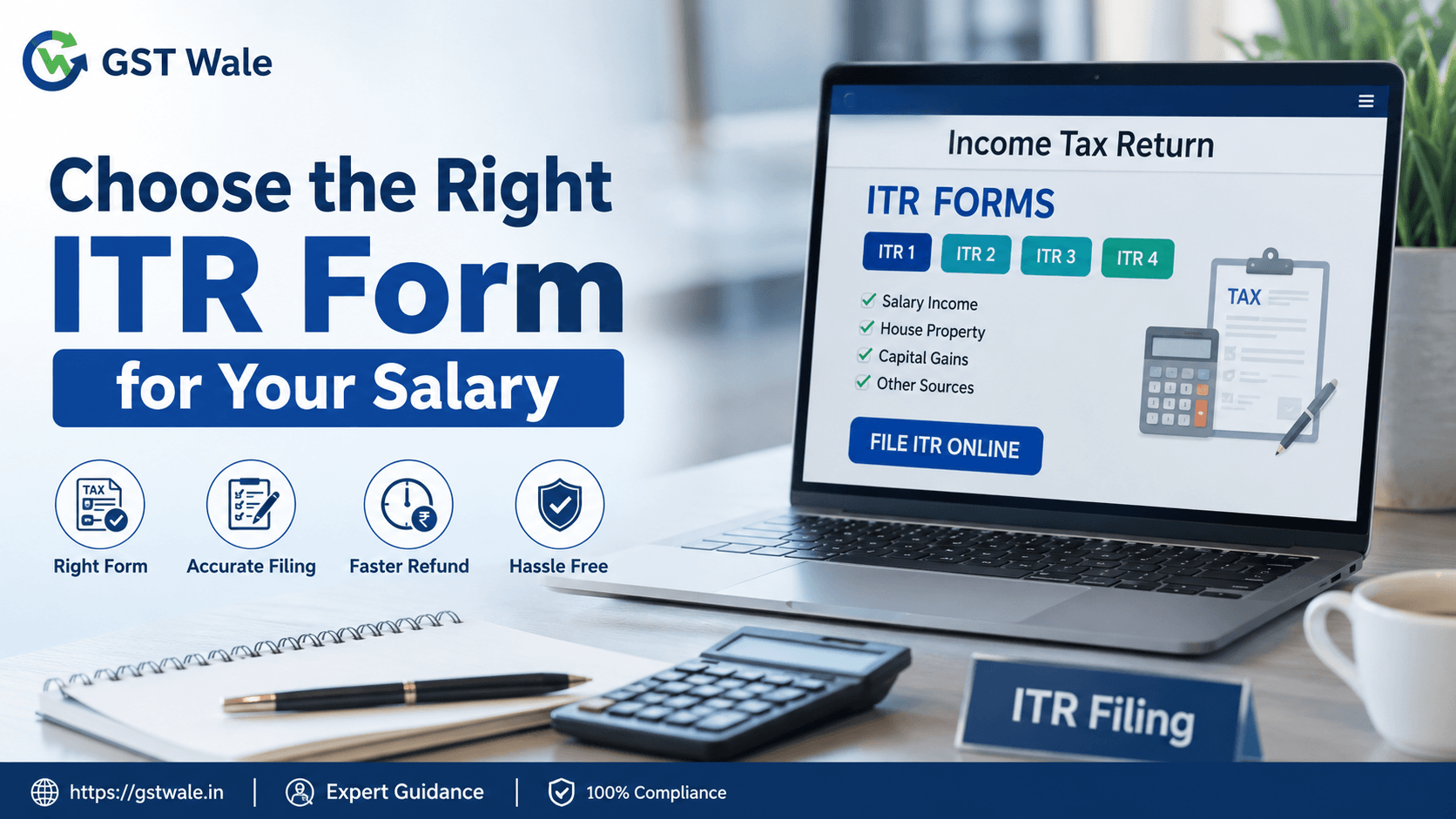
Choosing the correct income tax return itr form is one of the most important steps while filing your annual tax return. Many salaried individuals assume that all taxpayers use the same form, but that's not true. Selecting the wrong form can lead to defective returns, delays in processing, or even notices from the Income Tax Department.
If you're planning your ITR Filing , understanding which form applies to your income is the first step toward accurate tax compliance. At GST Wale, we regularly help salaried employees, professionals, and business owners choose the correct form and file their returns without unnecessary complications.
Why Choosing the Right Income Tax Return ITR Form Matters
Every taxpayer has a different source of income, and the Income Tax Department has designed separate forms to match those income categories. Filing the correct income tax return itr form helps ensure:
- Faster processing of your return
- Quicker income tax refunds
- Reduced chances of receiving notices
- Accurate reporting of income and deductions
- Smooth verification by the Income Tax Department
Even a small mistake in selecting the form can result in your return being marked as defective under the Income Tax Act.
Understanding Different Types of Income Tax Return ITR Form
Before selecting an income tax return itr form, you should identify all your income sources.
These may include:
- Salary or pension
- House property income
- Interest from savings accounts or fixed deposits
- Capital gains from shares or property
- Business or professional income
- Agricultural income
- Foreign assets or foreign income
Your combination of income sources determines the correct form.
Income Tax Return ITR Form for Salaried Individuals
Most salaried taxpayers generally fall under one of the following categories.
ITR 1 (Sahaj)
ITR 1 is the most commonly used income tax return itr form for salaried individuals.
You can use itr 1 if you have:
- Income from salary or pension
- Income from one house property
- Other income such as bank interest
- Agricultural income up to ₹5,000
- Total income up to the prescribed eligibility limit under current tax rules
However, you cannot use itr 1 if you have:
- Capital gains
- Business income
- Multiple house properties
- Foreign assets
- Income from lottery or racehorses
- Directorship in a company under specified conditions
ITR 2
This income tax return itr form is suitable if you earn salary but also have:
- Capital gains from shares, mutual funds, or property
- Income from multiple house properties
- Foreign income or assets
- Agricultural income exceeding the specified limit
Many salaried employees who actively invest in the stock market often need ITR 2 instead of itr 1.
ITR 3
If you receive salary along with business or professional income, ITR 3 becomes the appropriate income tax return itr form.
For example:
- A software engineer with freelance income
- A salaried doctor running a private clinic
- An employee operating a side business
When Does ITR 4 Apply?
Many taxpayers confuse itr 4 with salary returns.
ITR 4 is primarily meant for taxpayers opting for the presumptive taxation scheme under Sections 44AD, 44ADA, or 44AE.
You may use itr 4 if:
- You are a freelancer under presumptive taxation.
- You run a small business.
- Your professional income qualifies under the presumptive scheme.
- You also have eligible salary income within the permitted conditions.
If your income does not meet the eligibility criteria, another income tax return itr form may be applicable.
How Income Tax Form 16 Helps You Choose the Correct Form
One of the first documents every salaried employee should review is the income tax form 16 provided by the employer.
The income tax form 16 contains:
- Salary details
- TDS deducted
- Taxable allowances
- Deductions claimed
- Employer information
Although income tax form 16 helps calculate your salary income, it does not automatically determine the correct income tax return itr form. You should also consider other sources of income before filing.
Example
Suppose Rahul receives:
- Salary of ₹12 lakh
- Interest income of ₹20,000
- Capital gains from selling mutual funds
Even though he has income tax form 16, he cannot use itr 1 because of capital gains. He should file ITR 2.
Step-by-Step Guide to Choose the Right Income Tax Return ITR Form
Selecting the correct income tax return itr form becomes much easier if you follow a structured approach.
Step 1: Identify Your Income Sources
Prepare a complete list of income earned during the financial year.
Include:
- Salary
- Interest
- Rental income
- Capital gains
- Business income
- Freelance income
Step 2: Check Your Eligibility
Read the eligibility conditions for each income tax return itr form before filing.
Many taxpayers mistakenly choose itr 1 without considering investments or additional income.
Step 3: Review Your Income Tax Form 16
Compare your salary details with bank statements, investment statements, and Form 26AS or the Annual Information Statement (AIS).
This ensures all income is correctly reported.
Step 4: Verify Deductions
Check deductions under:
- Section 80C
- Section 80D
- Home loan interest
- National Pension System (NPS)
- Donations under eligible sections
Step 5: File ITR Online Carefully
Today, most taxpayers prefer to file itr online using the Income Tax Department's portal or through professional tax consultants.
Before you file itr online, ensure:
- PAN and Aadhaar are linked
- Bank account is pre-validated
- Mobile number is updated
- All income is disclosed correctly
- The selected income tax return itr form matches your eligibility
Common Mistakes While Selecting an Income Tax Return ITR Form
Avoid these common errors:
- Choosing itr 1 despite having capital gains
- Ignoring interest income from fixed deposits
- Not reporting rental income
- Using itr 4 without qualifying for presumptive taxation
- Depending only on income tax form 16
- Forgetting to verify the filed return
These mistakes can delay refunds or create compliance issues.
Practical Example
Let's understand this with a real-life situation.
Priya works in a multinational company and earns ₹14 lakh annually. She also:
- Owns one residential property
- Earns bank interest
- Invests in equity mutual funds
- Sold shares during the financial year
Initially, Priya believed itr 1 would be sufficient because she was salaried. However, since she earned capital gains from shares, the correct income tax return itr form was ITR 2.
By choosing the correct form, she successfully return taxes without receiving any notices from the department.
Benefits of Filing the Correct Income Tax Return ITR Form
Choosing the correct income tax return itr form offers several advantages.
- Accurate tax computation
- Faster processing of returns
- Easy refund processing
- Better compliance history
- Lower chances of scrutiny
- Peace of mind during future financial transactions
Whether you file itr online yourself or take professional assistance, accuracy should always be your priority.
Frequently Asked Questions
Which income tax return itr form is best for salaried employees?
Most salaried individuals use itr 1, but if you have capital gains, multiple properties, foreign income, or other specified income sources, another income tax return itr form such as ITR 2 or ITR 3 may be applicable.
Can I file itr online without Income Tax Form 16?
Yes. You can file itr online even without income tax form 16 by using salary slips, Form 26AS, AIS, and other financial records. However, Form 16 makes salary reporting easier.
Is ITR 4 meant only for business owners?
Mostly yes. itr 4 is designed for eligible taxpayers opting for the presumptive taxation scheme, although certain salaried individuals with qualifying presumptive income may also use it if they meet the prescribed conditions.
What happens if I choose the wrong income tax return itr form?
Your return may be treated as defective, leading to delays, additional compliance requirements, or notices from the Income Tax Department.
Can professionals help me return taxes correctly?
Yes. Tax professionals can review your income sources, identify the correct income tax return itr form, and help you accurately return taxes while maximizing eligible deductions.
Selecting the right income tax return itr form is essential for every salaried taxpayer. While itr 1 is suitable for many employees, additional income such as capital gains, business income, or foreign assets can change the applicable form. Reviewing your income tax form 16, understanding your income sources, and choosing the appropriate form will help you file itr online accurately and return taxes without unnecessary hassles.
At GST Wale, we believe tax filing should be simple, accurate, and stress-free. Our experienced tax professionals carefully assess your income, recommend the correct income tax return itr form, and ensure your return is filed in full compliance with the latest tax regulations. Get in touch with GST Wale today and let us make your income tax filing smooth, timely, and worry-free.
 Previous