


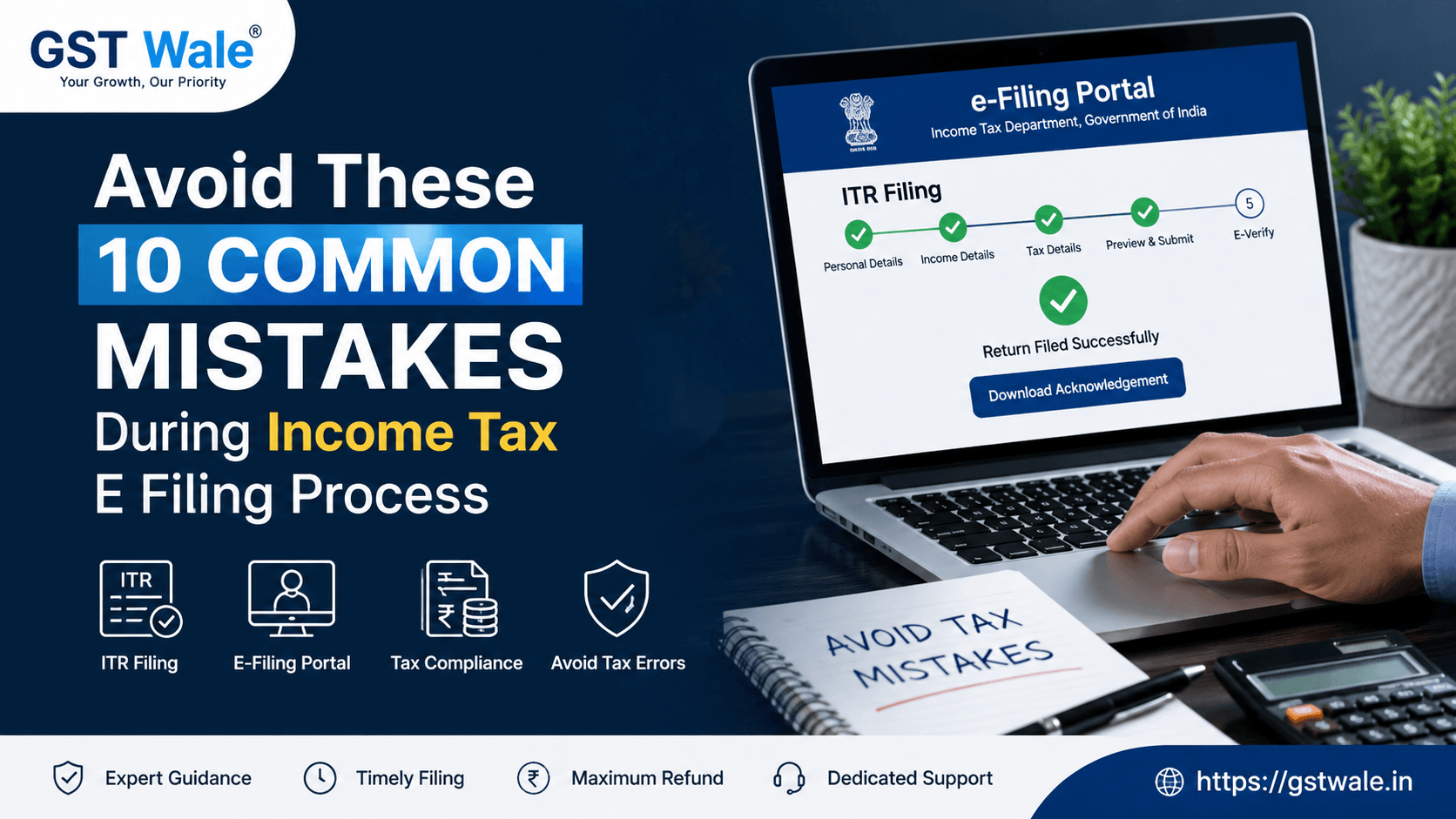
Avoid These 10 Common Mistakes During Your Income Tax E Filing Process
Avoid These 10 Common Mistakes During Your Income Tax E Filing Process
Income tax e filing has made return submission faster, easier, and more transparent for taxpayers across India. Whether you are a salaried employee, freelancer, business owner, or professional, filing your Income Tax Return (ITR) online is now a necessary part of financial compliance. However, many taxpayers still make avoidable mistakes during the process, which can lead to notices, delayed refunds, penalties, or even rejection of returns.
At GST Wale, we regularly assist clients who face issues because of incorrect details, missed disclosures, or improper tax computation during income tax e filing. Many of these errors can easily be avoided with proper guidance and attention to detail. If you are planning your ITR Filing, understanding these common mistakes can save you both time and money.
In this article, we will discuss the 10 most common mistakes people make during income tax e filing and how you can avoid them for a smooth and stress-free experience.
1. Choosing the Wrong ITR Form
One of the most common mistakes during income tax e filing is selecting the incorrect ITR form. Different categories of taxpayers must file different forms based on their income source and nature of earnings.
Common Examples:
- ITR-1 for salaried individuals with simple income
- ITR-3 for business or professional income
- ITR-4 for presumptive taxation scheme
Filing the wrong form can make your return defective under Section 139(9).
Expert Tip from GST Wale
Before starting income tax e filing, carefully check your income sources, capital gains, business income, foreign assets, and other disclosures to select the correct form.
2. Ignoring AIS Data and TIS Summary
The Income Tax Department now provides detailed financial information through AIS data (Annual Information Statement) and TIS summary (Taxpayer Information Summary).
Many taxpayers skip reviewing these statements during income tax e filing, resulting in mismatches.
Why This Matters
AIS data may include:
- Bank interest
- Share transactions
- Mutual fund investments
- TDS deductions
- Property transactions
If your filed return does not match the department’s records, you may receive a notice later.
Best Practice
Always compare your Form 16, bank statements, and books of accounts with AIS data and TIS summary before submitting your return.
3. Incorrect Personal Information
Simple mistakes in PAN, Aadhaar number, bank account details, or address can create major problems during income tax e filing.
Common Issues:
- Wrong IFSC code
- Incorrect email ID or mobile number
- Name mismatch between PAN and Aadhaar
These errors can delay communication and tax refund status updates.
Practical Advice
Double-check all personal details before final submission on the e-filing portal.
4. Forgetting to Report All Income Sources
Many taxpayers report only salary income and forget additional income sources during income tax e filing.
Frequently Missed Incomes:
- Savings bank interest
- Fixed deposit interest
- Freelancing income
- Rental income
- Capital gains
- Dividend income
Even small undisclosed income can trigger tax scrutiny.
Real-World Example
A salaried employee received a tax notice because he forgot to declare FD interest of ₹18,000. The department already had this information through AIS data.
GST Wale Recommendation
Maintain a yearly income checklist to ensure no source is missed during income tax e filing.
5. Errors in Tax Computation
Incorrect tax computation is another major reason for notices and penalties.
Common Tax Errors:
- Wrong deduction claims
- Incorrect HRA calculation
- Missing surcharge or cess
- Incorrect capital gains calculation
Taxpayers often rely entirely on auto-filled data without verifying calculations.
Expert Suggestion
Review your:
- Section 80C deductions
- Home loan benefits
- Medical insurance deductions
- TDS credits
Proper tax computation ensures accurate filing and prevents future disputes.
6. Claiming Ineligible Deductions
Many individuals unintentionally claim deductions they are not eligible for during income tax e filing.
Examples:
- Claiming both HRA and home loan incorrectly
- Fake investment proofs
- Deduction without supporting documents
The Income Tax Department now uses advanced data matching systems to identify incorrect claims.
Important Advice
Always keep valid documentation for every deduction claimed in your return.
7. Missing the Filing Deadline
Late income tax e filing can lead to penalties, interest, and loss of certain benefits.
Consequences of Late Filing:
- Late filing fee under Section 234F
- Interest on unpaid taxes
- Loss of carry-forward benefits for capital losses
Many taxpayers wait until the last moment, causing errors due to server issues or rushed filing.
GST Wale Tip
Start your income tax e filing process early to avoid unnecessary stress and mistakes.
8. Problems with Login Credentials
Many taxpayers struggle to access the e-filing portal because of outdated or incorrect login credentials.
Common Problems:
- Forgotten password
- Unlinked Aadhaar
- Old mobile number
- Inactive email ID
Without proper access, filing and verification become difficult.
Solution
Ensure your:
- Mobile number is active
- Email ID is updated
- Aadhaar is linked with PAN
Keeping login credentials updated helps avoid delays in income tax e filing.
9. Not Verifying the Return After Filing
Many people believe their work is complete after submitting the return online. However, income tax e filing is incomplete without verification.
Verification Methods:
- Aadhaar OTP
- Net banking
- Demat account
- EVC through bank account
If the return is not verified within the prescribed time, it may be treated as invalid.
Quick Reminder
Always check the acknowledgement status after submission on the e-filing portal.
10. Ignoring ITR Rectification When Errors Are Found
Mistakes can happen even after careful filing. Unfortunately, many taxpayers ignore errors after submission instead of correcting them through ITR rectification.
When ITR Rectification Is Needed
- Incorrect TDS credit
- Wrong tax computation
- Missing income disclosure
- Clerical mistakes
Why Timely Correction Matters
Rectifying errors quickly reduces the risk of notices and penalties.
GST Wale Advice
If you identify any issue after income tax e filing, take immediate corrective action rather than waiting for departmental communication.
Additional Tips for Smooth Income Tax E Filing
Here are a few practical steps to simplify your filing process:
Keep Documents Ready
Prepare:
- PAN and Aadhaar
- Form 16
- Bank statements
- Investment proofs
- Loan certificates
Track Your Tax Refund Status
After filing, regularly monitor your tax refund status to ensure timely processing.
Use Reliable Professional Support
Professional guidance helps avoid costly tax errors and ensures compliance with the latest rules.
FAQs on Income Tax E Filing
1. What is the last date for income tax e filing in India?
The due date usually depends on the taxpayer category and government notifications. Filing early is always advisable.
2. Can I revise my return after income tax e filing?
Yes, you can file a revised return if you discover mistakes after submission.
3. What happens if I do not verify my ITR?
Your return may become invalid if it is not verified within the prescribed time limit.
4. Why is AIS data important during filing?
AIS data contains financial information available with the Income Tax Department. Matching your return with AIS reduces notice risks.
5. How can I check my tax refund status?
You can track your tax refund status through the official e-filing portal after processing.
Income tax e filing is convenient, but even small mistakes can create unnecessary complications. From selecting the wrong ITR form to ignoring AIS data, errors can result in delayed refunds, notices, penalties, and compliance issues.
The good news is that most of these problems are completely avoidable with proper planning, careful review, and expert assistance. By understanding these common mistakes and following the right approach, you can complete your income tax e filing smoothly and confidently.
At GST Wale, we help individuals, professionals, and businesses manage their tax compliance accurately and efficiently. Whether you need assistance with return filing, tax computation, ITR rectification, or refund-related concerns, our experienced team is here to guide you at every step.
Avoid costly mistakes and make your income tax e filing process stress-free with expert support from GST Wale.
 Previous