


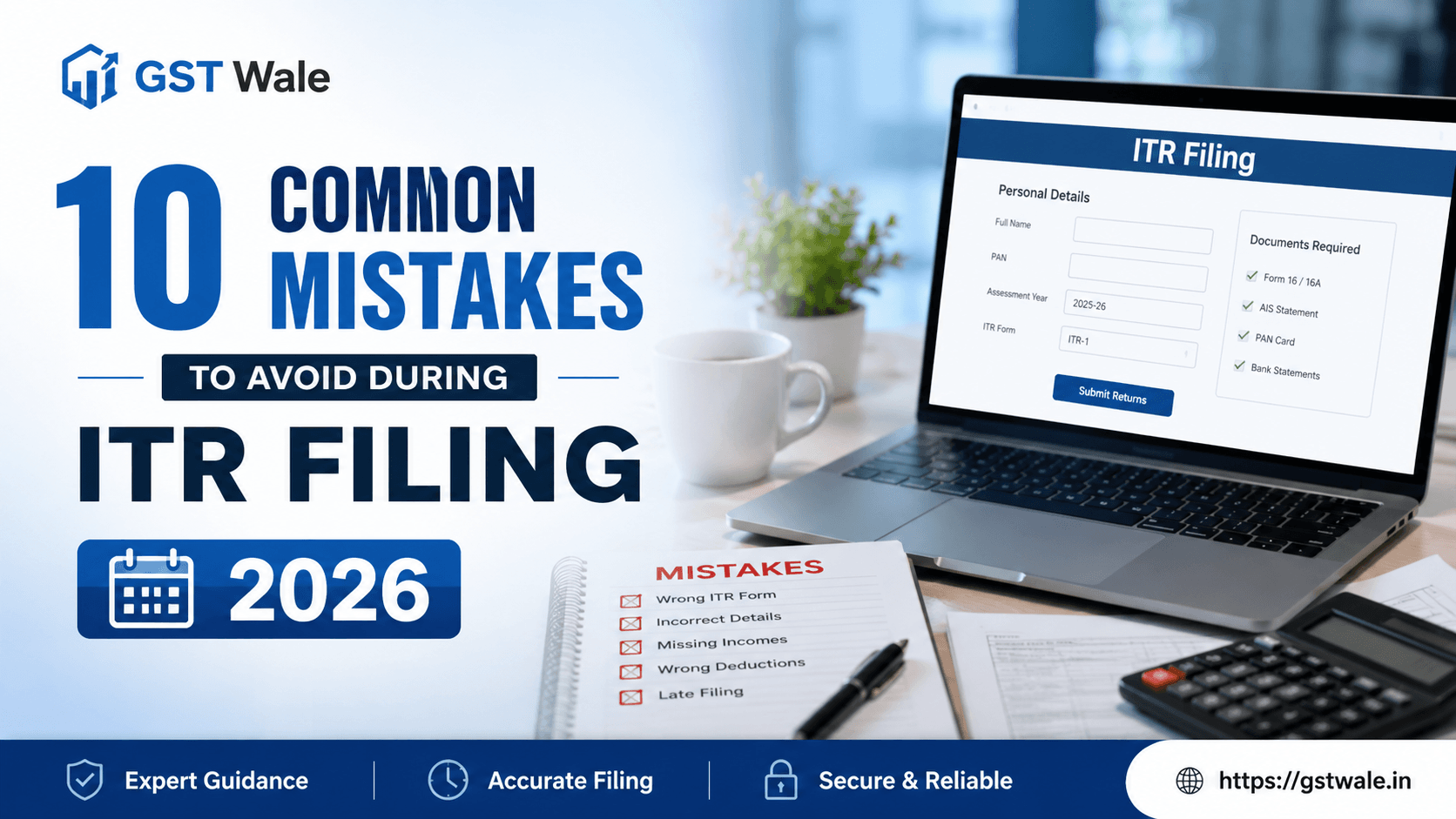
10 Common Mistakes to Avoid During ITR Filing in 2026
10 Common Mistakes to Avoid During ITR Filing in 2026
Every year, thousands of taxpayers in India end up receiving notices, paying unnecessary tax penalties, or delaying refunds because of small but avoidable mistakes during ITR Filing. Whether you are a salaried employee, freelancer, business owner, or professional, filing your income tax return correctly is just as important as filing it on time.
At GST Wale, we regularly help individuals and businesses correct income tax return mistakes that could have easily been avoided with proper planning and attention. From mismatched income details to choosing the wrong return form, even a minor error can create major complications later.
If you are planning your ITR Filing for Assessment Year 2026-27, this guide will help you understand the most common mistakes taxpayers make and how you can avoid them confidently.
Why Accurate ITR Filing Matters in 2026
The Income Tax Department has become much stricter and more technology-driven in recent years. With tools like the AIS form, TIS summary, and data matching systems on the e-filing portal, the department can easily detect mismatches or hidden income.
Incorrect ITR Filing may lead to:
- Delayed refunds
- Income tax notices
- Additional tax liability
- Tax penalties and interest
- Problems during loan approvals or visa applications
- Increased scrutiny or tax audit risks
That is why accurate and timely filing is essential.
1. Choosing the Wrong ITR Form
One of the most common income tax return mistakes is selecting the incorrect ITR form.
Different taxpayers must use different forms based on their income source:
- ITR-1 for salaried individuals with simple income
- ITR-3 for business or professional income
- ITR-4 for presumptive taxation
- ITR-2 for capital gains or multiple house properties
Practical Example
A freelancer mistakenly files ITR-1 instead of ITR-3. The return may get defective status, leading to notices and correction procedures later.
Expert Advice from GST Wale
Always verify your income sources before starting your ITR Filing process.
2. Ignoring AIS Form and TIS Summary
The AIS form (Annual Information Statement) and TIS summary (Taxpayer Information Summary) are extremely important for accurate filing.
These reports contain details such as:
- Salary income
- Bank interest
- Stock market transactions
- Mutual fund investments
- TDS deductions
- Foreign remittances
Many taxpayers ignore these documents and file returns only based on Form 16.
Why This Creates Problems
If your declared income does not match the AIS form or TIS summary, the Income Tax Department may issue a notice.
What You Should Do
Before final submission:
- Download AIS form
- Review TIS summary
- Match all entries carefully
- Report discrepancies if required
3. Not Reporting All Sources of Income
Many individuals believe only salary income must be disclosed. This is incorrect.
During ITR Filing, you must report all taxable income, including:
- Savings account interest
- Fixed deposit interest
- Rental income
- Freelance income
- Capital gains
- Dividend income
Common Real-Life Situation
A salaried employee earns ₹18,000 annual FD interest but forgets to include it. The bank already reported this transaction to the department, leading to mismatch issues later.
GST Wale’s Recommendation
Maintain a yearly income checklist before filing returns.
4. Claiming Incorrect Deductions
Wrong deduction claims can attract scrutiny and tax penalties.
Commonly misused deductions include:
- Section 80C
- Section 80D
- Home loan deductions
- HRA exemption
Frequent Mistakes
- Claiming deductions without proof
- Double claiming investments
- Incorrect HRA calculations
- Claiming personal expenses as business expenses
Best Practice
Keep proper supporting documents ready before ITR Filing.
5. Filing Returns After the Deadline
Late filing is one of the costliest income tax return mistakes.
Consequences include:
- Late filing fees
- Interest on tax due
- Delayed refunds
- Loss adjustment restrictions
- Higher compliance scrutiny
Why Taxpayers Delay Filing
- Waiting for Form 16
- Lack of documentation
- Confusion regarding tax regime
- Last-minute rush on the e-filing portal
Professional Tip
Start preparing your documents at least 30–45 days before the due date.
6. Forgetting to Verify the Return
Many taxpayers complete the filing process but forget the final verification step.
Your ITR Filing is considered incomplete unless verified.
Verification Methods
- Aadhaar OTP
- Net banking
- Bank account validation
- Physical ITR-V submission
Important Point
If the return is not verified within the prescribed time, it becomes invalid.
7. Entering Incorrect Bank Details
Incorrect bank information can delay your refund significantly.
Common Errors
- Wrong account number
- Incorrect IFSC code
- Inactive bank account
- Unvalidated account on e-filing portal
GST Wale Advice
Always double-check:
- Refund bank account
- IFSC code
- Pre-validation status
before final submission.
8. Ignoring Advance Tax Liability
Freelancers, consultants, traders, and business owners often forget advance tax payments.
If your annual tax liability exceeds ₹10,000, advance tax rules may apply.
What Happens If Ignored
You may face:
- Interest under Sections 234B and 234C
- Additional tax burden
- Unnecessary financial stress
Who Should Be Careful
- Self-employed professionals
- Stock market traders
- Rental income earners
- High-income freelancers
Proper tax planning makes ITR Filing smoother and more affordable.
9. Mismatch Between TDS and Income Details
Another major reason for notices is mismatch between TDS records and reported income.
Example
Your Form 26AS shows TDS deducted on professional receipts, but that income is missing from the return.
This creates immediate red flags for the department.
How to Avoid This
Before submitting your ITR Filing:
- Match Form 26AS
- Verify AIS form
- Reconcile salary and TDS entries
- Check bank interest reporting
10. Not Maintaining Proper Documentation
Many taxpayers file returns casually without maintaining records.
This becomes risky during:
- Scrutiny cases
- Tax audit proceedings
- Loan applications
- Future assessments
Documents You Should Keep
- Form 16
- Investment proofs
- Rent receipts
- Bank statements
- Capital gain statements
- GST records for businesses
- Expense invoices
Recommended Retention Period
Maintain records for at least 6 years.
Important Tips for Smooth ITR Filing in 2026
Here are some practical steps we recommend at GST Wale:
Create a Tax Folder
Store all financial documents digitally in one place.
Reconcile Income Monthly
Avoid year-end confusion by tracking income regularly.
Use Trusted Professionals
Professional guidance reduces the risk of costly mistakes.
Don’t Wait Until the Last Date
Heavy traffic on the e-filing portal can create technical issues near deadlines.
Review Before Submission
Take 15 minutes to cross-check every detail carefully.
FAQs on ITR Filing
What happens if I make mistakes during ITR Filing?
You may receive notices, face tax penalties, or experience refund delays. Some mistakes can also trigger scrutiny.
Can I revise my ITR after submission?
Yes, the Income Tax Department allows revised returns within the permitted timeline.
Is AIS form mandatory for ITR Filing?
While not separately mandatory, checking the AIS form is highly recommended to avoid mismatches.
Who is required to undergo tax audit?
Businesses and professionals crossing specified turnover or income limits may require a tax audit under the Income Tax Act.
What is the penalty for late ITR Filing?
Late filing fees can go up to ₹5,000 along with interest on unpaid taxes.
Accurate ITR Filing is no longer just a yearly compliance activity. It plays a major role in your financial credibility, tax planning, and long-term peace of mind. Even small income tax return mistakes can lead to notices, delayed refunds, and unnecessary tax penalties.
By carefully reviewing your AIS form, TIS summary, deductions, bank details, and income disclosures, you can avoid most common filing errors. Proper planning and timely action make the entire process much easier.
At GST Wale, we help individuals, professionals, startups, and businesses complete their ITR Filing accurately and stress-free. Our experienced tax experts ensure proper compliance, maximum eligible deductions, and complete support throughout the filing process.
If you want error-free tax filing assistance in 2026, connect with GST Wale today and file your return with confidence.
 Previous