


What Should You Do If You Paid Tax in the Wrong Head in GST R 3 B?
What Should You Do If You Paid Tax in the Wrong Head in GST R 3 B?
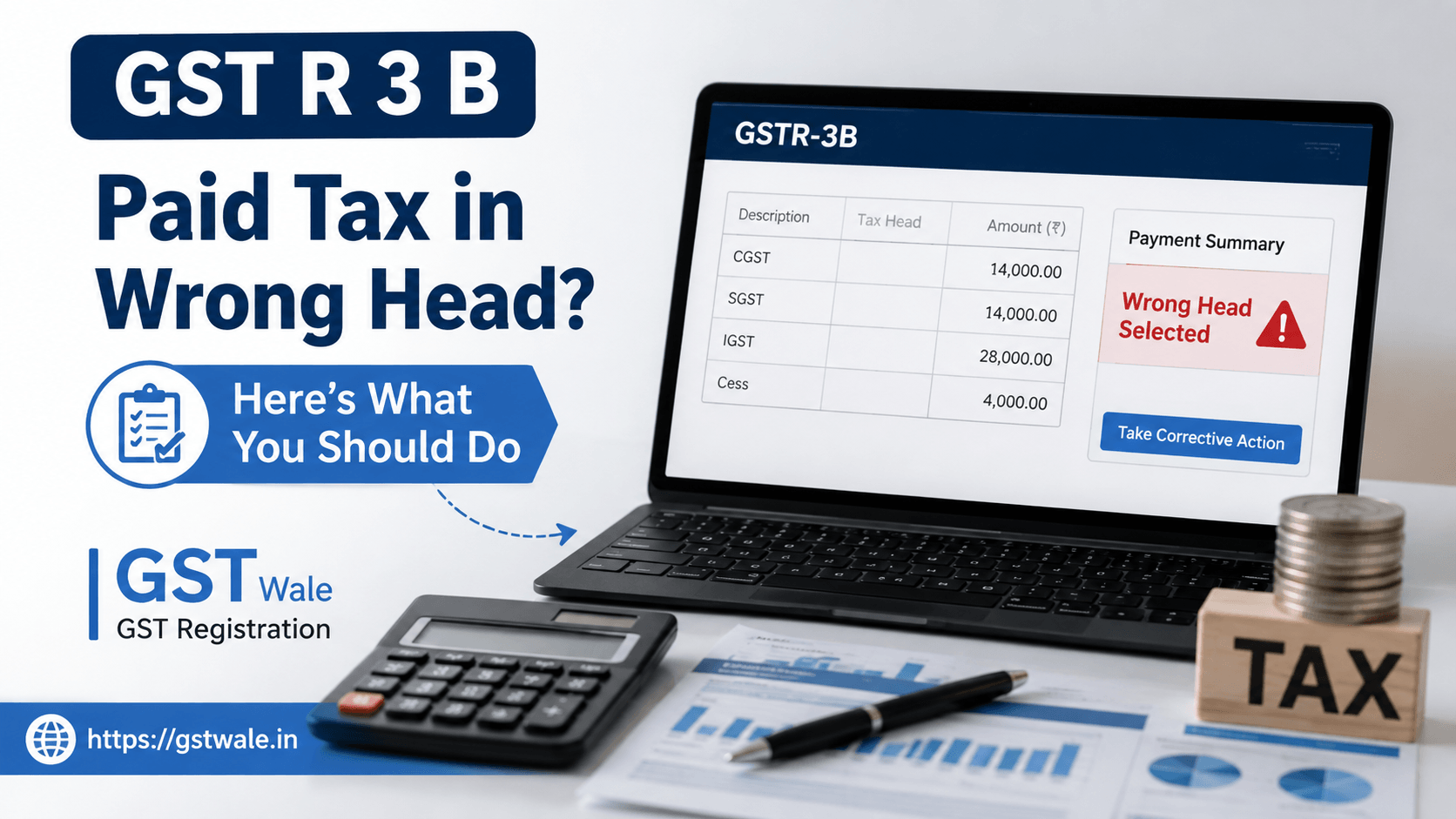
Paying GST under the wrong tax head in gst r 3 b is more common than many businesses realise. A taxpayer may accidentally pay CGST instead of IGST, SGST instead of CGST, or select the wrong minor head while creating a challan. The good news is that such an error does not automatically mean your money is lost. However, you need to take the right corrective steps and maintain proper records.
If you are handling GST compliance for your business, accurate GST Registration and regular reconciliation of your GST ledgers can prevent many such problems. At GST Wale, we often see businesses confuse tax liability with the tax head under which the payment was made. Understanding the correction mechanism can save you unnecessary cash-flow pressure and compliance complications.
What Happens When You Pay GST Under the Wrong Head?
The GST system maintains separate electronic ledgers for different tax components. When you make a payment, the amount gets credited to the relevant head in your electronic cash ledger.
For example, suppose your actual liability is:
- IGST: ₹50,000
- CGST: ₹25,000
- SGST: ₹25,000
Instead, you accidentally deposit ₹50,000 under CGST. The money is sitting in your cash ledger, but it may not be available for payment of the IGST liability in the manner you intended.
This is where gst r 3 b reconciliation becomes important. Filing the return without identifying the mismatch can make your books and GST records difficult to reconcile later.
Can You Transfer the Amount to the Correct GST Head?
Yes, in many cases, an amount lying in the electronic cash ledger can be transferred between tax heads using Form PMT-09, subject to the applicable GST rules.
This is particularly useful when you have made a payment under the wrong head but the amount is still available in the electronic cash ledger.
Understanding PMT-09
Form PMT-09 is used for transferring an amount from one head of the electronic cash ledger to another. For example, if CGST was deposited instead of IGST, eligible balance can potentially be shifted from CGST to IGST through this mechanism.
A practical pmt 09 form guide should always begin with checking the exact balance available in the electronic cash ledger and identifying the correct tax head before making the transfer.
Do not simply assume that every wrong payment can be moved through PMT-09. The nature of the payment, the ledger in which it appears, and the applicable provisions should be checked carefully.
Step-by-Step Process for Correcting Wrong Tax Payment
Step 1: Check Your Electronic Cash Ledger
Log in to the GST portal and examine your electronic cash ledger. Identify exactly where the payment has been credited.
Check:
- IGST balance
- CGST balance
- SGST/UTGST balance
- Applicable interest or penalty balances
This is the first step in electronic cash ledger correction.
Step 2: Compare the Payment With Your GST R 3 B Liability
Next, compare the cash ledger with the liability reported or payable through gst r 3 b.
For example, if your IGST liability is ₹40,000 but ₹40,000 was accidentally deposited under CGST, you need to identify the mismatch before filing or paying the relevant liability.
Step 3: Use PMT-09 Where Applicable
If the amount is eligible for transfer, file Form PMT-09 through the GST portal.
The transfer should clearly reflect the movement from the incorrect head to the appropriate head. This is commonly referred to as shifting balance CGST to IGST, although the same principle can apply to other permitted ledger transfers.
Step 4: Recheck the Ledger
After submitting the correction, verify whether the balance has moved correctly.
This step is important because portal ledger balancing should not be based only on your accounting software. Always compare your books, challans, electronic cash ledger and return liability.
Step 5: Pay Any Remaining Liability
If the correction does not fully cover your liability, deposit the remaining amount under the correct head.
For instance, if you owe ₹60,000 IGST but only ₹40,000 can be transferred from another eligible head, the remaining ₹20,000 should be paid correctly.
What If the Tax Was Already Utilised?
The situation becomes more complicated if the wrongly paid amount has already been utilised, or if the mistake relates to tax actually paid under the wrong tax category rather than merely an unused cash-ledger balance.
In such cases, do not make assumptions based on another taxpayer's experience. Review the return, payment challan, liability register and relevant GST provisions.
A gst r 3 b mistake involving actual tax liability may require a different remedy from a simple cash-ledger transfer.
What About Refund of Wrongly Paid Tax?
Businesses sometimes consider applying for a refund of wrongly paid tax. Whether a refund is appropriate depends on the facts of the case.
If the amount is simply sitting in the electronic cash ledger under an incorrect head and can legally be transferred, using the permitted ledger correction mechanism may be more practical than immediately seeking a refund.
However, if the amount cannot be transferred and the circumstances satisfy the applicable refund provisions, a refund application may need to be considered.
The important point is to establish exactly what went wrong before choosing the remedy.
Common Mistakes Businesses Should Avoid
Do Not Ignore the Difference
A small mismatch in gst r 3 b may become difficult to explain later if it remains unreconciled across multiple tax periods.
Do Not Pay Twice Without Checking
Some businesses discover that tax was paid under the wrong head and immediately make another payment under the correct head. This can unnecessarily block working capital.
First check whether the original amount can be corrected or transferred.
Do Not Depend Only on Accounting Software
Your accounting software may show the tax liability correctly, but the GST portal records the actual payment and ledger position. Both must be reconciled.
Keep Supporting Documents
Keep copies of challans, payment confirmations, ledger screenshots, workings and return reconciliation records. These documents can be valuable if the transaction is questioned later.
A Practical Example
Suppose ABC Traders has an IGST liability of ₹75,000 for a particular month. While making the GST payment before filing gst r 3 b, the accountant accidentally deposits ₹75,000 under CGST.
The accountant notices the mistake before finalising the payment of the return. The first action should be to check whether the ₹75,000 remains available in the electronic cash ledger.
If eligible, the business can consider PMT-09 to transfer the amount from the incorrect head to the appropriate head. After the transfer, the accountant should verify the updated ledger and reconcile it with the gst r 3 b liability.
This simple reconciliation can prevent unnecessary duplicate payment and cash-flow disruption.
When Should You Consult a GST Professional?
Professional advice becomes especially useful when:
- The wrong payment relates to a previous tax period.
- The amount has already been utilised.
- The tax head involves multiple components.
- Interest or late fees are involved.
- A refund may be required.
- There is a mismatch between books and GST portal records.
- A notice has already been received from the department.
A CA or GST professional can examine the complete transaction instead of treating the issue as just a payment error.
Frequently Asked Questions
Can PMT-09 correct every wrong GST payment?
No. PMT-09 is meant for eligible transfers within the electronic cash ledger. It should not be treated as a universal solution for every GST payment or tax-classification mistake.
Can I shift balance from CGST to IGST?
In eligible circumstances, an amount available in the electronic cash ledger may be transferred between permitted heads through the prescribed mechanism. This is why shifting balance CGST to IGST should be checked against the current GST rules before taking action.
Is a refund always required for wrong payment?
No. If the amount can be appropriately transferred within the electronic cash ledger, a refund may not be necessary. A refund of wrongly paid tax should be considered based on the specific facts and applicable provisions.
What should I check before filing GST R 3 B?
Check your sales data, input tax credit, tax liability, challans, electronic cash ledger and electronic credit ledger. Proper reconciliation before filing gst r 3 b can identify errors before they create bigger problems.
Can GST Wale help with such GST issues?
Yes. GST Wale can help businesses understand their GST compliance requirements, reconcile portal balances and take appropriate corrective steps based on the nature of the error.
Paying tax under the wrong head does not necessarily mean that you have lost the money. The key is to identify the mistake quickly, check the electronic cash ledger, reconcile the amount with your gst r 3 b liability and use the appropriate correction mechanism where permitted.
Whether the solution involves PMT-09, additional payment, refund procedures or another corrective action, do not rely on guesswork. Proper documentation and portal ledger balancing are essential for clean GST records.
At GST Wale, we believe GST compliance should be practical and understandable. If you are facing a wrong-head payment, return mismatch or other gst r 3 b issue, get professional guidance before making another payment or filing a correction. Proper action today can prevent unnecessary financial and compliance complications tomorrow.
 Previous