


GST Registration vs Composition Scheme: Which is Better?
GST Registration vs Composition Scheme: Which is Better?
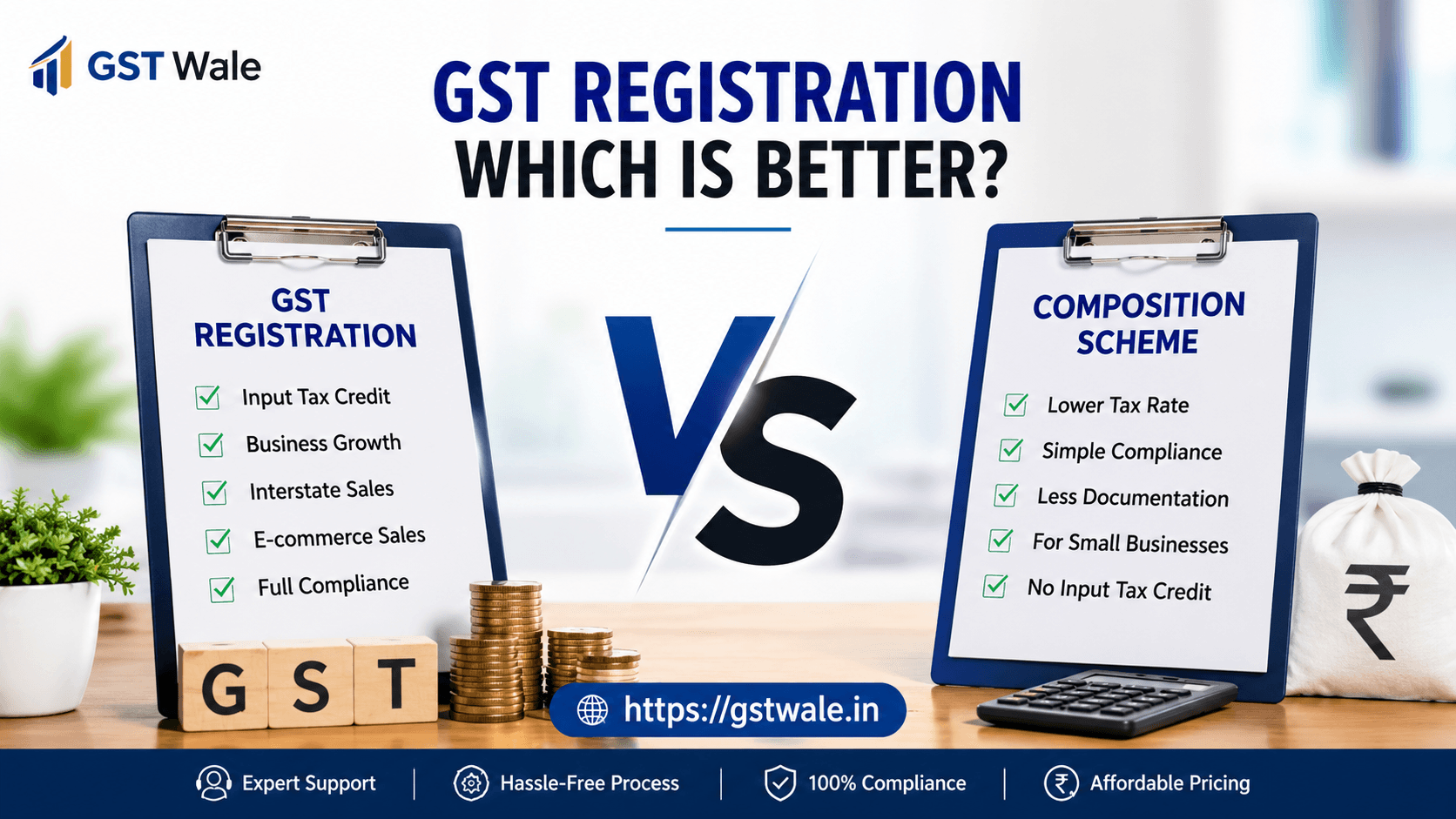
Choosing the right GST structure is one of the most important decisions for any business in India. Many small business owners often get confused between regular GST Registration and the Composition Scheme. Both options come with different compliance requirements, tax rates, and benefits.
At GST Wale, we regularly guide traders, manufacturers, freelancers, startups, and service providers who struggle to decide which GST setup is better for their business. While regular GST Registration offers wider business flexibility and input tax credit benefits, the composition scheme is designed to reduce compliance for small taxpayers.
If you are planning to apply for GST Registration, understanding these two schemes properly can help you avoid future tax and compliance issues.
In this article, we will explain the complete difference between composition vs regular GST, their advantages, disadvantages, eligibility, and which option is suitable for your business.
What is GST Registration?
GST Registration is the process through which a business becomes legally registered under Goods and Services Tax (GST) laws in India. Once registered, the business receives a GSTIN (Goods and Services Tax Identification Number).
A business generally requires GST Registration if:
- Annual turnover exceeds the prescribed limit
- It sells goods or services interstate
- It operates through e-commerce platforms
- It wants to claim Input Tax Credit (ITC)
- It deals with GST-compliant businesses
Regular GST Registration allows businesses to collect GST from customers and claim tax credits on purchases.
What is the GST Composition Scheme?
The gst composition scheme india is a simplified taxation scheme introduced for small taxpayers. It reduces compliance burden and allows businesses to pay GST at a fixed percentage of turnover.
Instead of filing multiple detailed GST returns, composition dealers file simpler returns and pay tax at lower rates.
However, businesses under the composition scheme cannot:
- Claim Input Tax Credit
- Collect GST separately from customers
- Make interstate taxable supplies
- Sell through e-commerce operators in many cases
This scheme is mainly suitable for local businesses with smaller turnover.
GST Registration vs Composition Scheme: Major Differences
Eligibility Criteria
Regular GST Registration
Any eligible business can opt for regular GST Registration regardless of turnover if it wants full GST benefits.
Composition Scheme
The composition scheme is available only for eligible small taxpayers whose turnover remains within prescribed limits.
Generally:
- Traders and manufacturers can opt subject to turnover conditions
- Some service providers are also eligible under specific rules
Businesses involved in interstate sales are usually not eligible.
GST Scheme Comparison: Tax Rates
Tax Rates Under Regular GST Registration
Under regular GST Registration, businesses charge GST according to the applicable slab:
- 5%
- 12%
- 18%
- 28%
Businesses can also claim Input Tax Credit on purchases.
Tax Rates Under Composition Scheme
Under the gst composition scheme india, lower fixed tax rates apply on turnover:
- Traders: Around 1%
- Manufacturers: Around 1%
- Restaurants: Around 5%
- Certain service providers: Around 6%
These rates may vary depending on government notifications.
Input Tax Credit (ITC) Difference
Benefit Under Regular GST Registration
One of the biggest advantages of regular GST Registration is Input Tax Credit.
Suppose:
- You purchase raw material worth ₹1 lakh plus GST
- You can claim the GST paid as credit
This reduces your final tax liability significantly.
No ITC in Composition Scheme
Composition dealers cannot claim ITC. This often increases actual business costs, especially for businesses with high purchase expenses.
For example:
- A wholesaler purchasing goods with heavy GST may lose substantial credit benefits under composition.
Compliance Requirements
Compliance Under Regular GST Registration
Businesses with regular GST Registration must:
- File monthly or quarterly GST returns
- Maintain detailed records
- Generate proper tax invoices
- Reconcile purchase and sales data
Compliance is comparatively higher.
Compliance Under Composition Scheme
The composition scheme is simpler because:
- Fewer returns are required
- Record-keeping is easier
- Tax payment process is simplified
This makes it attractive for small shopkeepers and local traders.
Composition vs Regular GST: Which is Better for Small Businesses?
The answer depends entirely on your business model.
Choose Regular GST Registration If:
- You deal in interstate sales
- Your customers are businesses claiming ITC
- You want long-term business growth
- You sell on Amazon, Flipkart, or other platforms
- You have high input costs
- You want better market credibility
Choose Composition Scheme If:
- You run a small local shop
- Your customers are mostly end consumers
- You want minimal compliance
- Your turnover is limited
- You do not require ITC benefits
Real-World Example
Let us understand this with a practical example.
Example 1: Local Grocery Store
A grocery store in Noida with annual turnover of ₹35 lakh sells mainly to local consumers.
In this case:
- Composition scheme may work well
- Compliance remains low
- Customers usually do not ask for GST invoices
Example 2: B2B Manufacturing Unit
A small manufacturing company supplying goods across multiple states may benefit more from regular GST Registration because:
- Buyers prefer GST invoices
- ITC benefits become important
- Interstate sales require regular registration
This is where proper gst scheme comparison becomes essential before making a decision.
Advantages of Regular GST Registration
Better Business Expansion
Regular GST Registration supports interstate business growth and large-scale operations.
Input Tax Credit Benefits
Businesses save money through ITC claims.
Improved Business Credibility
Many corporate clients prefer working with GST-registered vendors.
E-commerce Selling Allowed
Regular GST Registration enables businesses to sell online easily.
Advantages of Composition Scheme
Lower Compliance Burden
Small taxpayers can avoid complicated filing procedures.
Reduced Tax Rates
Lower tax rates help certain businesses save money.
Easier Accounting
Simplified records and invoicing reduce administrative workload.
Disadvantages of Composition Scheme
While attractive for small taxpayers, the composition scheme has limitations.
No Input Tax Credit
This can reduce profitability.
Limited Business Growth
Interstate sales restrictions can impact expansion.
Not Preferred in B2B Markets
Business clients often prefer suppliers with regular GST Registration.
GST for Small Taxpayers: Important Decision Factors
Before selecting between gst tax options india, consider:
- Nature of customers (B2B or B2C)
- Business expansion plans
- Turnover size
- Purchase expenses
- Compliance handling capability
- Need for Input Tax Credit
Many businesses initially choose the composition scheme and later shift to regular GST Registration as they grow.
Common Mistakes Businesses Make
Choosing Composition Only for Lower Tax
Many businesses ignore ITC losses and later regret the decision.
Ignoring Future Expansion
Businesses planning interstate sales should avoid composition from the beginning.
Incorrect Eligibility Understanding
Some businesses opt for the composition scheme despite being ineligible, leading to penalties.
Proper professional guidance helps avoid such mistakes.
FAQs
Is GST Registration mandatory for all businesses?
No. GST Registration becomes mandatory only when turnover crosses prescribed limits or specific conditions apply.
Can I switch from composition scheme to regular GST Registration?
Yes. Businesses can shift from composition to regular GST Registration if needed.
Can composition dealers issue GST invoices?
No. Composition dealers cannot collect GST separately from customers.
Which option is better for service providers?
It depends on turnover, customer type, and ITC requirements. Many growing service providers prefer regular GST Registration.
Is composition scheme beneficial for online sellers?
Generally, online sellers require regular GST Registration because e-commerce sales often do not qualify under composition rules.
Choosing between regular GST Registration and the composition scheme is not simply about lower tax rates. The right decision depends on your business model, customer base, growth plans, and compliance capacity.
For businesses aiming for long-term expansion, interstate trade, and Input Tax Credit benefits, regular GST Registration is usually the better option. On the other hand, small local businesses with limited turnover may find the composition scheme more practical.
At GST Wale, we help businesses make the right GST decisions based on real financial and operational requirements. Whether you are starting a new business, switching schemes, or facing GST compliance confusion, our experts can guide you at every step.
 Previous