


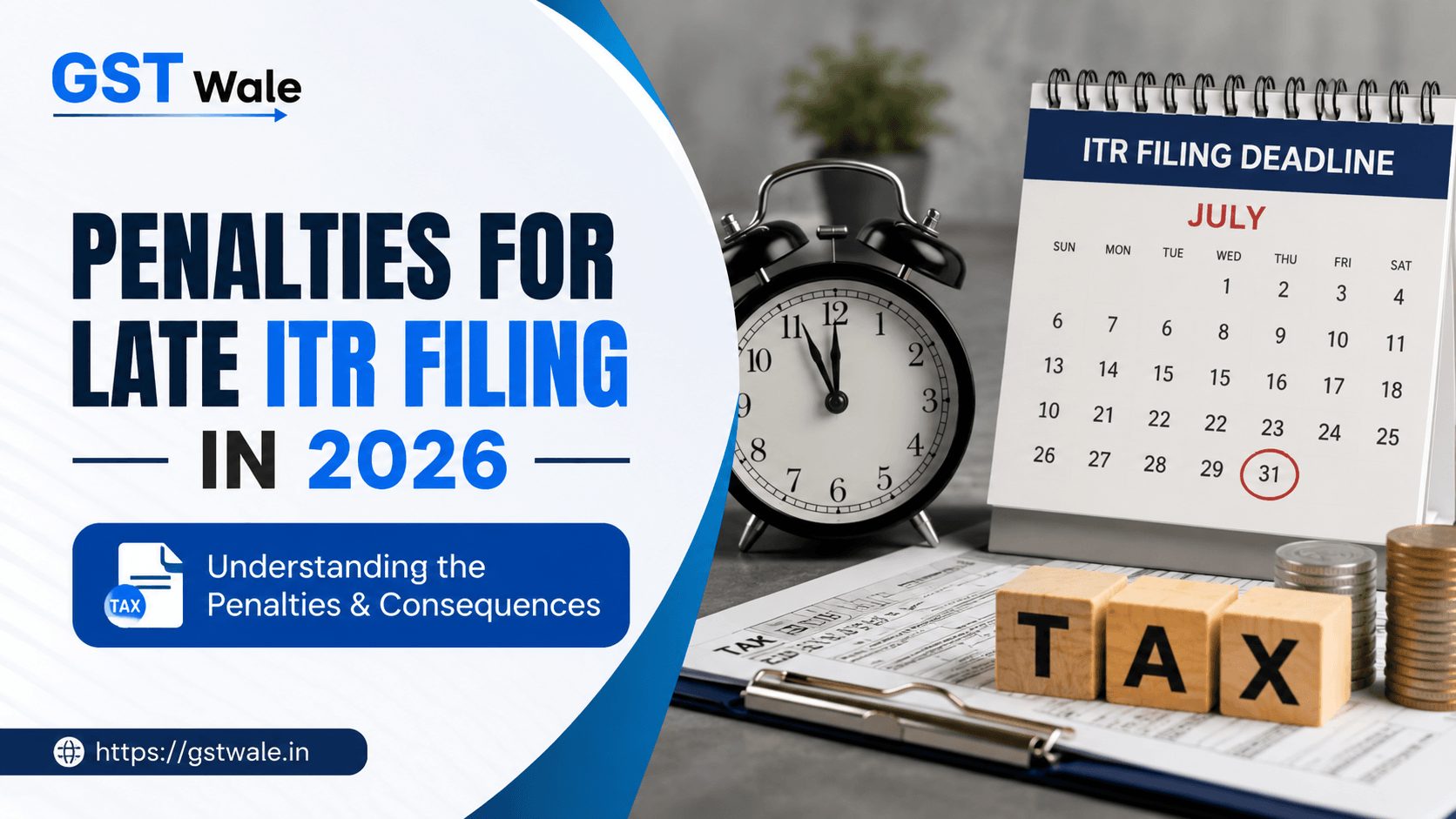
Understanding the Penalties for Late ITR Filing in 2026
Understanding the Penalties for Late ITR Filing in 2026
Every year, millions of taxpayers in India scramble to meet the income tax return deadline — and every year, thousands end up paying a price they simply didn't have to. If you've been putting off your ITR Filing, it's time to understand exactly what's at stake in 2026. At GST Wale, we work with salaried individuals, freelancers, and business owners every single day, and the number one question we get after July 31 is: "I missed the deadline — now what do I do?" This guide will walk you through everything you need to know about the penalties, interest, and consequences of late ITR filing — in plain, honest language.
Why the ITR Filing Deadline Matters More Than Ever
The Income Tax Department has tightened its compliance framework significantly over the past few years. With PAN-Aadhaar linking, AIS (Annual Information Statement) tracking, and digital cross-checking of financial transactions, the taxman knows a lot more about your income than you might think. Missing the ITR filing deadline is not just a paperwork issue anymore — it can trigger penalties, interest, and in some cases, legal notices.
For Assessment Year 2026-27, the standard deadline for individuals and entities not subject to audit is July 31, 2026. Businesses requiring a tax audit have until October 31, 2026. Marking these dates in your calendar is step one. Everything else is damage control.
What is a Belated Return — and Is It the Same as a Revised Return?
These two terms confuse a lot of people, so let's clear it up right away.
Belated Return
A belated return is filed after the original due date has passed but within the extended window — typically December 31 of the assessment year. So if you missed July 31, 2026, you can still file a belated return by December 31, 2026. However, this comes with its own set of penalties and restrictions, which we'll cover in detail below.
Revised Return
A revised return is filed when you've already submitted your return on time but later realized there was an error or omission. The good news is that a revised return can be filed without any additional penalty, as long as it's filed before December 31 of the assessment year or before assessment is completed — whichever is earlier.
GST Wale Tip: If you made a genuine mistake in your original return, always file a revised return. Don't ignore errors — they can attract scrutiny notices later.
Section 234F: The Late Fee You Cannot Escape
This is the big one. Section 234F of the Income Tax Act, 1961 prescribes a mandatory late fee for delayed ITR filing. It's not a penalty that can be waived at the discretion of an officer — it is calculated automatically by the system at the time of filing.
How Much is the Late Fee Under Section 234F?
| Filing Date | Total Income Above ₹5 Lakh | Total Income Up to ₹5 Lakh |
|---|---|---|
| After July 31, 2026 but before December 31, 2026 | ₹5,000 | ₹1,000 |
| After December 31, 2026 | ₹10,000 | ₹1,000 (capped) |
| If total income is below exemption limit | Nil (No late fee) | |
So if you're a salaried professional earning ₹8 lakh per year and you file your return in November 2026 instead of July, you're looking at a ₹5,000 hit — just for being late. Wait until January 2027 and that doubles to ₹10,000. It adds up fast.
Tax Interest: Section 234A, 234B, and 234C
Beyond the late fee, the Income Tax Department also levies tax interest on unpaid or underpaid taxes. There are three key provisions here:
Section 234A — Interest on Late Filing
If you have any tax liability outstanding at the time of filing (i.e., you didn't pay your self-assessment tax in full), then Section 234A kicks in. It charges 1% interest per month (or part of a month) from the due date of filing until the date of actual filing. This interest is calculated on the amount of tax remaining unpaid.
Section 234B — Interest for Default in Advance Tax
If your total tax liability exceeds ₹10,000 and you haven't paid at least 90% of it as advance tax during the financial year, Section 234B applies. The interest rate is again 1% per month on the shortfall, from April 1 of the assessment year until the date of assessment or payment — whichever comes first.
Section 234C — Deferment of Advance Tax Instalments
This applies when advance tax instalments are not paid in the correct percentages by the due dates (15th June, 15th September, 15th December, and 15th March). Each instalment shortfall attracts interest at 1% per month for a specified period.
Real-World Example: Rajesh, a 34-year-old freelance consultant in Pune, had a tax liability of ₹60,000 for FY 2025-26. He skipped advance tax entirely and filed his return only in October 2026. By then, he owed not just the ₹60,000 tax but also roughly ₹4,800 under Section 234B and an additional ₹3,000 under Section 234A — plus the ₹5,000 late fee under Section 234F. His total outgo jumped to nearly ₹73,000. A timely filing would have saved him over ₹8,000.
Other Consequences of Missing the ITR Filing Deadline
The financial penalties are painful, but the non-financial consequences can be equally troublesome. Here's what else you stand to lose:
Loss of Carry Forward of Losses
This is one that most people miss. If you have capital losses or business losses that you want to carry forward to offset future income, you must file your return on time. A belated return does not allow the carry forward of losses (except for losses from house property). So if you incurred a ₹2 lakh loss in the stock market this year and missed the July 31 deadline, that loss is gone — you cannot offset it against future gains.
Delayed Refunds
If TDS has been deducted on your income and you're eligible for a refund, filing late means your refund gets processed later. Moreover, if there is a delay attributable to the taxpayer, the interest on refund under Section 244A may not apply, costing you additional money.
Prosecution in Extreme Cases
In cases of wilful tax evasion or deliberate non-filing, the Income Tax Act provides for prosecution under Section 276CC. While this is an extreme measure and typically reserved for significant tax evasion, it's important to be aware of the legal framework. Continued non-compliance is never taken lightly.
What About a Deadline Extension in 2026?
Every year, taxpayers hope for a deadline extension — and sometimes the government does grant one, usually due to technical glitches on the IT portal or other extraordinary circumstances. However, it is never guaranteed. In recent years, the Income Tax Department has become increasingly strict about maintaining deadlines, and the e-filing portal has significantly improved.
At GST Wale, our advice is simple: never bank on an extension. Start your ITR filing process at least 3–4 weeks before the due date, gather your Form 16, AIS, bank statements, and investment proofs well in advance, and file early. If there is an extension, consider it a bonus — not a plan.
Step-by-Step: What to Do If You've Already Missed the Deadline
If you've realised you've missed July 31, don't panic. Here's what you should do:
- Assess your liability: Calculate your total tax payable after accounting for TDS, advance tax already paid, and deductions you're eligible for.
- Pay self-assessment tax: If there's any tax outstanding, pay it immediately via Challan 280. The sooner you pay, the less interest accrues.
- File the belated return: Log in to the Income Tax e-filing portal (www.incometax.gov.in), select the correct ITR form, and file your return with the applicable late fee.
- Don't inflate deductions: A belated return is not the place to make aggressive claims. Stick to what's documented and verifiable.
- Keep proof of filing: Download and save your ITR-V acknowledgement immediately after filing.
- E-verify within 30 days: An unverified return is treated as if it was never filed. Verify via net banking, Aadhaar OTP, or send the physical ITR-V to CPC, Bengaluru.
How GST Wale Makes ITR Filing Simple and Stress-Free
At GST Wale, we believe that tax compliance shouldn't feel like a punishment. Our team of qualified CAs and tax experts handles ITR filing for individuals, freelancers, salaried employees, HUFs, and small businesses across India. Whether you're filing on time or catching up on a missed deadline, we make the process fast, accurate, and affordable.
We help you:
- Identify the correct ITR form for your income type
- Maximize legitimate deductions under 80C, 80D, HRA, and more
- Calculate and pay advance tax on time to avoid interest
- File belated or revised returns with proper disclosures
- Respond to income tax notices with confidence
Frequently Asked Questions (FAQs)
Q1. What is the maximum late fee I have to pay under Section 234F in 2026?
If your total income exceeds ₹5 lakh, the maximum late fee is ₹10,000 if you file after December 31, 2026. If your income is ₹5 lakh or below, the late fee is capped at ₹1,000 regardless of when you file the belated return.
Q2. Can I still claim deductions in a belated return?
Yes, most deductions under Chapter VI-A (like 80C, 80D, 80G) can still be claimed in a belated return. However, you cannot carry forward most losses — particularly business losses and capital losses — if you file after the original due date.
Q3. Is a revised return the same as a belated return?
No. A revised return is filed to correct errors in an already-filed return and attracts no penalty. A belated return is filed after the original deadline and attracts a late fee under Section 234F. A belated return can also be revised, but only within the permitted time window.
Q4. Will I get interest on my refund even if I filed late?
Generally, Section 244A provides interest on refunds, but this may be restricted or adjusted if the delay in filing is on the taxpayer's part. Filing on time ensures you get the maximum benefit of refund interest, wherever applicable.
Q5. What happens if I don't file my ITR at all?
Non-filing can attract a penalty under Section 271F of up to ₹10,000, in addition to interest on outstanding taxes. More seriously, repeated non-compliance can trigger income tax notices, best judgment assessments by the Assessing Officer, and in severe cases of wilful evasion, prosecution under Section 276CC. It's simply not worth the risk.
Don't Let Procrastination Cost You More
Late ITR filing is one of the most avoidable financial mistakes you can make. Between the Section 234F late fee, interest under Sections 234A, 234B, and 234C, and the loss of carry-forward benefits, the true cost of delay can be significantly higher than people anticipate. In 2026, with the Income Tax Department's robust digital infrastructure tracking financial activity more precisely than ever, staying compliant is not just smart — it's essential.
At GST Wale, we've helped thousands of taxpayers across India file their returns accurately and on time, saving them both money and stress. Whether you're filing for the first time or trying to clean up a missed deadline, our experts are ready to guide you every step of the way.
 Previous