


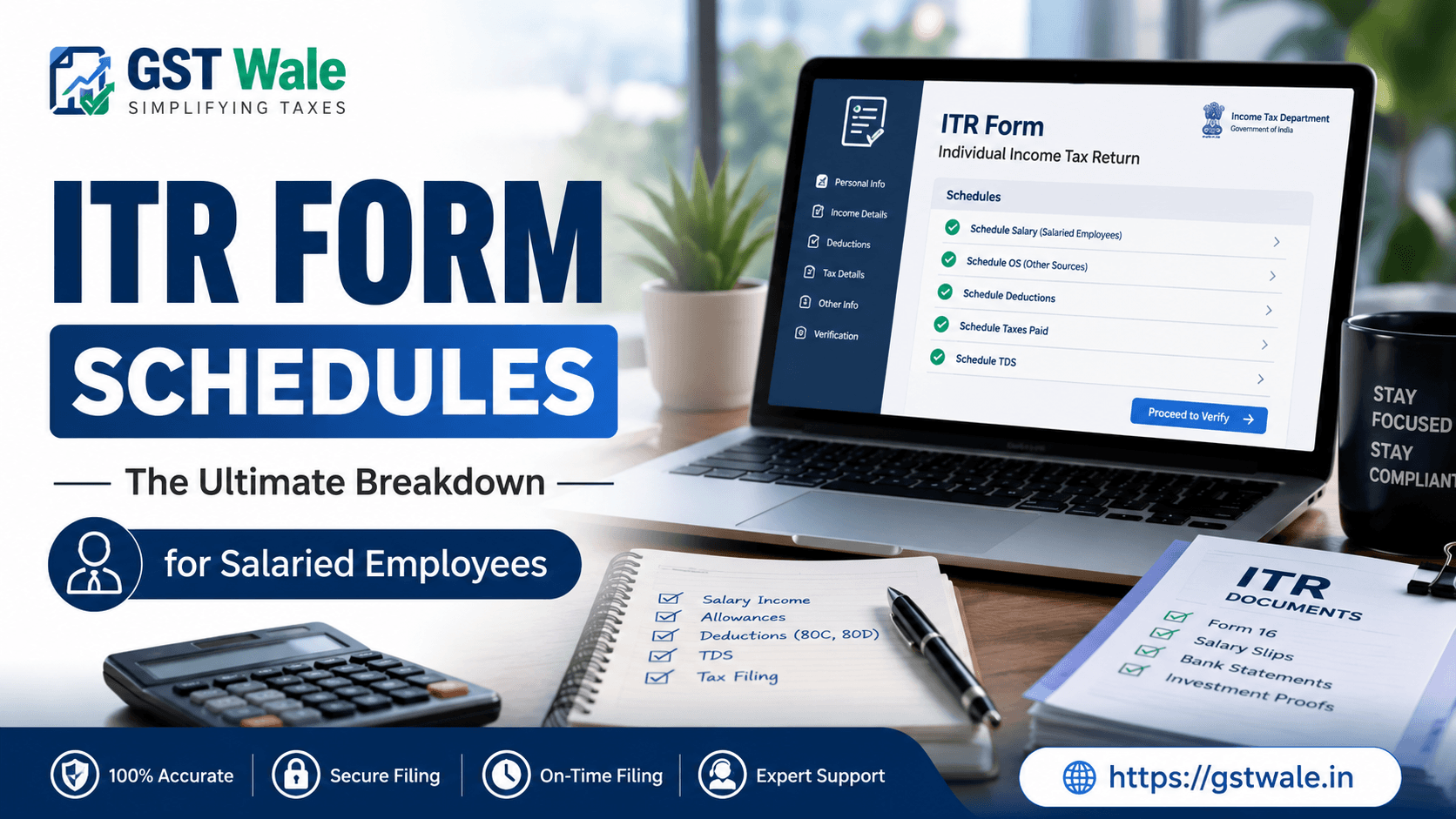
The Ultimate Breakdown of ITR Form Schedules for Salaried Employees
The Ultimate Breakdown of ITR Form Schedules for Salaried Employees
Selecting the right itr form can feel like trying to solve a complex puzzle, especially when you are balancing a full-time job and personal finances. Every year, millions of taxpayers get intimidated by the sheer volume of schedules, but it doesn’t have to be this way. At GST Wale, we believe that understanding your taxes is the first step toward financial freedom, which is why our team of experts provides professional ITR Filing services to ensure you remain compliant and claim every benefit you deserve. Whether you are doing it yourself or seeking assistance, knowing the nuances of the itr form is essential for a smooth assessment year.
Why Understanding Your ITR Form Matters
Many salaried employees make the mistake of simply uploading their Form 16 and clicking submit. While that might work for some, it often leads to missed deductions or, worse, notices from the Income Tax Department. The income tax return form is not just a government requirement; it is a declaration of your financial health.
When you file income tax return online, you are essentially telling the government exactly how much you earned and how much you have already paid in taxes. If the schedules are not mapped correctly, you might end up paying more than necessary.
Which ITR Form is for You?
For most salaried employees in India, the two most common forms are ITR-1 and ITR-2.
ITR-1 (Sahaj): This is for individuals with income from salary, one house property, and other sources (like interest) having a total income up to ₹50 lakh.
ITR-2: This is for those who have capital gains, own more than one house property, or hold directorships in companies.
If your financial situation has evolved, choosing the correct itr form is the first step in successful it filing.
A Breakdown of Key Schedules
Once you start the process to file it returns online, you will encounter various schedules. Let’s break down the most important ones for salaried taxpayers.
Schedule Salary (Salary Details)
This is where you report your gross salary, allowances, and perquisites. Most of this data is pre-filled, but it is your responsibility to verify it against your Form 16. If there are discrepancies, you must correct them before you file income tax return online.
Schedule HP (House Property)
If you are paying an EMI on a home loan, this schedule is your best friend. You can claim deductions under Section 24(b) for interest paid on housing loans. Even if you have let out your property, you need to report the rental income here.
Schedule OS (Income from Other Sources)
Don’t forget this section! Many people forget to report bank interest or dividend income. This schedule captures all income that doesn't fit into the "Salary" or "House Property" buckets. Accurate disclosure here prevents unnecessary scrutiny during it filing.
Schedule VI-A (Deductions)
This is where the magic happens. This schedule lists all the deductions you are claiming under Chapter VI-A, such as:
Section 80C (PPF, LIC, ELSS)
Section 80D (Health Insurance)
Section 80E (Education Loan Interest)
Section 80G (Donations)
Common Mistakes When Filling the ITR Form
Even experienced professionals can make mistakes. As a CA, here are the most frequent blunders I see:
Ignoring Exempt Income: Many taxpayers think they don't need to report tax-free income (like some dividends or maturity proceeds). Always disclose them in the appropriate section of your itr form.
Mismatched TDS: Ensure the TDS mentioned in your itr form matches exactly with what is reflected in your Form 26AS or AIS/TIS.
Last-Minute Rush: Trying to file it returns online at 11 PM on the due date is a recipe for disaster. Data entry errors are most common when you are in a hurry.
Frequently Asked Questions
Is it mandatory to disclose all bank accounts in the itr form?
Yes. Even if you have an account that you rarely use, the Income Tax Department requires you to list all active savings and current accounts in India, excluding dormant ones.
Can I change my itr form after submission?
If you realize you made a mistake, you can file a 'Revised Return' under Section 139(5). However, it is always better to get it right the first time to avoid the administrative hassle.
What happens if I file the wrong itr form?
If you file the wrong form, your return may be treated as "defective." The department will send you a notice, and you will have 15 days to file a revised return using the correct itr form.
Do I need to attach documents like Form 16 to the portal?
No, the Indian tax system is paperless. You do not need to attach documents, but you must keep them safe for at least 6–8 years in case of future inquiries.
Tax filing doesn't have to be a nightmare. By understanding the structure of your itr form and staying organized throughout the year, you can ensure a stress-free tax season. Remember, the goal of every it filing is to be compliant while optimizing your tax liability legally.
If you find the process overwhelming or simply don't have the time to navigate complex schedules, the team at GST Wale is here to help. We take the complexity out of your taxes so you can focus on what you do best. Reach out to us today and let us handle your itr form with the professional care it requires!
 Previous