


The Impact of Digital Assets on Your Income Tax 2026 Returns
The Impact of Digital Assets on Your Income Tax 2026 Returns
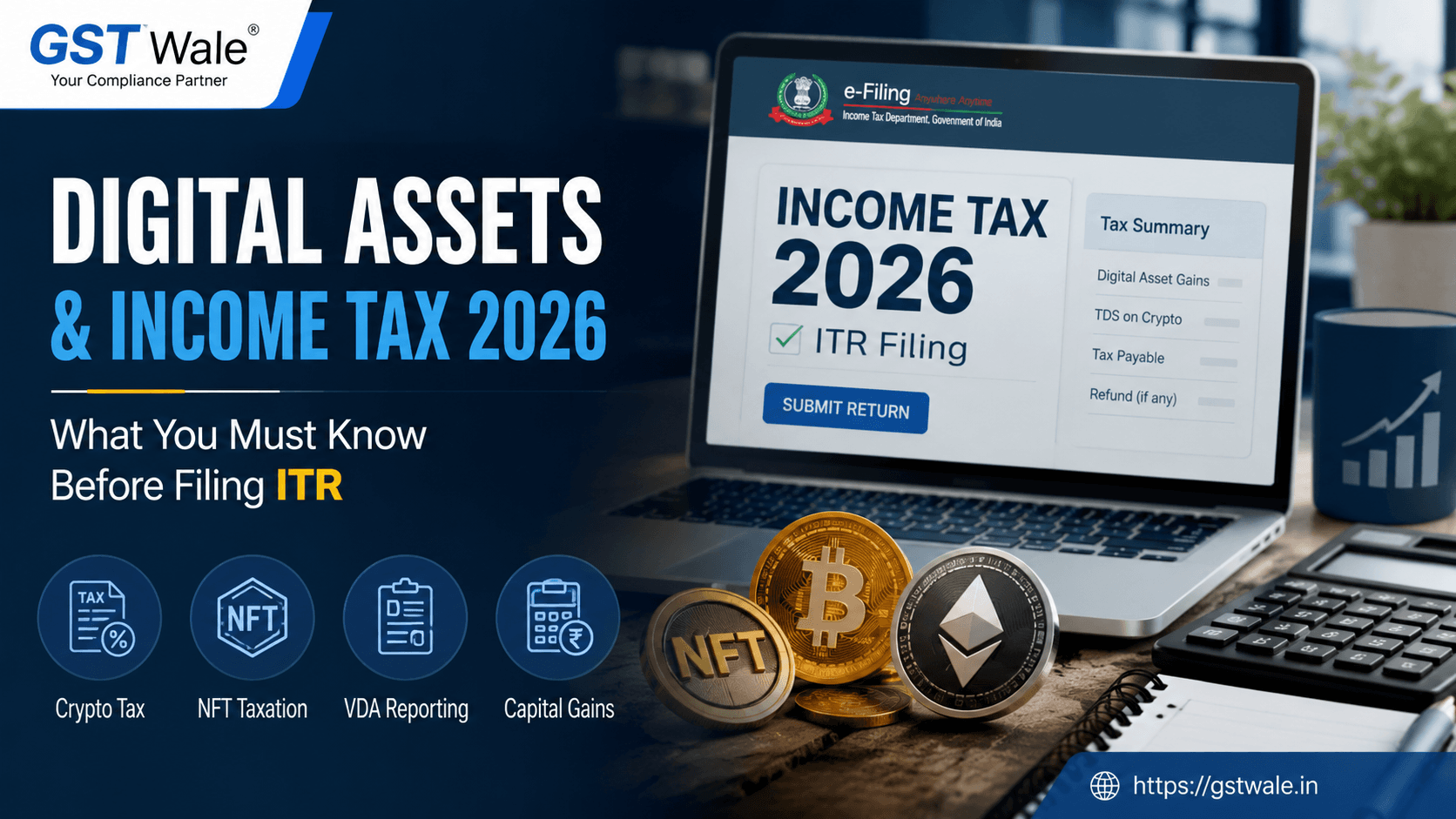
Digital assets are no longer limited to tech enthusiasts and crypto traders. Today, many Indian investors, freelancers, gamers, and business owners are dealing with cryptocurrencies, NFTs, and other blockchain assets in some form. As tax laws evolve, understanding how these investments impact your Income Tax 2026 returns has become extremely important.
At GST Wale, we are seeing a sharp increase in taxpayers receiving notices simply because they failed to report digital asset transactions properly. Whether you earn profits through crypto trading, NFT sales, staking rewards, or token transfers, the Income Tax Department now tracks these transactions more closely than ever before.
If you are planning your ITR Filing, this guide will help you understand the latest tax implications of digital assets and how to stay compliant under Income Tax 2026.
Understanding Digital Assets Under Income Tax 2026
Under Indian tax law, digital assets are classified as Virtual Digital Assets (VDAs). This includes:
- Cryptocurrencies like Bitcoin and Ethereum
- NFTs (Non-Fungible Tokens)
- Digital tokens
- Certain blockchain-based assets
- Crypto rewards and staking income
The government introduced specific tax rules for these assets, and those rules continue to play a major role in Income Tax 2026 filings.
Many taxpayers wrongly assume crypto income is anonymous or untraceable. In reality, exchanges now maintain transaction records, and authorities can access this data when required.
How Crypto Tax Works in India
Flat 30% Tax on Gains
One of the biggest aspects of Income Tax 2026 is the taxation of crypto profits. Any income arising from the transfer of virtual digital assets is taxed at a flat 30%.
This applies to:
- Selling cryptocurrency at profit
- Swapping one crypto for another
- Selling NFTs
- Redeeming tokens
For example, if you purchased Bitcoin for ₹2 lakh and sold it for ₹3 lakh, your ₹1 lakh gain is taxable at 30%, plus applicable surcharge and cess.
No Deduction Except Cost of Acquisition
A common mistake taxpayers make during Income Tax 2026 filing is claiming deductions against crypto profits.
Under current rules:
- Only purchase cost is allowed as deduction
- No deduction for internet bills, advisory fees, mining costs, or platform charges
- Losses cannot be adjusted against salary, business income, or other capital gains
This makes crypto tax treatment stricter compared to traditional investments.
TDS on Crypto Transactions
Understanding 1% TDS Rule
The government introduced TDS on crypto to improve transaction tracking. Under this provision, 1% TDS is deducted on certain digital asset transfers beyond prescribed limits.
This directly impacts Income Tax 2026 because many taxpayers forget to reconcile TDS entries with their actual crypto income.
Suppose you sold crypto worth ₹5 lakh through an exchange. The platform may deduct ₹5,000 as TDS before releasing payment.
You should:
- Verify TDS entries in Form 26AS
- Match exchange records
- Report correct VDA income in your return
Failure to reconcile these details may trigger scrutiny notices.
Why TDS Reconciliation Matters
At GST Wale, we often notice taxpayers underreporting transactions because they rely only on bank statements.
However, the Income Tax Department compares:
- Exchange transaction reports
- PAN-linked TDS records
- Reported VDA income
Mismatch can create compliance issues during Income Tax 2026 assessments.
NFT Taxation in Income Tax 2026
NFTs Are Also Taxable
NFT taxation is another area gaining attention. Many creators, artists, and investors are unaware that NFT sales are taxable under VDA rules.
If you sell an NFT at profit:
- The gain is taxed at 30%
- TDS provisions may apply
- Reporting in ITR becomes mandatory
Even creators receiving payment in crypto for digital artwork must disclose such earnings.
Example of NFT Taxation
Consider a graphic designer who creates and sells NFTs internationally. If they receive ₹4 lakh in Ethereum for NFT sales, this income becomes taxable in India.
Depending on the nature of activity, the income may fall under:
- Business income
- Income from transfer of VDAs
Proper classification is essential for accurate Income Tax 2026 filing.
VDA Reporting Requirements in Income Tax 2026
Disclosure Is Mandatory
The Income Tax Department has strengthened VDA reporting requirements. Taxpayers must now disclose digital asset transactions separately in income tax returns.
This includes:
- Purchase value
- Sale value
- Date of transfer
- Nature of digital asset
- Income earned
Incomplete disclosure may attract notices or penalties.
Common Reporting Mistakes
Many taxpayers make these errors while filing Income Tax 2026 returns:
- Ignoring small crypto trades
- Not reporting foreign exchange wallets
- Missing NFT transactions
- Incorrect calculation of gains
- Forgetting peer-to-peer transfers
Even inactive traders should maintain proper records.
Capital Gains vs Business Income
How Classification Impacts Taxation
One important issue in Income Tax 2026 is whether crypto income should be treated as capital gains or business income.
Generally:
- Occasional investors may classify gains as capital gains
- Frequent traders may fall under business income
However, since VDAs have special tax provisions, both categories effectively face similar tax rates in many cases.
Still, classification affects:
- Audit applicability
- Return forms
- Compliance requirements
Real-World Example
A salaried employee investing occasionally in Bitcoin may report gains differently from a person doing daily crypto trading as a full-time activity.
At GST Wale, we recommend maintaining:
- Trading history
- Wallet records
- Exchange statements
- Investment purpose documentation
These records become useful if authorities question transaction nature during Income Tax 2026 scrutiny.
Taxation of Foreign Crypto Exchanges
Foreign Holdings Must Be Reported
Many Indians use overseas exchanges for crypto investments. A major misconception is that foreign exchanges escape Indian taxation.
Under Income Tax 2026:
- Global income is taxable for Indian residents
- Foreign digital assets may require disclosure
- Foreign account reporting rules can apply
Failure to disclose overseas blockchain assets can create serious compliance risks.
Importance of Proper Documentation
Keep records of:
- Wallet addresses
- Exchange statements
- Transaction screenshots
- Conversion rates
- Transfer receipts
These help calculate accurate tax liability.
How to Calculate Crypto Tax Correctly
Step-by-Step Process
To simplify your Income Tax 2026 compliance:
- Download transaction history from all exchanges
- Segregate purchases and sales
- Calculate gains for each transfer
- Deduct eligible purchase cost
- Verify TDS deductions
- Report income under VDA schedule
Professional calculation becomes important for active traders handling multiple transactions.
Penalties for Non-Disclosure
Consequences of Incorrect Filing
Ignoring digital asset reporting can lead to:
- Income tax notices
- Interest and penalties
- Reassessment proceedings
- Increased scrutiny in future years
The government is increasingly using technology and data analytics to identify unreported crypto income.
Under Income Tax 2026, transparency is the safest approach.
Practical Tips for Taxpayers
Maintain Proper Records
Always preserve:
- Exchange invoices
- Wallet transaction IDs
- Bank entries
- TDS certificates
- Purchase proofs
Avoid Last-Minute Filing
Crypto tax calculations can take time, especially for high-frequency traders.
Consult Professionals
Digital asset taxation is evolving rapidly. Professional guidance helps avoid costly mistakes.
At GST Wale, we assist taxpayers in accurate VDA reporting, crypto tax computation, and Income Tax 2026 compliance.
FAQs on Income Tax 2026 and Digital Assets
Is crypto income taxable even if I do not withdraw money to my bank account?
Yes. Even crypto-to-crypto transfers may attract tax implications under Income Tax 2026.
Can crypto losses be adjusted against salary income?
No. Current provisions do not allow adjustment of VDA losses against other income heads.
Is NFT income taxable in India?
Yes. NFT taxation falls under virtual digital asset provisions.
Do I need to report small crypto transactions?
Yes. Even small transactions should be disclosed properly in Income Tax 2026 returns.
What happens if I fail to disclose crypto income?
You may receive notices, penalties, or reassessment proceedings from the Income Tax Department.
Digital assets have transformed modern investing, but they have also introduced complex tax responsibilities. Whether you trade cryptocurrencies, invest in NFTs, or hold blockchain assets abroad, proper reporting is essential for smooth Income Tax 2026 compliance.
Ignoring crypto tax rules or incomplete VDA reporting can create unnecessary legal and financial complications later. The best strategy is to maintain accurate records, understand applicable tax provisions, and seek expert guidance when needed.
At GST Wale, our experienced tax professionals help individuals, traders, freelancers, and businesses handle Income Tax 2026 filings with complete accuracy and compliance. If you want stress-free tax filing and expert support for digital asset taxation, connect with GST Wale today.
 Previous