


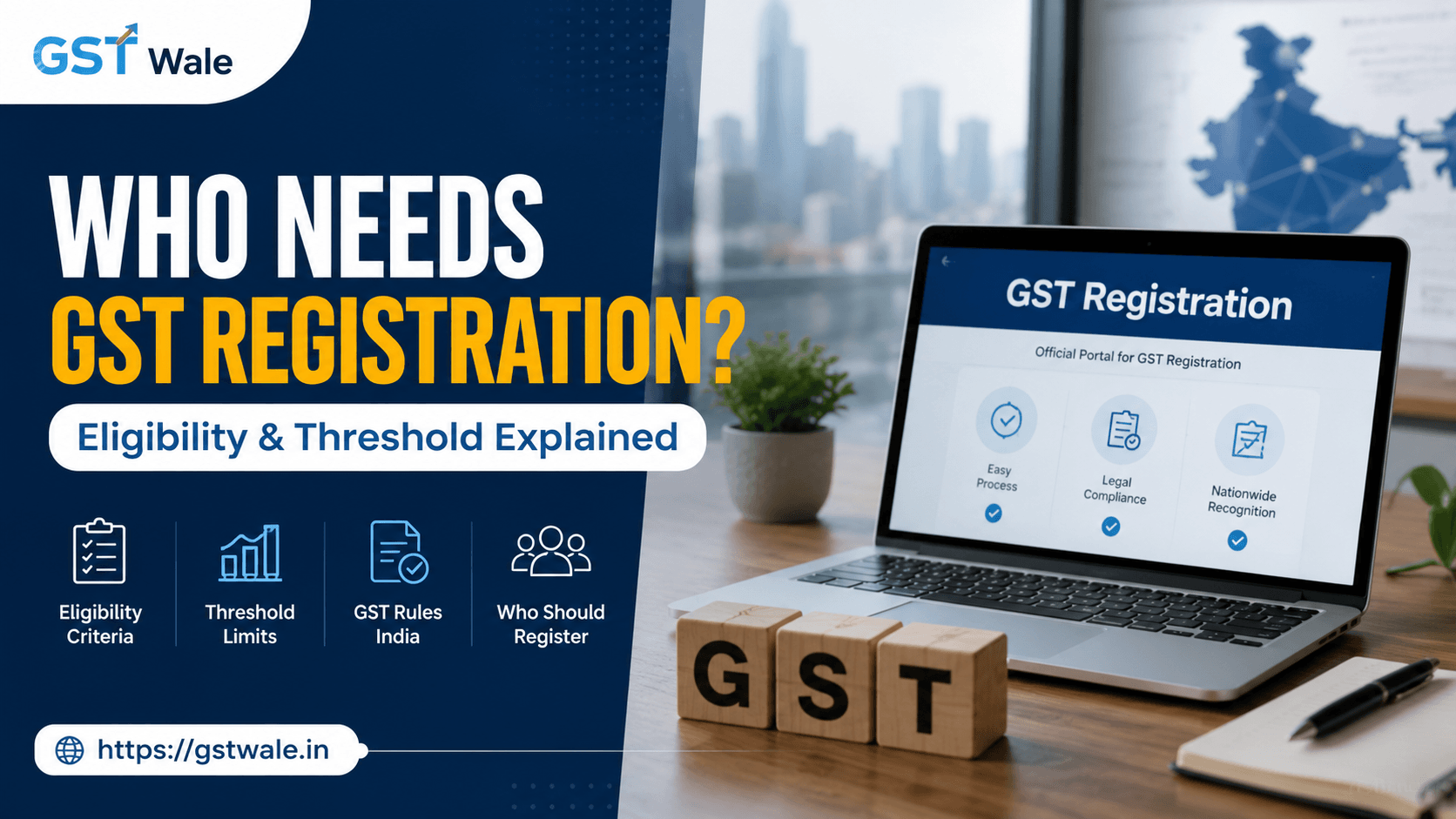
Who Needs GST Registration in India? Eligibility & Threshold Explained
Who Needs GST Registration in India? Eligibility & Threshold Explained
If you are running a business in India, understanding GST Registration is no longer optional. Whether you are a freelancer, trader, startup founder, online seller, or service provider, knowing the GST rules can save you from penalties and compliance issues later.
Many business owners still ask questions like — Who should register GST?, What is the GST threshold limit in India?, or Is GST mandatory for small businesses? The answer depends on your turnover, business type, and the nature of transactions you undertake.
At GST Wale, we regularly help businesses understand their GST obligations and complete their GST Registration process smoothly without unnecessary delays. In this article, we will explain GST registration eligibility, threshold limits, applicability rules, and practical examples in simple language.
What is GST Registration?
GST Registration is the process through which a business becomes registered under the Goods and Services Tax (GST) system in India. Once registered, the business receives a unique GSTIN (Goods and Services Tax Identification Number) from the government.
A registered business can:
- Collect GST from customers
- Claim Input Tax Credit (ITC)
- Issue GST-compliant invoices
- Legally sell goods and services across India
Without proper GST Registration, businesses may face penalties, restrictions, and difficulties in dealing with vendors or large clients.
Who Needs GST Registration in India?
One of the most important aspects of GST applicability India is identifying whether your business falls under mandatory registration criteria.
Here are the categories of people and businesses who should register GST.
GST Threshold Limit India Explained
The government has prescribed turnover-based limits for GST Registration.
For Goods Businesses
Businesses dealing in goods must register if their annual turnover exceeds:
- ₹40 lakh in most states
- ₹20 lakh in special category states
For Service Providers
Service providers must obtain GST Registration if annual turnover exceeds:
- ₹20 lakh in most states
- ₹10 lakh in special category states
These turnover limits are known as the GST threshold limit India.
Businesses That Must Register for GST Regardless of Turnover
In certain situations, GST Registration becomes compulsory even if your turnover is below the prescribed threshold.
Interstate Supply of Goods
If you sell goods from one state to another, GST Registration may become mandatory.
Example:
A Delhi-based clothing seller supplying products to customers in Maharashtra through courier services.
E-Commerce Sellers
If you sell products through platforms like:
- Amazon
- Flipkart
- Meesho
- Myntra
You generally need GST Registration irrespective of turnover.
This is one of the most common GST criteria India that small online sellers often ignore.
Casual Taxable Persons
Businesses participating in exhibitions, temporary stalls, or seasonal trade in another state may require temporary GST Registration.
Example:
- Trade fairs
- Festive stalls
- Temporary exhibitions
Input Service Distributors
Businesses distributing tax credits across branches need mandatory GST Registration under GST rules India.
Reverse Charge Mechanism (RCM) Cases
Certain notified businesses liable under reverse charge provisions may also require registration.
Non-Resident Taxable Persons
Foreign businesses supplying taxable goods or services in India must obtain GST Registration before starting operations.
GST Registration Eligibility for Freelancers and Professionals
Freelancers often believe GST applies only to companies. That is incorrect.
Freelancers providing:
- Digital marketing services
- Graphic designing
- Consultancy
- Software development
- Content writing
- Coaching services
must check their annual turnover carefully.
If turnover crosses the prescribed limit, GST Registration becomes mandatory.
Additionally, freelancers providing interstate services or exporting services may also need registration depending on business structure and compliance strategy.
GST Applicability India for Online Businesses
Online businesses are among the most affected categories under GST rules India.
Who Should Register GST in Online Business?
The following usually require GST Registration:
- E-commerce sellers
- Dropshippers
- Shopify store owners
- Amazon sellers
- Online service providers
- Digital product sellers
Even if profits are low, GST applicability India may still apply because many e-commerce platforms require GSTIN compulsorily.
GST Registration for Small Businesses
Many small businesses hesitate to apply due to fear of compliance.
However, voluntary GST Registration can actually benefit businesses.
Benefits of Voluntary GST Registration
- Better business credibility
- Ability to claim Input Tax Credit
- Easier vendor onboarding
- Improved chances of getting corporate clients
- Smooth interstate business operations
For startups and growing businesses, early GST Registration often creates long-term advantages.
Composition Scheme Under GST
Small taxpayers can also opt for the Composition Scheme if eligible.
Key Features
- Lower tax rates
- Reduced compliance
- Quarterly returns
- Simpler bookkeeping
Eligibility Conditions
Generally available for businesses with turnover up to prescribed limits under GST rules India.
However, composition dealers cannot:
- Claim Input Tax Credit
- Make interstate supplies
- Sell through certain e-commerce operators
This scheme is ideal for local traders and small restaurants.
Documents Required for GST Registration
To complete GST Registration smoothly, businesses usually need:
For Proprietorship
- PAN card
- Aadhaar card
- Business address proof
- Bank statement or cancelled cheque
- Photograph
For Companies or LLPs
- PAN of company
- Certificate of incorporation
- MOA/AOA
- Address proof
- Director details
- Bank proof
Having proper documentation speeds up approval significantly.
Step-by-Step GST Registration Process
Here is a simplified overview of the GST Registration process.
Step 1: Application Filing
Submit details on the GST portal.
Step 2: Document Upload
Upload identity and business documents.
Step 3: ARN Generation
Application Reference Number (ARN) is generated.
Step 4: Verification by Department
GST officer verifies documents.
Step 5: GSTIN Allotment
After approval, GSTIN is issued.
With proper guidance, the process usually becomes faster and hassle-free.
Penalty for Not Taking GST Registration
Ignoring GST registration eligibility can lead to penalties and notices.
Common Consequences
- Heavy penalties
- Interest liability
- Business restrictions
- Input Tax Credit denial
- Legal notices
Under GST rules India, non-compliance may attract penalties up to 10% of tax due or higher in fraud cases.
Common Mistakes Businesses Make
Many businesses unknowingly violate GST criteria India due to confusion.
Frequent Errors
- Ignoring interstate transactions
- Delaying registration after threshold crossing
- Wrong business category selection
- Using incorrect HSN/SAC codes
- Not filing returns after registration
Professional guidance helps avoid these costly mistakes.
FAQs on GST Registration
Is GST Registration mandatory for small businesses?
Not always. It depends on turnover, business type, and transaction nature under GST applicability India.
What is the GST threshold limit India for services?
For most states, service providers must register once annual turnover exceeds ₹20 lakh.
Can I apply for GST Registration voluntarily?
Yes. Even if turnover is below the threshold, businesses can voluntarily register under GST.
Who should register GST compulsorily?
E-commerce sellers, interstate suppliers, non-resident taxable persons, and certain notified businesses must register regardless of turnover.
How long does GST Registration take?
If documents are correct, GST Registration generally takes around 3–7 working days.
Understanding GST Registration is extremely important for every business owner in today’s competitive environment. Whether you are a freelancer, trader, startup, online seller, or service provider, knowing your GST registration eligibility helps you stay compliant and avoid unnecessary penalties.
The GST threshold limit India, interstate transaction rules, and e-commerce applicability often create confusion for businesses. That is why taking expert guidance becomes essential.
At GST Wale, we help businesses understand GST applicability India, complete registrations accurately, and stay fully compliant with the latest GST rules India. If you are unsure whether your business needs GST Registration, our experts can guide you with practical and professional support tailored to your business needs.
 Previous