


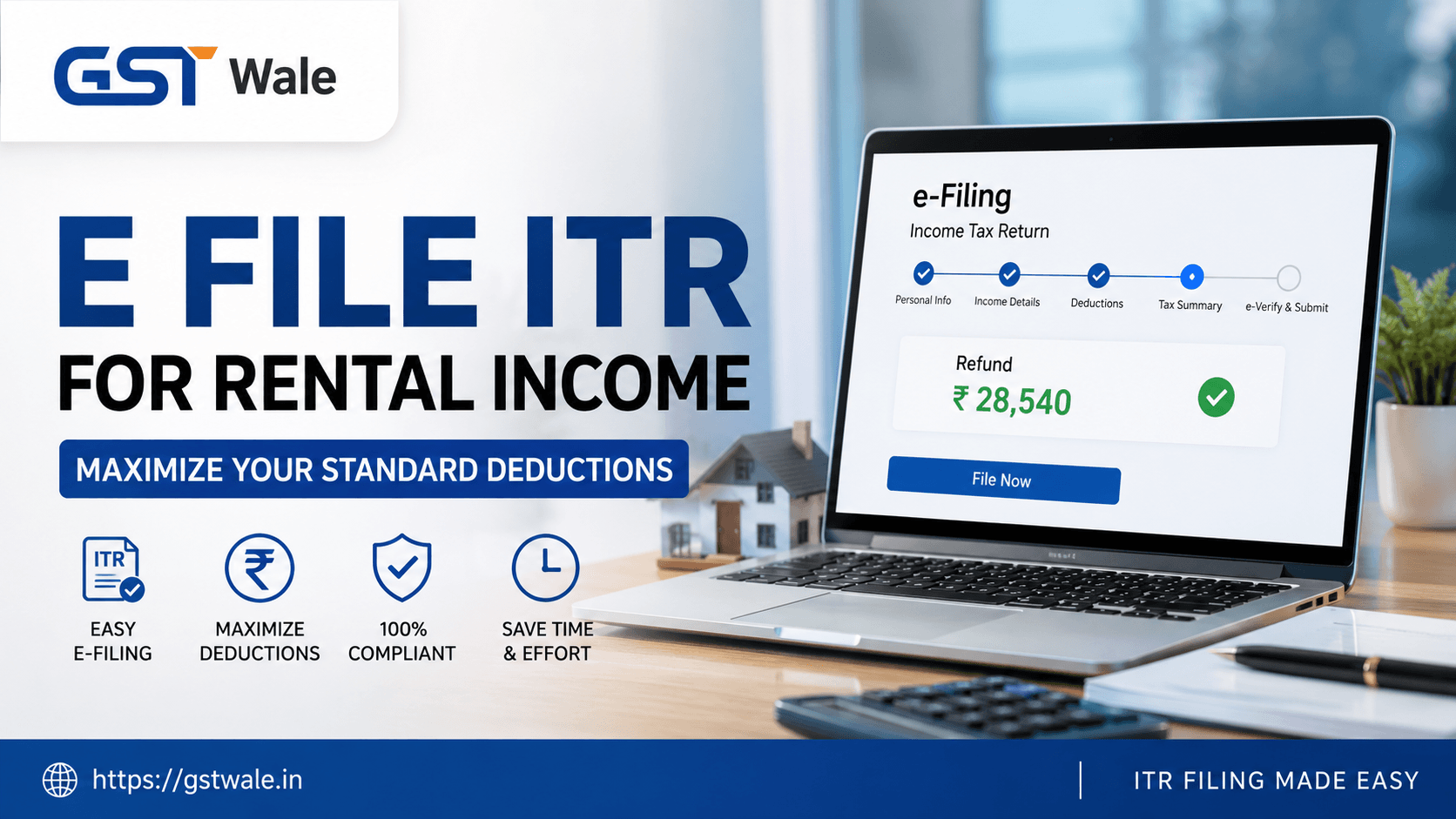
How to E File ITR for Rental Income: Maximize Your Standard Deductions
How to E File ITR for Rental Income: Maximize Your Standard Deductions
Earning a steady rental income from a commercial or residential property is one of the finest ways to build wealth in India. However, with consistent cash flow comes the responsibility of managing your taxes correctly. Many property owners lose a significant portion of their earnings simply because they do not know how to declare their earnings accurately or maximize the deductions available under the Income Tax Act.
When you sit down to e file ITR on the official Income Tax portal, understanding how your rental income is evaluated can save you thousands of rupees. In this expert guide, we will break down the process of reporting your house property income, navigating the specific rules for the current financial year, and utilizing legal deductions to keep your tax liability as low as possible.
Managing your tax portfolio does not have to be stressful. Whether you are handling rental earnings, capital gains, or business accounting, expert guidance can make all the difference. To ensure complete compliance and accurate reporting, you can easily outsource your annual filings through our dedicated service for ITR Filing, allowing our team of experienced Chartered Accountants to optimize your tax structure from start to finish.
Understanding House Property Income ITR Classifications
Before you initiate the process to e file ITR, you must understand how the Income Tax Department views your real estate assets. For tax purposes, property is divided into distinct categories under the head "Income from House Property":
Self-Occupied Property (SOP): A property occupied by the owner for their own residence. You can claim up to two properties as self-occupied, and their Gross Annual Value is considered 'Nil'.
Let-Out Property (LOP): A property that is actively rented out to tenants for all or part of the year. The actual rent received or receivable is taxable.
Deemed Let-Out Property (DLOP): If you own more than two residential properties, and the remaining properties are vacant (not self-occupied or rented), the law deems them to be rented out. You must calculate and pay tax on a hypothetical "notional rent" based on market values.
How to Calculate Taxable Rental Income
Taxable rental income is calculated using a clear, step-by-step formula. You do not pay tax on the gross amount your tenant transfers to your bank account; instead, you pay tax on the Net Annual Value (NAV) after accounting for allowable deductions.
1. Gross Annual Value (GAV)
This is the starting point of your rental income tax return. It is the higher of the actual rent received/receivable or the reasonable fair market rent that the property can fetch in that locality.
2. Subtracting Property Tax Deductions
You can deduct municipal taxes, sewage taxes, and property tax deductions from the GAV, but only if two conditions are met:
The taxes must have been paid during the exact financial year.
The taxes must be paid directly by you (the landlord), not by your tenant.
Maximize Deductions: Standard Deduction Section 24 Explained
Once you arrive at the Net Annual Value (NAV), the Income Tax Act provides two major relief measures under Section 24. These deductions are designed to lower your taxable shield legally.
The Flat 30% Standard Deduction Section 24(a)
The standard deduction Section 24 is a flat 30% deduction allowed on your Net Annual Value.
Expert Insight from GST Wale: This 30% deduction is a statutory allowance. It is granted irrespective of your actual expenditure on the property. Even if you spent zero rupees on painting, whitewashing, or plumbing repairs during the year, you are still legally entitled to claim the full 30% deduction to reduce your taxable income.
Full Interest on Home Loan Section 24(b)
If you took a housing loan to buy, construct, or renovate the property you are renting out, you can deduct the entire interest component paid during the financial year.
Under the Old Tax Regime: There is no upper limit on the amount of interest you can deduct for a let-out property. If your rental income is ₹4 Lakhs and your loan interest is ₹5 Lakhs, you can report a net loss of ₹1 Lakh from house property. This loss can be set off against other income heads like salary or business income (capped at ₹2 Lakhs per year).
Under the New Tax Regime: You can still claim the full home loan interest deduction against your rental income. However, if the interest exceeds the rent, creating a loss under house property, you cannot set off this loss against your salary or other income heads. It also cannot be carried forward to subsequent years.
Step-by-Step Guide to E File ITR for Rental Income
When preparing for your e-filing rent submission, following a structured process prevents processing delays and avoids notices from the Central Processing Centre (CPC).
Step 1: Gather Your Documents
Before logging into the portal, compile your rent agreements, rent receipts, bank statements showing credit entries, municipal tax receipts, and the interest certificate provided by your home loan lender.
Step 2: Choose the Correct ITR Form
Selecting the wrong ITR form can make your return defective.
ITR-1 (Sahaj): Can be used if you own a single house property (either self-occupied or let out) and your total income from all sources does not exceed ₹50 Lakhs.
ITR-2: Must be used if you own more than one house property, or if you have capital gains income alongside your rental earnings.
ITR-3 / ITR-4: Used if you have income from a business or profession alongside your rental properties.
Step 3: Complete Schedule HP (House Property)
Log into the income tax portal to e file ITR. Navigate to "Schedule HP". Select the type of property (Let Out) and input the gross rent received. Fill in the municipal taxes paid to auto-calculate the Net Annual Value. The portal will automatically compute the 30% standard deduction Section 24 based on your entries. Enter the home loan interest data under Section 24(b) if applicable.
Step 4: Verify with Form 26AS and AIS
Ensure that if your tenant has deducted Tax Deducted at Source (TDS) under Section 194I (applicable if annual rent exceeds ₹2.4 Lakhs from a commercial tenant or individual tenant under specific rules), it reflects accurately in your Annual Information Statement (AIS). Claim the corresponding tax credit before submitting your return.
Smart Tax Planning Tips for Property Owners
At GST Wale, we always advise our clients to structure their lease contracts strategically to legally minimize their tax liability.
Split the Maintenance and Utility Charges: Instead of drafting a consolidated rent agreement, separate the core rent from society maintenance, Wi-Fi, and water charges. Tax is calculated on the core rent component, keeping the extra operational costs outside the scope of your house property income ITR calculations.
Opt for Joint Ownership: If you purchase a property jointly with your spouse or family members, the rental income can be split according to the ownership ratio. This distributes the tax slab across two individuals, often keeping the overall tax rate much lower.
Frequently Asked Questions (FAQs)
Q1. Can I claim the 30% standard deduction if my actual repair expenses were higher?
No. The standard deduction under Section 24(a) is strictly capped at a flat 30% of the Net Annual Value. If your actual repair expenses were higher than 30%, you cannot claim the excess amount. Conversely, if your expenses were lower or non-existent, you still get the full 30% deduction.
Q2. Is rental income from a commercial shop treated differently than a residential flat?
The calculation mechanism remains exactly identical. Rental income from commercial shops, office complexes, and warehouses is filed under the same "Income from House Property" head, and enjoys the same 30% standard deduction benefits.
Q3. What happens if my tenant pays me advance rent?
Advance rent is taxable in the specific financial year in which it is received. When you e file ITR, you must include the advance rent received in your Gross Annual Value for that year.
Q4. Can I claim property tax deductions if the bills are unpaid?
No. The Income Tax Department allows deductions for municipal and property taxes strictly on a cash basis. You can only deduct them if they were actually paid out of your pocket during the relevant financial year.
Filing taxes on your rental revenue does not have to be a complicated puzzle. When you understand how to clear your municipal dues on time, maintain clean rent records, and declare your variables correctly while you e file ITR, you protect your hard-earned wealth. Utilizing the 30% standard deduction and maximizing your home loan interest allowances ensure you pay only what is legally required.
Tax laws undergo steady structural updates, and oversight during data entry can lead to avoidable compliance mismatches. Let the tax professionals handle the heavy lifting for you. Reach out to GST Wale today for seamless, error-free income tax planning and file your returns with complete peace of mind!
 Previous