


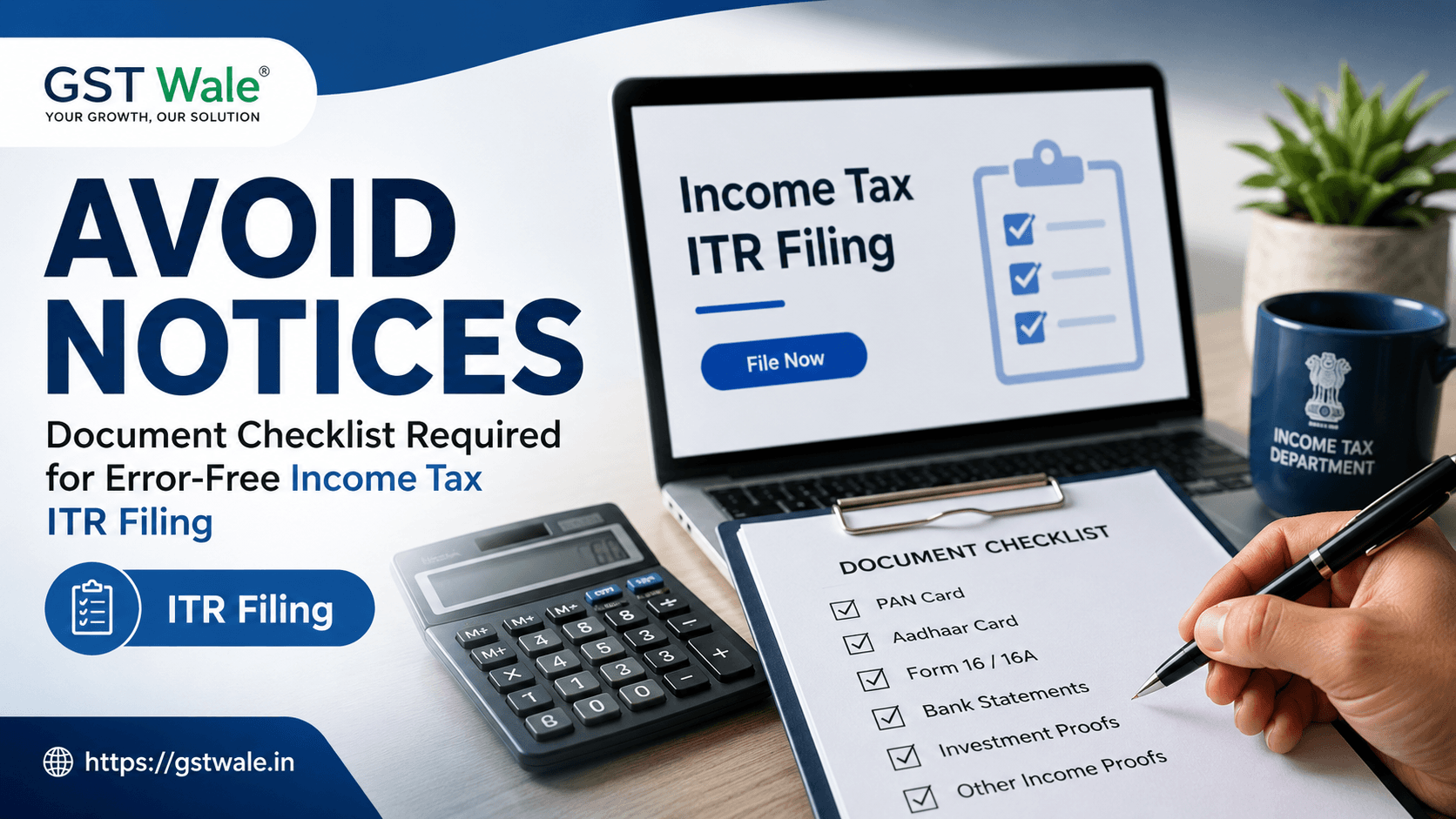
Avoid Notices: Document Checklist Required for Error-Free Income Tax ITR Filing
Avoid Notices: Document Checklist Required for Error-Free Income Tax ITR Filing
It is that time of the year again when the calendar ticks closer to the tax deadline, and the phrase "tax filing" starts echoing in every corporate office and business hub across India. As a salaried professional, a freelance consultant, or a business owner, you might view the annual ritual of filing your taxes as just another compliance hurdle. However, rushing through your income tax itr filing at the eleventh hour without adequate preparation is a recipe for disaster. Year after year, the Income Tax Department is upgrading its technology infrastructure, relying heavily on Artificial Intelligence and data-driven algorithms to spot even the tiniest discrepancies. A simple mismatch between what you report and what the department already knows can trigger an automated scrutiny notice, causing unnecessary anxiety and financial strain.
At GST Wale, we believe that compliance should be a seamless experience rather than a stressful event. If you want to secure your hard-earned money and keep tax litigation at bay, the secret lies entirely in your preparation. By organizing the right set of documents well in advance, you can ensure that your tax returns are absolutely flawless. To help you navigate this process smoothly, we provide expert guidance and professional assistance for ITR Filing, making sure your records align perfectly with tax laws. Let us dive deep into the comprehensive document checklist you need to stay compliant, eliminate errors, and protect yourself from unexpected tax notices.
Why is a Pre-Filing Document Checklist Vital?
Many taxpayers mistakenly believe that filing a tax return is simply a matter of entering numbers into an online portal. In reality, every single figure you input must be backed by verifiable evidence. When you sit down to income tax itr filing, having a structured checklist prevents you from omitting key income sources or making math errors.
The Income Tax Department receives financial data from multiple third parties, including your bank, employer, registrar of properties, and stockbrokers. If your reported figures do not match these third-party streams, a notice under Section 143(1) or Section 139(9) for a defective return is almost guaranteed. Gathering your documents early gives you the power to cross-verify information and rectify disparities before the tax authorities catch them.
The Core Identity and Salary Documents
Before moving to investment proofs, you must secure the foundational documents that validate your identity and primary income streams. Missing out on details here can invalidate your entire return application.
1. PAN and Aadhaar Card Linkage
Your Permanent Account Number (PAN) and Aadhaar card are the foundational pillars of your tax profile. Ensure that they are successfully linked. Any spelling mismatches in your name, or discrepancies in your date of birth between these two documents, can stall your verification process, leading to a rejected filing or delayed refunds.
2. Form 16: The Salaried Professional's Bible
For salaried individuals, Form 16 is an absolute necessity. Issued by your employer, this certificate outlines the total salary paid to you and the Tax Deducted at Source (TDS) withheld during the financial year. It is divided into Part A (TDS details) and Part B (salary breakup, allowances, and deductions). Always verify that the TDS amount mentioned in Form 16 matches your salary slips exactly.
The Digital Ledger: Form 16 and 26AS Synergy
One of the most frequent causes for tax notices is a mismatch between your self-declared figures and the government's digital records. To achieve an error-free income tax itr filing, you must thoroughly evaluate your financial footprints across multiple official statements.
Understanding Form 26AS and AIS/TIS
When you prepare for ITR, your primary task must be to cross-reference your Form 16 and 26AS alongside the Annual Information Statement (AIS) and Taxpayer Information Summary (TIS). Form 26AS acts as your official tax ledger, reflecting all TDS deposited against your PAN by employers, banks, or clients.
On the other hand, the AIS is a highly detailed dossier capturing every financial transaction you made during the year, including stock market investments, mutual fund redemptions, foreign remittances, and high-value credit card spendings. If your friend or broker tells you a transaction is hidden, remember that it is already captured in your AIS.
Expert Tip from GST Wale: Before submitting your return, download your AIS and match it line-by-line with your personal bank statements. If you find an error—such as an incorrect transaction reported by a bank—you can submit feedback online to get it corrected before finalizing your return.
Banking and Investment Income Checklists
A very common trap where taxpayers falter is failing to report secondary incomes, such as interest earned on minor accounts or savings certificates. Let us check what documents you need to keep ready.
Interest Certificates from Banks and Post Offices
Do not make the mistake of assuming that savings account interest is tax-free. While Section 80TTA provides deductions up to ₹10,000 for individuals (and Section 80TTB provides up to ₹50,000 for senior citizens), the entire interest earned must still be declared under "Income from Other Sources".
You must collect interest certificates from every commercial bank, cooperative society, and post office where you hold a savings account, recurring deposit, or fixed deposit. Relying purely on passbook printouts can lead to math errors; official certificates provide the precise accrued figures required for an accurate return.
Capital Gains Statements for Stocks and Mutual Funds
If you trade in equity shares, derivative instruments, or invest in mutual funds, you cannot calculate your liability based on guesswork. You must obtain consolidated Capital Gains Statements from your stockbrokers or platforms like CAMS and Karvy. These statements segregate your earnings into Short-Term Capital Gains (STCG) and Long-Term Capital Gains (LTCG), factoring in grandfathering clauses where applicable, saving you from complex mathematical mistakes during your income tax itr filing.
Real Estate Transactions and House Property Documents
Owning, selling, or renting out a house property introduces distinct tax liabilities and lucrative deductions. Failing to maintain these files correctly is an open invitation for tax scrutiny.
Home Loan Tax Documents
If you are repaying a home loan, your bank will issue an annual provisional interest certificate. This is one of the most critical home loan tax documents you will need. It clearly bifurcates your total annual payment into the principal component (eligible for deduction under Section 80C) and the interest component (eligible for deduction under Section 24(b) up to ₹2 Lakhs). Claiming these deductions without holding the official interest certificate can backfire significantly if your return is picked up for random scrutiny.
Rental Income and Co-ownership Records
If you have rented out a property, you need to maintain a clean record of the rent received, municipal taxes paid, and tenant details (including their PAN if the annual rent exceeds ₹1 Lakh). For joint owners, make sure the rental income and home loan benefits are split in the exact ratio of ownership as documented in the sale deed.
Tax Saving Deductions (Chapter VI-A) Proofs
Legitimately reducing your tax liability requires maintaining a clean, systematic paper trail of all your investments made before the end of the financial year. Keep these receipts close at hand:
Section 80C Investments: Life insurance premium receipts, Public Provident Fund (PPF) passbooks, National Savings Certificates (NSC), and Tax-Saving Equity Linked Saving Schemes (ELSS) investment statements.
Section 80D Health Insurance: Premium receipts for medical insurance policies covering yourself, your spouse, dependent children, or parents. Ensure the payment was made through digital modes or cheques, as cash payments do not qualify for deduction.
Section 80E Education Loan: Certificates showing the exact interest component repaid on higher education loans.
Step-by-Step Blueprint to Prepare for ITR Safely
To summarize the process and ensure an error-free tax filing journey, follow this simple step-by-step framework curated by our tax experts at GST Wale:
Gather and Sort: Collect your physical and digital tax documents list, prioritizing your PAN, Aadhaar, Form 16, and bank statements.
Reconcile Digital Data: Log into the income tax portal and download your Form 26AS and AIS. Compare these against your interest certificates and salary statements.
Verify Tax Credits: Ensure that all TDS deducted by your employers or clients is fully reflecting in your Form 26AS tax credit ledger.
Choose the Right Form: Select the correct ITR form (ITR-1 to ITR-4) depending on your nature of income. Choosing the wrong form automatically labels your return as defective.
File and E-Verify: Submit your return accurately and do not forget to e-verify it via Aadhaar OTP within the stipulated timeline. An unverified ITR is treated as invalid by law.
Frequently Asked Questions (FAQs)
Q1: What happens if there is a mismatch between Form 16 and Form 26AS?
If your Form 26AS shows a lower tax deduction than your Form 16, you must immediately contact your employer or deductor to rectify the error and file a revised TDS return. Filing your ITR with mismatched figures will prompt the tax department to issue a demand notice for the shortfall.
Q2: Can I claim home loan interest deductions without the home loan tax documents?
No. While you enter the numeric values online without uploading documents, you must possess the actual interest certificate issued by your lending institution to back your claims if your case is selected for verification later.
Q3: Is it necessary to report interest from a basic savings account?
Yes, declaring interest from all active savings bank accounts is mandatory. Even though you can claim a deduction up to ₹10,000 under Section 80TTA, the gross interest must be declared during your income tax itr filing process.
Q4: What should I do if I forget to report an investment in my initial filing?
If you miss out on reporting any income or claiming a valid deduction, you can file a Revised Return under Section 139(5) before the end of the relevant assessment year to correct your mistakes without penalties.
Filing your tax returns should never be a game of guesswork. A meticulous approach backed by a solid tax documents list is your absolute armor against compliance issues, penalties, and scrutiny notices. When you organize your papers and actively verify your records, you pave the way for a stress-free, accurate, and completely transparent tax season. Remember, the key to a smooth income tax itr filing is starting early and staying diligent with your checks.
 Previous