


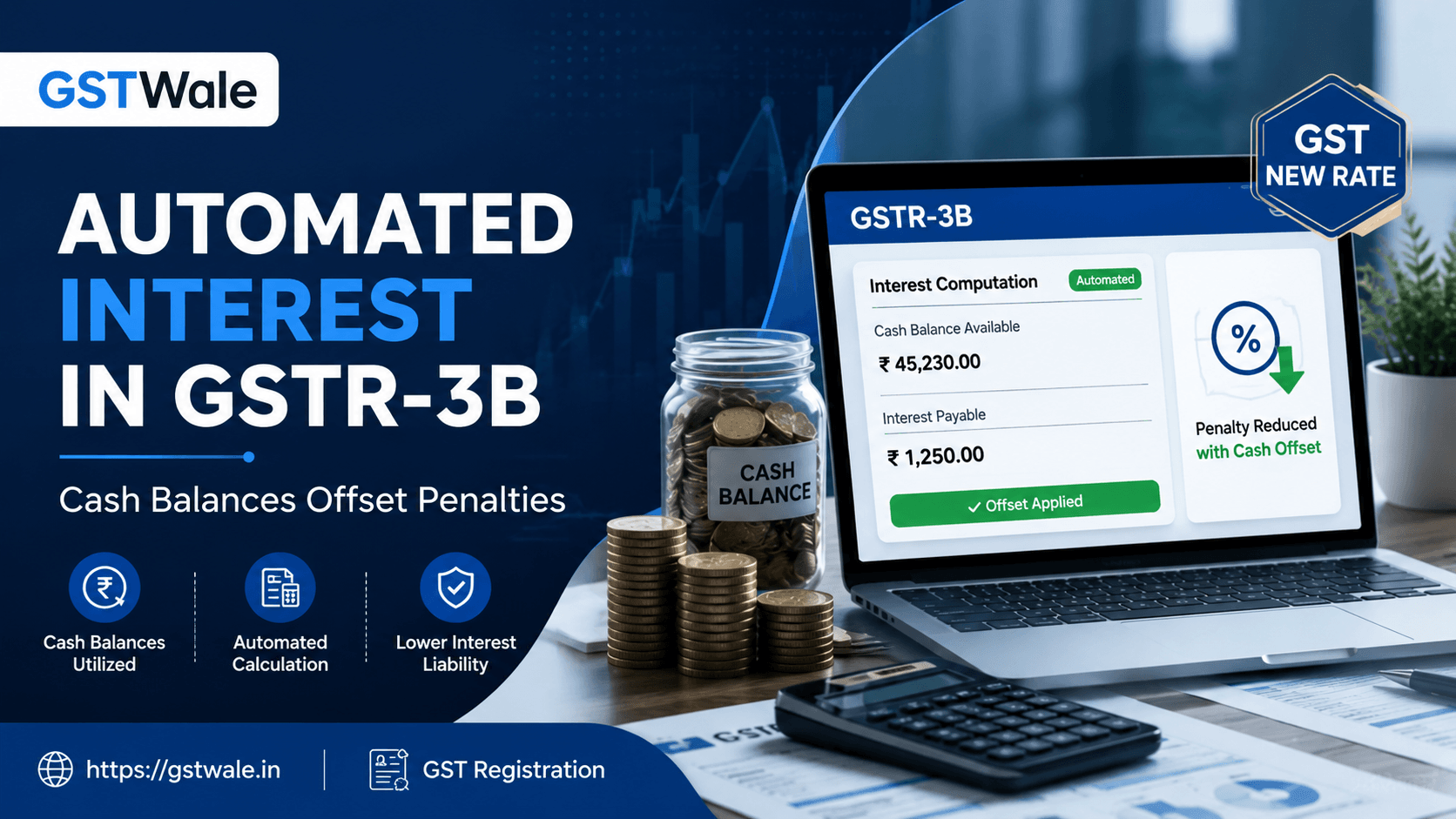
The New Automated Interest Computation in GSTR-3B: How Cash Balances Offset Penalties
The New Automated Interest Computation in GSTR-3B: How Cash Balances Offset Penalties
Navigating the complexities of GST compliance can feel like a full-time job, especially with the portal’s latest updates. As a business owner, you likely focus on your operations, but keeping an eye on the gst new rate and filing requirements is crucial to avoid unnecessary penalties. If you are just starting out or expanding your business, remember that our team at GST Wale is always here to assist with your GST Registration needs, ensuring a smooth and compliant setup from day one.
Recently, the GST department introduced a significant change that impacts every taxpayer: the automated interest computation system in GSTR-3B. Let’s break down how this works and why it’s actually a win for honest taxpayers.
Understanding the New Automated Interest Computation
For years, many taxpayers were confused about how interest on late payments was calculated. You might have seen varying figures or worried about being charged on your entire tax liability. From the January 2026 tax period onwards, the GST portal shifted to a fully automated system for interest calculation under section 50 interest calculations.
When you file your GSTR-3B, you’ll now find that interest on delayed payments is auto-populated in Table 5.1. This is a game-changer because it takes the guesswork out of your self-assessment. The system is designed to be fair, ensuring that interest is charged only on the "net cash shortfall" rather than the gross tax liability.
How Cash Balances Offset Penalties
The core philosophy of this automation is the proper use of your Electronic Cash Ledger. Previously, if you were late in filing, there was often ambiguity regarding whether interest applied to the total tax or just the amount unpaid in cash.
The current system applies a precise formula:
Interest = (Net Tax Liability – Minimum Cash Balance in ECL from due date to date of debit) × (Number of days delayed / 365) × 18%.
This means that if you have already deposited money into your ledger on or before the due date, that balance is considered "offset." You are only penalized on the remaining gap. This makes managing your electronic cash ledger benefits a strategic move. By maintaining a buffer in your cash ledger, you essentially insulate yourself from hefty interest charges even if a filing delay occurs.
Why the "gst new rate" Matters for Your Business
While the automation handles the math, you should also be mindful of the gst new rate and any changes in the gst new slab or gst new rate list that might affect your specific industry. Keeping track of the latest gst rates is vital because incorrect categorization can lead to discrepancies in your tax liability breakup, which the system now monitors closely.
If the portal’s auto-calculated figure seems off, don’t panic. There is now a "RE-COMPUTE INTEREST" button in Table 5.1. Clicking this triggers the system to re-verify your ledger balances and updated parameters, providing a more accurate figure based on your actual filings.
Tips to Avoid a Delayed Return Filing Penalty
To keep your compliance record clean and avoid the stress of a delayed return filing penalty, consider these practical steps:
Pre-fund your Ledger: Keep enough balance in your Electronic Cash Ledger before the due date. Even if you aren't ready to file, this protects you against interest on the cash component.
Reconcile Regularly: Use the "Tax Liability Breakup" feature to verify your numbers. Don't wait until the last day to discover a mismatch between your GSTR-1 and GSTR-3B.
Leverage Technology: Whether you use a manual tracker or an accounting software, ensure it is updated with the latest gst new rate to prevent manual entry errors that trigger system warnings.
Frequently Asked Questions
Is the interest on delayed payment still 18%?
Yes, under Section 50(1) of the CGST Act, the interest rate for delayed tax payments remains at 18% per annum.
Does the system calculate interest on the full tax liability?
No. Thanks to the automation, it calculates interest only on the net cash shortfall after adjusting for any balance available in your Electronic Cash Ledger.
What if I disagree with the auto-populated interest amount?
You can use the “RE-COMPUTE INTEREST” button located in Table 5.1 of your GSTR-3B. This forces the system to recalculate based on the latest ledger data.
Do I pay interest if I have a Nil return?
If your return is truly "Nil" (no tax liability), interest does not apply. However, late filing still attracts a nominal late fee.
How often should I check the gst new rate list?
Tax rates can evolve. We recommend checking the official GST portal or consulting with our experts at GST Wale periodically to ensure your business invoices reflect the correct current rates.
Stay Compliant with GST Wale
The new automated interest system is a step toward greater transparency, but staying on top of your compliance requires consistent effort. Don't let tax complexities hold your business back. Whether you need help with a new GST Registration or need an expert to audit your monthly filings to ensure you're benefiting from the best possible gst new rate, our team at GST Wale is ready to help. Reach out to us today and let’s keep your business growth compliant and worry-free.
 Previous