


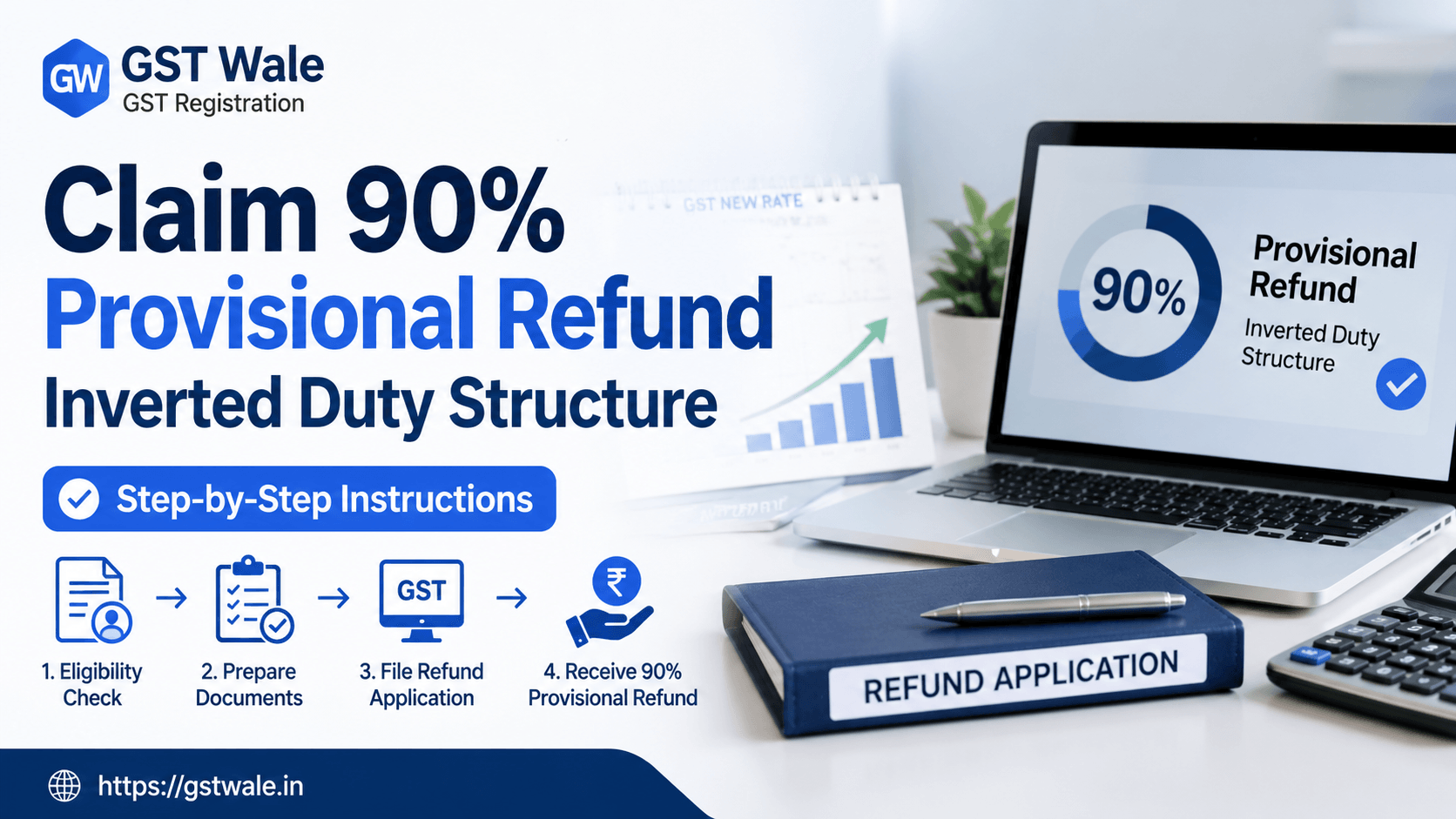
Step-by-Step Instructions to Claim 90% Provisional Refund for Inverted Duty Structure
Step-by-Step Instructions to Claim 90% Provisional Refund for Inverted Duty Structure
Managing cash flow is the heartbeat of any manufacturing business. As a Chartered Accountant, I’ve seen far too many entrepreneurs lose sleep over capital being trapped in the form of accumulated Input Tax Credit (ITC). If you are operating in a sector where your input tax is higher than your output liability, you are likely dealing with an inverted duty structure. It’s a common hurdle, but one that can be cleared with the right approach. If you are just starting your business journey and need assistance getting your GST Registration sorted out correctly from the beginning, we are here to help you lay a solid foundation.
Understanding the gst new rate landscape is vital for every business owner today. When your raw materials are taxed at a higher slab than your finished goods, that "leftover" credit doesn't just vanish; it sits in your ledger. Thankfully, the law provides a mechanism to unlock this capital.
Understanding the Inverted Duty Structure
An inverted duty structure occurs when the gst new slab applied to your inward supplies (inputs) exceeds the tax rate applicable to your outward supplies (finished goods). This imbalance leads to a persistent accumulation of unutilized ITC in your electronic credit ledger. While this is a standard feature of many industries like pharmaceuticals, textiles, and electric vehicle manufacturing, it shouldn't be treated as a permanent "sunk cost."
The government recognizes this through Section 54(3) of the CGST Act, which allows registered taxpayers to claim a refund of this accumulated credit. This is a critical pillar of manufacturing cash flow optimization, allowing you to reinvest that locked-up money into scaling your operations.
The 90% Provisional Refund Advantage
One of the biggest game-changers for taxpayers recently has been the streamlining of the online refund application dashboard. Under the current provisions, eligible manufacturers can now claim a 90% provisional refund of the accumulated ITC.
This isn't just a promise; it’s a process. Once you file your application correctly, the system is designed to grant this provisional amount to provide immediate liquidity, pending the final tax officer approval. As we keep our eyes on finance bill tracking to stay ahead of regulatory shifts, it’s clear that the department is moving toward a more automated, faster clearance process for compliant taxpayers.
Step-by-Step Instructions to Claim Your Refund
Claiming a refund under section 54 can feel daunting, but when broken down, it is a straightforward process. Here is how we at "GST Wale" suggest you approach it:
1. Preparation and Reconciliation
Before you touch the portal, ensure your house is in order.
GSTR-1 and GSTR-3B: Ensure all your returns for the relevant period are filed.
ITC Reconciliation: Compare your GSTR-2B with your purchase register. Any mismatch here is a red flag that could lead to a rejection.
Eligibility Check: Verify if your specific goods are eligible for an inverted duty refund, as some items are specifically excluded by the GST Council.
2. Accessing the GST Portal
Navigate to the "Services" tab on the official portal, select "Refunds," and click on "Application for Refund." Select the option labeled "Refund of ITC accumulated due to inverted tax structure."
3. Using the Offline Utility
Download the offline utility for Statement 1A. This is where you detail your inward and outward supplies. Accuracy here is non-negotiable. Ensure that the "Turnover of inverted rated supply of goods" and "Net ITC" are calculated according to the formula prescribed under Rule 89(5).
4. Submission and Verification
Once the JSON file is generated and uploaded, validate it on the portal. The system will perform automated checks. After you are satisfied, submit the application using a Digital Signature Certificate (DSC) or Electronic Verification Code (EVC).
Once filed, keep an eye on the online refund application dashboard to track the status. The provisional 90% is typically processed within seven days, provided your documentation is flawless.
Expert Tips for a Smooth Claim Process
Don’t Delay: The time limit for filing a refund is two years from the end of the financial year in which the claim arises. Don't wait until the last minute.
Documentation is King: Keep a physical or digital file of all invoices, shipping bills (if applicable), and your tax computations. If a tax officer approval requires a physical visit or additional clarification, having your data ready saves weeks of back-and-forth.
Stay Updated: Always keep an eye on the latest gst new rate notifications. Sometimes, a simple rate change can affect your entire refund calculation for the next cycle.
Frequently Asked Questions
Can I claim a refund if my output supply is exempt?
Generally, no. The refund for an inverted duty structure is specifically for cases where the input tax rate is higher than the output tax rate. If your output is entirely exempt, the law usually does not permit this specific refund.
Is the 90% provisional refund guaranteed?
It is subject to your compliance history. If your filings are clean and you haven't had issues with previous refunds, the process is usually smooth. However, any discrepancy in your GSTR-3B or GSTR-2B can trigger a deficiency memo.
What documents should I keep ready?
Maintain copies of your GSTR-3B, GSTR-1, and your purchase/sales registers. Additionally, ensure you have the statement of invoices prepared as per the portal's format.
Can I claim a refund for input services?
No. The refund for an inverted duty structure is specifically restricted to "inputs" (physical goods). ITC on input services, such as rent, courier charges, or professional fees, cannot be included in the refund claim.
Navigating the complexities of GST requires vigilance, especially when it comes to the gst new rate and its impact on your margins. While the refund process under section 54 is a powerful tool for manufacturing cash flow optimization, it demands meticulous record-keeping and a deep understanding of the law.
At "GST Wale," we believe your focus should be on growing your business, not chasing paper trails. If you find the compliance load getting heavy, remember that we are just a call away. Let us handle the technicalities of your tax compliance so you can focus on what you do best—building your brand. Reach out to us today and let’s secure the liquidity your business deserves.
 Previous