


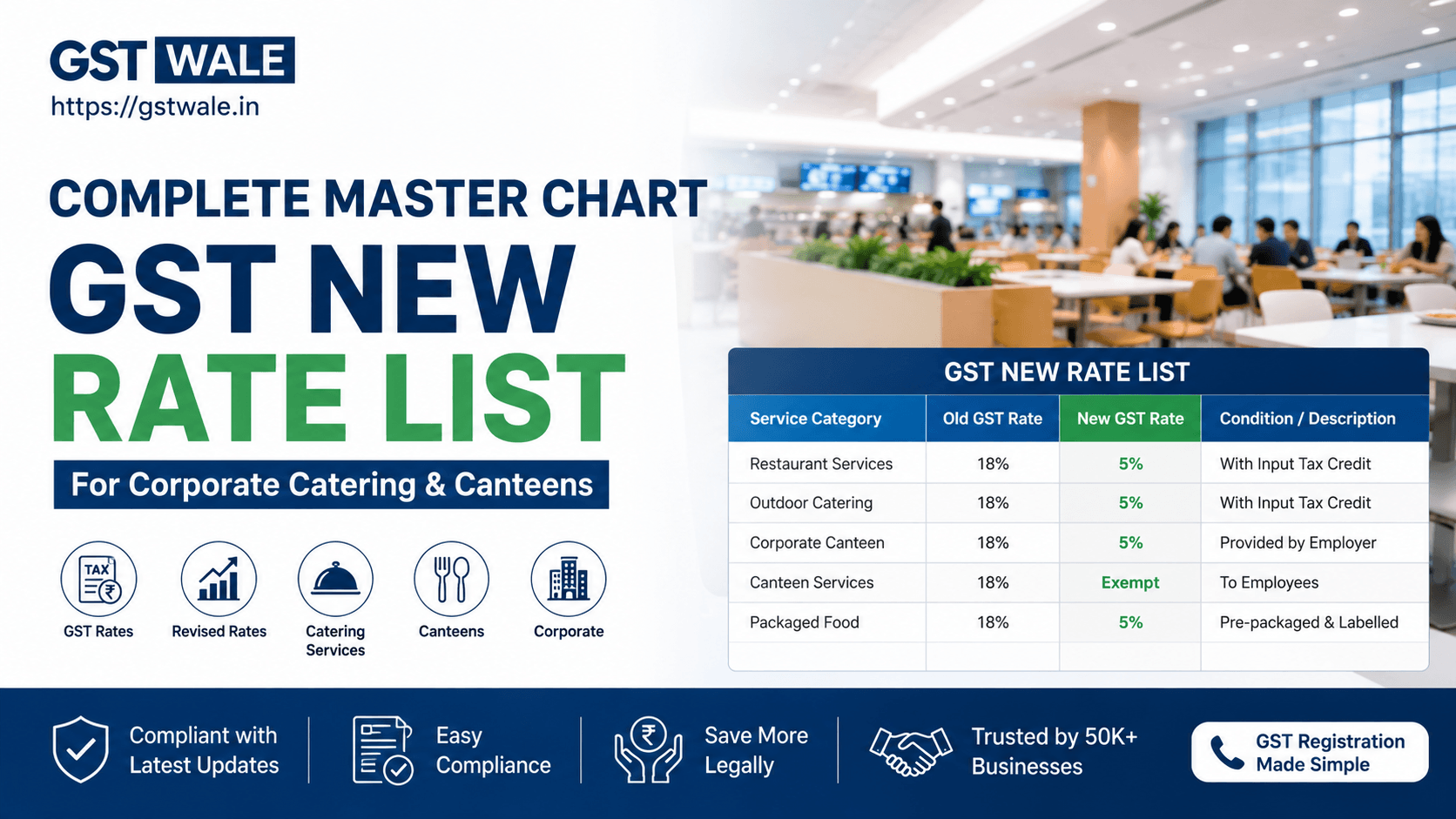
Complete Master Chart: The Revised GST New Rate List for Corporate Catering and Canteens
Complete Master Chart: The Revised GST New Rate List for Corporate Catering and Canteens
Running a business in India comes with its fair share of paperwork, and keeping up with the ever-evolving tax landscape is often the toughest part. If you manage corporate catering or canteen services, you know that even a small error in tax classification can lead to unnecessary scrutiny. For business owners navigating these complexities, getting your GST Registration in order is the first step toward building a solid, compliant foundation for your operations. At "GST Wale," we frequently receive queries about the recent updates, so let’s break down the gst new rate list to help you stay ahead.
Understanding the GST New Rate List for Catering Services
When it comes to the gst new rate list, the tax liability largely depends on the nature of your service and the premises where the food is served. The government has streamlined these rates to differentiate between standalone catering, canteen services, and high-end hospitality.
Broadly speaking, most standard corporate catering and canteen services attract a GST rate of 5%. However, there is a catch: if you opt for this gst new rate, you generally cannot claim Input Tax Credit (ITC) on your purchases. Conversely, if you operate in "specified premises"—such as restaurants within hotels with a high room tariff—or if you choose to provide services with full ITC benefits, the rate moves to 18%.
Key Slabs at a Glance
To make things easier for your accounting team, here is the basic breakdown:
Standard Canteen/Mess Services: Usually taxed at 5% (no ITC allowed).
Outdoor Catering Contracts: Typically attract 18% GST, with the benefit of claiming ITC on inputs like raw materials, equipment rentals, and transportation.
Specified Premises: Restaurants or catering units within hotels (declared room tariff of ₹7,500 or more) are charged at 18% with full ITC eligibility.
How the GST New Slab Impacts Your Billing
Many canteen operators often get confused about whether to charge 5% or 18%. The choice of gst new slab is a strategic business decision. If your procurement costs (ingredients, gas, maintenance) are high, opting for the 18% rate might be more profitable because it allows you to offset your tax liability using Input Tax Credit.
However, if you are running a high-volume, low-margin corporate canteen, the 5% rate is often the industry standard. It simplifies your billing but requires you to manage your costs effectively since you won’t be able to claim credits on your purchases.
Compliance Tips for Food Court Billing
Effective food court billing compliance is not just about picking the right percentage; it’s about proper documentation. Whether you are issuing invoices for outdoor catering contracts or daily canteen meals, ensure your invoices clearly mention:
Correct SAC Code: Use the appropriate Service Accounting Code (SAC) to avoid classification disputes.
Breakdown of Taxes: Even if it’s a 5% rate, ensure the split between CGST and SGST is clearly visible.
Nature of Supply: Clearly label whether the service is a canteen, outdoor catering, or restaurant service.
Managing Employee Welfare Food Tax
A major area of concern is the employee welfare food tax aspect. If you are an employer providing subsidized meals, remember that the GST treatment depends on whether the canteen is run by a third-party contractor or managed in-house. Under recent clarifications, if a canteen is mandatory under the Factories Act, the employer may be eligible to claim ITC on the GST charged by the contractor.
Frequently Asked Questions (FAQs)
Q1: Can I switch my GST rate preference?
Yes, but this is usually a yearly decision. Once you choose between the 5% (no ITC) and 18% (with ITC) scheme, you should stick to it for the financial year to maintain clean books.
Q2: Does the gst new rate list apply to small food stalls?
If your annual turnover is below the threshold (typically ₹20 lakh), you may not need to register. However, once you cross the turnover limit, you must adhere to the standard gst rates applicable to your service category.
Q3: What is the primary difference between outdoor catering and a canteen?
An outdoor catering contract is usually an event-based, non-continuous supply, whereas canteen services refer to a permanent arrangement (often B2B) for providing daily food to employees.
Q4: Is GST applicable on free meals provided to staff?
If the meal is a part of the employment contract and provided free of cost, it is often treated as a "no supply" scenario, but the input tax credit implications for the employer can be tricky. Consult with a professional to ensure your specific case is structured correctly.
Navigating the gst new rate list doesn't have to be a headache. Whether you are struggling with the nuances of non ac restaurant rates or the complexities of large-scale corporate catering, accuracy is your best defense against audits.
At GST Wale, we specialize in simplifying these technicalities for business owners. Don't let tax compliance hold back your growth—let our experts handle your filings and advisory so you can focus on scaling your business. Reach out to us today for personalized guidance on your GST journey!
 Previous