


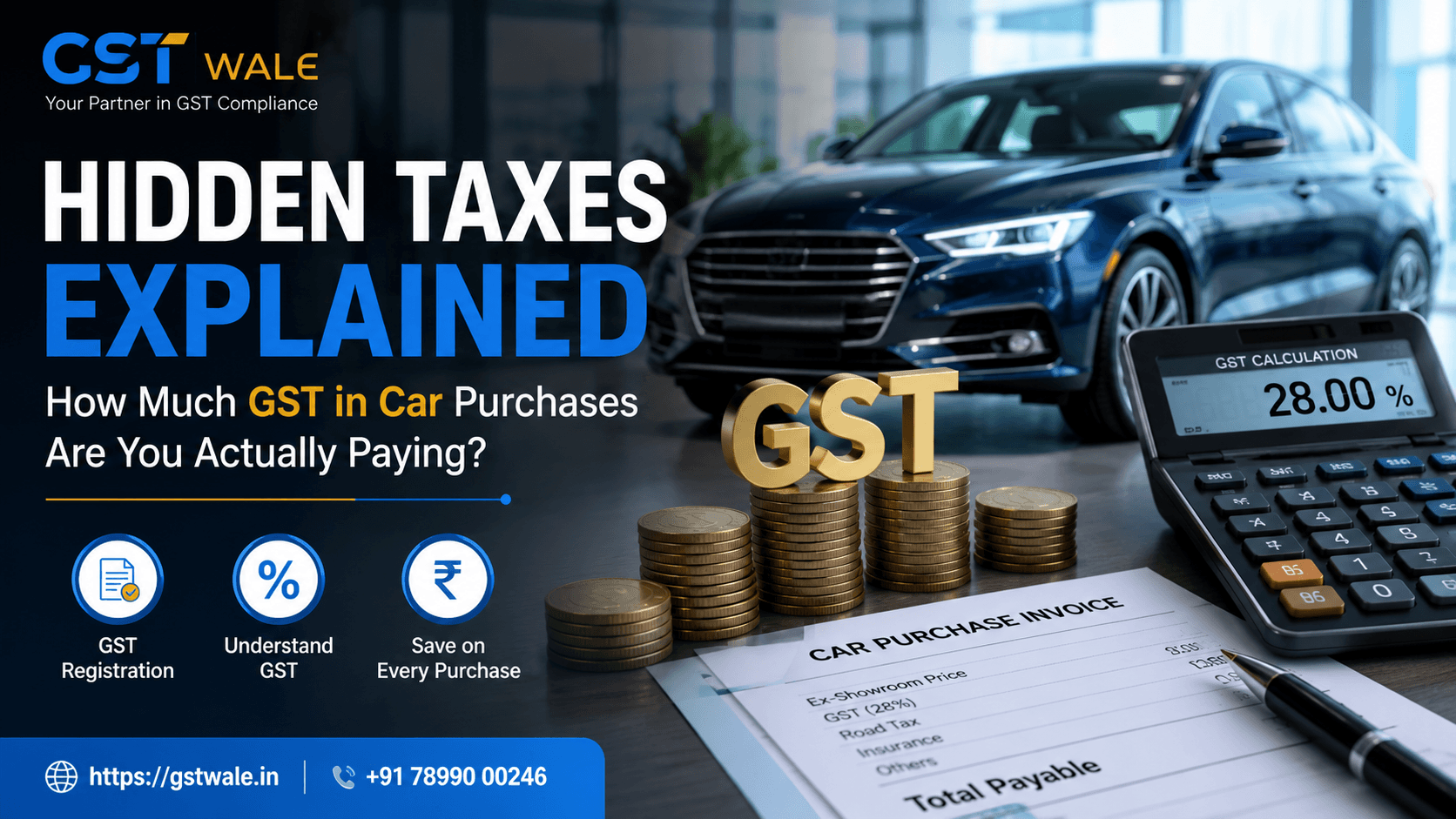
Hidden Taxes Explained: How Much GST in Car Purchases Are You Actually Paying?
Hidden Taxes Explained: How Much GST in Car Purchases Are You Actually Paying?
Buying a car in India is often a dream come true, but the final invoice frequently leaves buyers scratching their heads. You walk into a showroom, fall in love with a shiny new vehicle, and look at the price tag. But wait—the price you see isn't the price you pay. As a practitioner at GST Wale, I often hear clients ask, "Why is the tax so high" Understanding the gst in car components is essential because it isn't just a flat rate. Navigating these tax layers can be complex, and much like ensuring your business is compliant with GST Registration protocols, knowing exactly where your money goes empowers you to make smarter financial decisions.
Let’s break down the layers of taxation that make up your final on-road price.
Understanding the Tax Structure: GST in Car Purchases
Many people assume there is just one tax on vehicles. In reality, the government levies a multi-tiered tax structure. The gst in car pricing is primarily bifurcated into the base GST rate and the additional compensation cess.
The GST Council has categorized automobiles under the highest slab, which is 28%. However, that is only the beginning. The government imposes a compensation cess on top of the 28% GST to discourage luxury consumption and high-emission vehicles. This cess can range from 1% to 22%, depending on the engine capacity, length of the vehicle, and ground clearance.
Why Your Ex-Showroom Price GST Matters
When you see the ex-showroom price gst component, it essentially covers the manufacturer's margin, dealer's margin, and the total tax burden. It is important to remember that GST is applied to the transaction value between the manufacturer and the dealer, and then passed on to the consumer. If you are a business owner looking to buy a vehicle in the name of your company, you might be wondering about Input Tax Credit (ITC). Generally, GST paid on cars is not available as ITC unless your business involves selling cars or providing passenger transportation services.
Decoding the SUV GST Rate and Cess
The classification of vehicles has become a major talking point in recent years. Specifically, the suv gst rate has caused confusion for many buyers. Under current norms, to qualify for the standard 28% GST plus a lower cess, a vehicle must meet strict criteria: length exceeding 4,000 mm, engine capacity greater than 1,500 cc, and ground clearance of 170 mm or more.
If a vehicle satisfies all these, it effectively attracts a higher total tax burden. When you are looking at that brochure, always ask the dealer about the specific cess applicable, as it can swing the final price by lakhs.
The Relationship Between RTO and GST
A common misconception is that the tax you pay at the RTO (Regional Transport Office) is part of the GST. This is incorrect. The rto and gst are entirely separate entities.
GST: A central and state-level indirect tax levied on the sale of goods.
RTO Charges: These are road taxes (or motor vehicle taxes) levied by the state government where the vehicle is registered.
While GST is uniform across India, road tax varies significantly from state to state. This is why a car registered in Delhi might have a different on-road price compared to the same model registered in Karnataka or Maharashtra.
Is Discount Taxability on Cars Real?
You might wonder, "If I get a massive discount, do I pay less GST" This is a tricky area. The discount taxability on cars follows a specific rule: if the discount is offered by the manufacturer and is known at or before the time of supply, the GST is calculated on the discounted price.
However, if the dealer gives you an "ex-gratia" discount that isn't linked to the invoice price, the GST might still be calculated on the full value. Always check your invoice to ensure the GST is charged on the actual amount you are paying after the discount.
Frequently Asked Questions
1. Is GST in car purchases refundable?
Generally, no. For individual buyers, the tax is a cost. For businesses, ITC is restricted under Section 17(5) of the CGST Act for most vehicles unless you fall under specific categories like motor vehicle leasing or transportation of passengers.
2. Does the engine capacity affect GST?
Yes. While the base rate is 28%, the compensation cess is highly sensitive to engine size (measured in cc), which directly impacts the total gst in car liability.
3. What is the highest tax slab for cars?
The effective tax rate, including the maximum compensation cess, can reach as high as 50% for high-end luxury vehicles and SUVs.
4. Can I save on GST by buying in another state?
No. GST is a destination-based tax and is uniform across India. However, you might save on RTO charges depending on the state of registration, though you must follow legal residency requirements.
Whether you are an individual upgrading your family vehicle or a business owner expanding your fleet, the hidden costs behind gst in car pricing can be daunting. The combination of GST, compensation cess, and state-specific road taxes makes the "on-road price" a complex calculation.
At GST Wale, we believe that informed decisions save money. If you are navigating the complexities of business taxation or need clarity on how your asset purchases impact your tax filings, we are here to help. Don't let tax confusion drive your budget off-course—reach out to our expert team for guidance today.
 Previous