


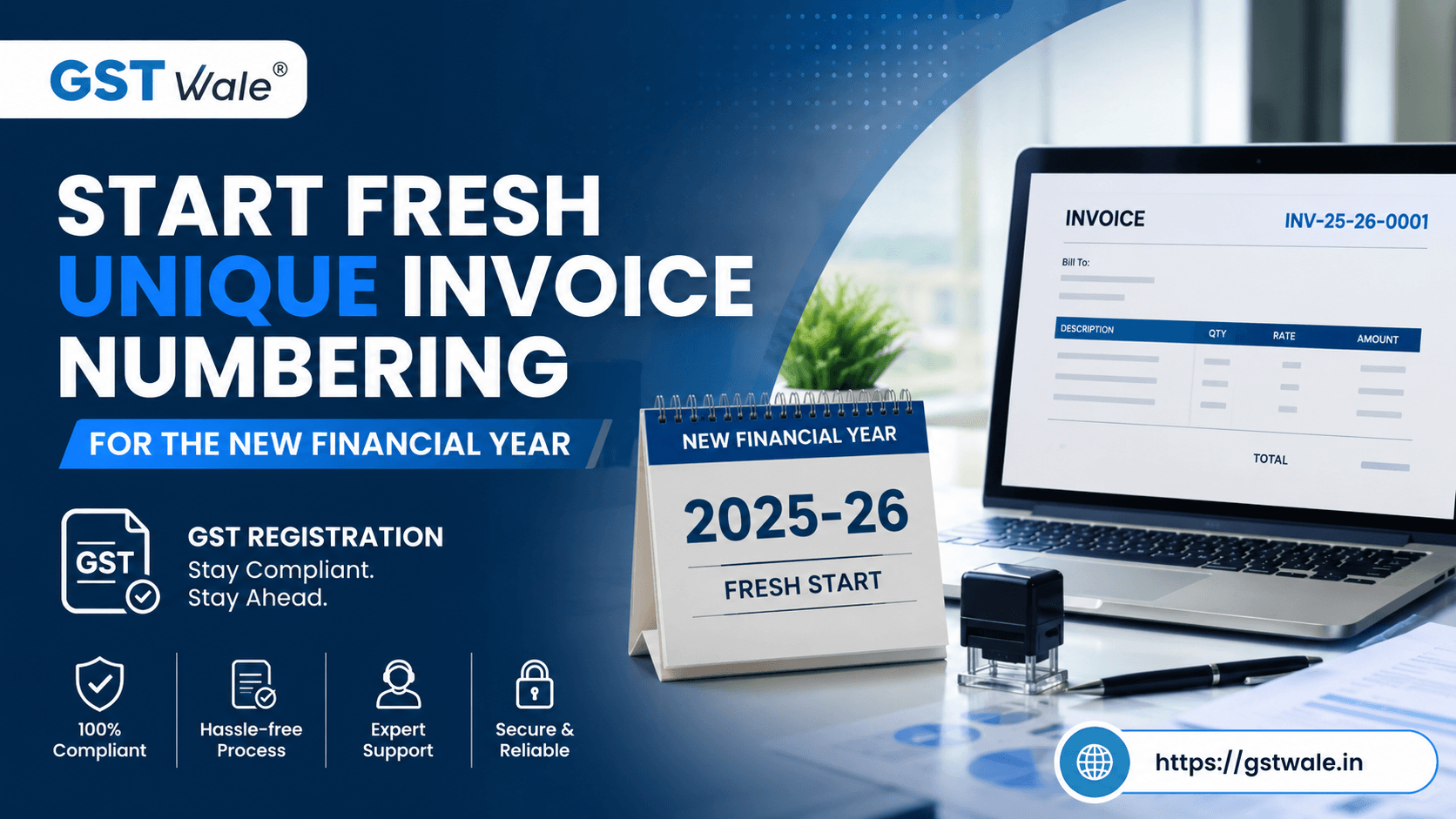
Essential Compliance: How to Start Fresh Unique Invoice Numbering for the New Financial Year
Essential Compliance: How to Start Fresh Unique Invoice Numbering for the New Financial Year
The transition to a new financial year brings a wave of excitement and administrative tasks for every business owner in India. Among the most critical tasks that often get overlooked is the reset of invoice numbering. As we guide you through these transitions at GST Wale, we often see businesses struggling with disorganized billing cycles that can trigger red flags during audits. Whether you are a new entrepreneur who just completed your GST Registration or a veteran business owner, setting up a fresh, unique invoice sequence is non-negotiable for maintaining clean books. Ensuring your documentation is streamlined is the first step toward successful goods and services tax registration maintenance.
Why Invoice Numbering Matters Under GST Law
Many businesses treat invoice numbering as a trivial task, but under the current tax regime, it is a legal requirement. Rule 46 of the CGST Rules mandates that every tax invoice must contain a unique serial number for the financial year. This isn't just about aesthetics; it is about compliance audit readiness.
When you start a new financial year, failing to reset your numbering can lead to overlapping sequences, which makes duplicate invoice tracking a nightmare for your accounting team. Think of your invoice number as the backbone of your GST compliance. If the sequence is broken or inconsistent, authorities might question the legitimacy of your transactions.
Understanding Invoice Prefix Rules
The law does not mandate a specific format, but it does demand uniqueness. Many businesses prefer to incorporate the financial year into their invoice prefix, such as "GW/2026-27/001." This is a smart practice. By including the year in your prefix, you eliminate the risk of confusion.
Be Consistent: Once you choose a format (e.g., prefix + financial year + serial number), stick to it for the entire year.
Keep it Simple: Avoid complex special characters that might not be supported by the GST portal’s offline tools or various accounting software.
Audit Trail: By using a distinct prefix for each year, you simplify the process of year-end reconciliation and ensure that your goods and services tax registration records remain impeccable.
Managing Your Accounting System Year End
When your accounting system year end approaches, your software should be configured to automatically trigger the new sequence. If you are using manual billing, you must manually ensure that your invoice books are marked clearly to reflect the change.
We always advise our clients to take a "cut-off" day. On the 1st of April, your invoice number should reset to 1. If you continue with the previous year's serial number (e.g., continuing from 500 to 501), you are technically compliant, but it makes tracking much harder. A fresh start ensures that your GSTIN number is mapped correctly to a specific, identifiable set of documents for that financial year.
Best Practices for Maintaining Unique Invoice Sequences
Maintaining a clean sequence is about discipline. Here is how you can stay ahead of the curve:
Define Your Sequence Early: Decide on your format at least a week before April 1st.
Update Software Settings: If you use cloud accounting or ERP software, update the "Document Numbering" settings to auto-reset on the first day of the financial year.
Physical Records: If you issue physical tax invoices, ensure that your printed books have the new financial year pre-printed to avoid human error.
Continuous Monitoring: Periodically check your sales register to ensure that no gaps exist in the numbering, as gaps are often interpreted by tax officers as potentially suppressed sales.
Effective management here is the hallmark of a business that takes its goods and services tax registration obligations seriously.
Frequently Asked Questions
Can I continue the same serial number from the previous year?
Yes, the law allows it, but it is highly discouraged. Starting a new sequence each year makes it much easier to track invoices and simplifies compliance audit readiness.
Does the GST portal restrict the length of my invoice number?
Yes, the invoice number cannot exceed 16 characters. It must be alphanumeric and can include slashes or dashes.
What should I do if I accidentally skipped an invoice number?
Maintain a formal note or a "cancellation register" explaining why the number was skipped. Transparency is key to avoiding penalties.
Does a change in invoice number affect my GSTIN number?
No, your GSTIN number is permanent and is not linked to your invoice numbering sequence.
Is it mandatory to use a prefix?
It is not explicitly mandatory to use a prefix, but it is highly recommended to ensure uniqueness and clarity in your financial records.
Get Expert Assistance from GST Wale
Navigating the complexities of tax compliance can be overwhelming, especially when you are trying to scale your business. At GST Wale, we specialize in helping businesses stay compliant with ease. From your initial goods and services tax registration to ongoing documentation support and audit preparation, our team is here to ensure you never face a notice due to simple clerical errors.
 Previous