


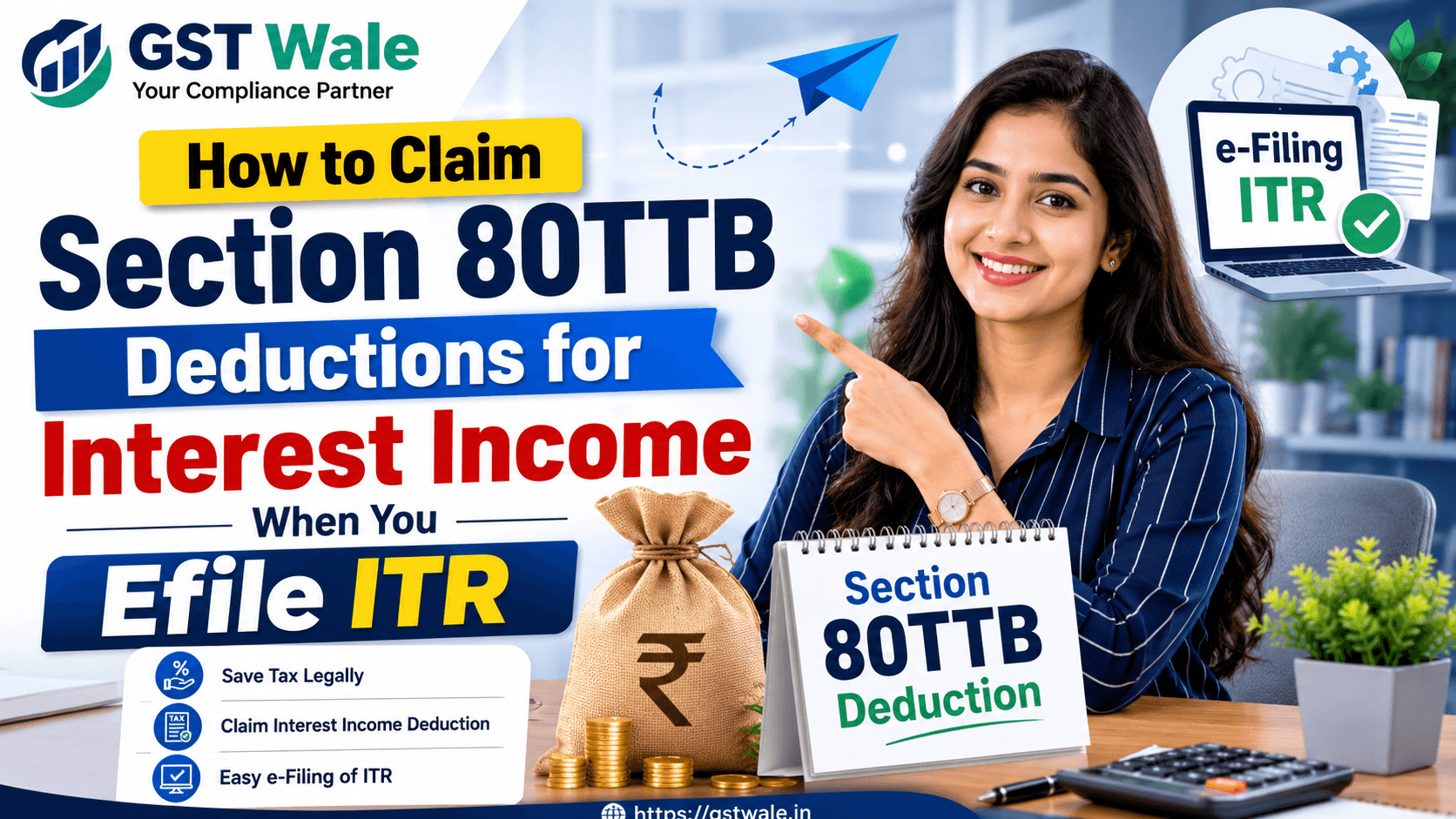
How to Claim Section 80TTB Deductions for Interest Income When You Efile ITR
How to Claim Section 80TTB Deductions for Interest Income When You Efile ITR
Managing taxes can often feel like a maze, especially when you are trying to navigate the complexities of interest income exemptions. Many of our clients at "GST Wale" frequently ask how they can optimize their tax liability while fulfilling their compliance requirements. Whether you are a business owner or an individual taxpayer, ensuring you ITR Filing is done correctly is the first step toward financial peace of mind. As you prepare to efile ITR, it is crucial to understand the specific benefits available to you, particularly if you fall under the senior citizen category.
Understanding Section 80TTB: A Senior Citizen’s Best Friend
When you efile ITR, many taxpayers—especially senior citizens—often overlook the powerful provisions of the Income Tax Act that can significantly reduce their tax burden. Section 80TTB is a specific tax provision introduced to provide relief to resident senior citizens (those aged 60 years or above).
Unlike the standard Section 80TTA, which is limited to savings account interest for everyone else, Section 80TTB offers a much broader Section 80TTB exemption. It allows senior citizens to claim a deduction of up to ₹50,000 on the aggregate of interest income earned from:
Deposits with a bank.
Deposits with a post office.
Deposits with a cooperative society engaged in banking.
This includes both your savings account interest and your FD interest tax deduction claims. Essentially, this provision acts as a savings account tax shield, protecting a portion of your hard-earned interest income from being taxed.
Why You Must Be Careful When You Efile ITR
The process to efile ITR has become highly automated, but automation doesn't mean you can skip the manual verification of your data. When you sit down to file your returns, you must ensure that your interest income is correctly categorized.
If you are a senior citizen, the tax portal does not automatically apply this deduction in every scenario. You must manually claim this while you efile ITR under the 'Deductions' section of your ITR form. Failing to do so means you end up paying tax on income that the government has explicitly exempted. At GST Wale, we have seen many individuals lose out on thousands of rupees simply because they didn't check the specific box for Section 80TTB.
Step-by-Step: Claiming the Deduction During E-filing
If you are wondering how to navigate the e-filing senior deductions portal, follow these steps to ensure you claim what is rightfully yours:
Gather Your Documents: Before you start to efile ITR, compile all your Form 16A or interest certificates from all your banks. Do not rely solely on the pre-filled data in the ITR form.
Report Gross Interest: Under the 'Income from Other Sources' tab, enter the gross interest income earned from all your savings accounts and fixed deposits.
Navigate to Deductions: Move to the 'Deductions' schedule. Look specifically for the section related to Section 80TTB.
Enter the Amount: Input the interest income claimed, keeping in mind the upper limit of ₹50,000. If your total interest income is ₹40,000, you claim ₹40,000. If it is ₹70,000, you cap it at ₹50,000.
Final Review: Before you click the submit button to efile ITR, cross-verify the total taxable income to ensure the deduction has been subtracted correctly.
Practical Example for Better Understanding
Imagine Mr. Sharma, a 68-year-old retired gentleman. In the current financial year, he earned ₹45,000 as interest from his savings account and ₹30,000 as interest from his Fixed Deposits. His total interest income is ₹75,000.
When Mr. Sharma decides to efile ITR, he should report the full ₹75,000 as 'Income from Other Sources'. However, in the deductions section, he can claim the maximum limit of ₹50,000 under Section 80TTB. Consequently, only ₹25,000 of his interest income will be added to his total taxable income. If he failed to claim this, he would be paying tax on the full ₹75,000, which is a completely avoidable financial loss.
Frequently Asked Questions
Can I claim both 80TTA and 80TTB?
No. If you are a senior citizen claiming a deduction under Section 80TTB, you cannot claim an additional deduction under Section 80TTA for the same income.
What if my interest income is less than ₹50,000?
You can only claim a deduction equal to the amount of interest earned. If you earned ₹30,000, your deduction is limited to ₹30,000.
Does Section 80TTB apply to HUFs or Firms?
No, the Section 80TTB exemption is exclusively available to individual resident senior citizens. It does not apply to Hindu Undivided Families (HUFs) or other entities.
Is the deduction applicable to income from company deposits?
No. The deduction is limited to interest from banks, post offices, and co-operative banks. Interest from company fixed deposits or bonds does not qualify.
Does the bank deduct TDS on the full amount?
Yes, banks will continue to deduct TDS if your interest exceeds the specified limits. However, when you efile ITR, you can claim the benefit of the Section 80TTB deduction to lower your final tax liability and potentially claim a refund of excess TDS.
Tax laws are designed to benefit those who understand them. At GST Wale, we believe that compliance should be efficient, not burdensome. While the process to efile ITR is straightforward for some, the nuances of deductions like 80TTB require a keen eye.
Don’t let your hard-earned interest income go toward unnecessary taxes. If you find the tax portal overwhelming or are unsure about your eligibility, reach out to us. At GST Wale, we specialize in helping senior citizens and business owners optimize their taxes accurately. Let us handle the complexities while you enjoy your retirement or focus on growing your business. Contact our team today for a hassle-free tax filing experience.
 Previous