


How to Claim Education Loan Interest Deductions Under Section 80E in ITR 2.0
How to Claim Education Loan Interest Deductions Under Section 80E in ITR 2.0
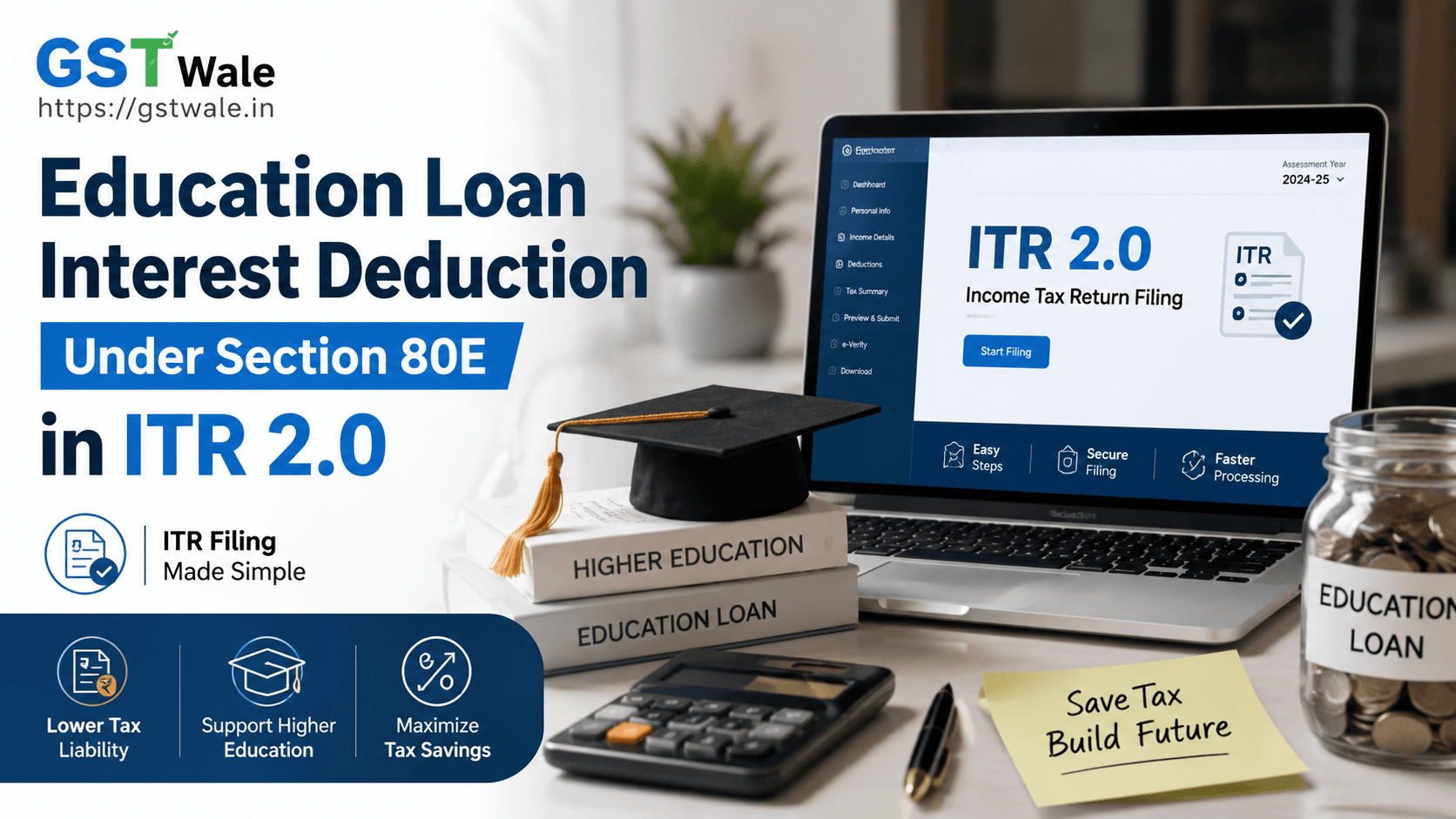
If you have taken an education loan for higher studies, you may be eligible for a valuable tax benefit under Section 80E of the Income Tax Act. While many taxpayers focus only on deductions under Sections 80C and 80D, Section 80E offers an excellent opportunity to reduce your taxable income by claiming the entire interest paid on your education loan. Understanding how to claim this benefit correctly in itr 2.0 can help you maximize your tax savings while ensuring complete compliance.
Whether you are filing your own income tax return form or seeking professional assistance, knowing the correct process is essential. If you need expert support for ITR Filing, GST Wale can help you prepare and submit your return accurately while ensuring you claim every eligible deduction.
Understanding Section 80E in itr 2.0
Section 80E allows taxpayers to claim a deduction for the interest paid on an education loan taken for higher education. Unlike several other deductions, there is no upper monetary limit on the interest amount that can be claimed. This makes Section 80E one of the most beneficial provisions for students and parents managing education loans.
When filing itr 2.0, taxpayers should carefully verify their interest certificate and ensure that only the interest component is claimed. The principal repayment does not qualify for deduction under this section.
Who Can Claim Education Loan Interest Deduction?
You can claim the deduction under Section 80E if you satisfy the following conditions:
- You are an individual taxpayer.
- The education loan has been taken from a recognized bank or approved financial institution.
- The loan is taken for higher education.
- The loan is for yourself, your spouse, your children, or a student for whom you are the legal guardian.
- You are paying the interest on the loan.
If these conditions are fulfilled, claiming the deduction in itr 2.0 becomes straightforward.
What Is Considered Higher Education?
Higher education refers to any course of study pursued after passing the Senior Secondary Examination or its equivalent. This includes:
- Graduation courses
- Postgraduate programs
- Professional courses
- Engineering
- Medical education
- Management studies
- International education
- Vocational courses after Class 12
The deduction is available irrespective of whether the education is pursued in India or abroad.
Benefits of Claiming Section 80E in itr 2.0
No Maximum Deduction Limit
One of the biggest advantages is that there is no ceiling on the amount of interest that can be claimed. If your annual interest payment is substantial, the entire eligible amount can be deducted while filing itr 2.0.
Available for Eight Assessment Years
The deduction is available from the year you begin repaying the interest and continues for eight consecutive assessment years or until the interest is fully paid, whichever is earlier.
Supports Long-Term Tax Planning
Education loans often extend over several years. Claiming deductions consistently through itr 2.0 helps reduce your tax liability during the repayment period.
Documents Required Before Filing itr 2.0
Keep the following documents ready before preparing your itr form:
- Interest certificate issued by the bank or financial institution.
- Loan sanction letter.
- PAN details.
- Salary documents or income records.
- Bank statements showing loan repayments.
- Supporting documents for other deductions, if applicable.
Maintaining proper documentation helps avoid issues if your return is selected for verification.
Step-by-Step Process to Claim Section 80E in itr 2.0
Step 1: Obtain the Interest Certificate
Request an annual interest certificate from your lender. This document clearly separates the principal and interest components.
Step 2: Choose the Correct Return
Select the appropriate income tax return form. Many salaried taxpayers with eligible income may use itr 2, while others should verify the applicable itr form based on their income sources.
Step 3: Enter Deduction Details
While completing itr 2.0, enter the eligible interest amount under the Section 80E deduction schedule exactly as mentioned in the bank certificate.
Step 4: Verify Information Carefully
Double-check all figures before submitting your return. Incorrect entries may delay processing or lead to notices from the Income Tax Department.
Step 5: Complete Verification
After submission, complete the verification process to successfully file income tax return online.
Practical Example
Suppose Rahul has taken an education loan for his MBA. During the financial year, he pays ₹1,65,000 as interest and ₹70,000 as principal repayment.
Under Section 80E, Rahul can claim the full ₹1,65,000 as a deduction while filing itr 2.0. The ₹70,000 principal repayment is not eligible under this section.
This reduces Rahul's taxable income significantly, helping him save a considerable amount of tax.
Common Mistakes to Avoid While Filing itr 2.0
- Claiming the principal repayment under Section 80E.
- Using loan statements instead of the official interest certificate.
- Claiming deductions for loans taken from relatives or friends.
- Selecting the wrong income tax return form.
- Entering incorrect interest figures.
- Ignoring verification after completing it filing.
Expert Tips from GST Wale
- Always collect the annual interest certificate before starting it filing.
- Keep digital copies of all supporting documents.
- Review your deduction details before final submission.
- Ensure your loan is from an eligible financial institution.
- Do not miss claiming Section 80E if you are eligible, as it can substantially reduce your tax liability.
Frequently Asked Questions
Can I claim both principal and interest under Section 80E?
No. Only the interest component of the education loan qualifies for deduction. The principal repayment is not eligible.
Can parents claim the deduction?
Yes. Parents can claim the deduction if they have taken the education loan for their child's higher education and are repaying the interest.
Is there any maximum deduction limit?
No. There is no upper limit on the amount of eligible interest that can be claimed under Section 80E.
Can I claim the deduction for education abroad?
Yes. Higher education pursued outside India also qualifies, provided all other conditions under Section 80E are satisfied.
How many years can I claim this deduction?
You can claim the deduction for up to eight consecutive assessment years from the year you begin repaying the interest or until the interest is fully repaid, whichever occurs earlier.
Claiming education loan interest deductions under Section 80E through itr 2.0 is one of the smartest ways to reduce your tax burden while investing in higher education. By understanding the eligibility conditions, maintaining proper documentation, choosing the correct itr form, and accurately reporting the interest amount, you can enjoy significant tax savings without any unnecessary complications.
At GST Wale, we help individuals, salaried professionals, students, and business owners complete their it filing accurately and confidently. If you want professional assistance to file income tax return online, maximize eligible deductions, and ensure error-free compliance, our experienced tax experts are ready to guide you every step of the way.
 Previous