


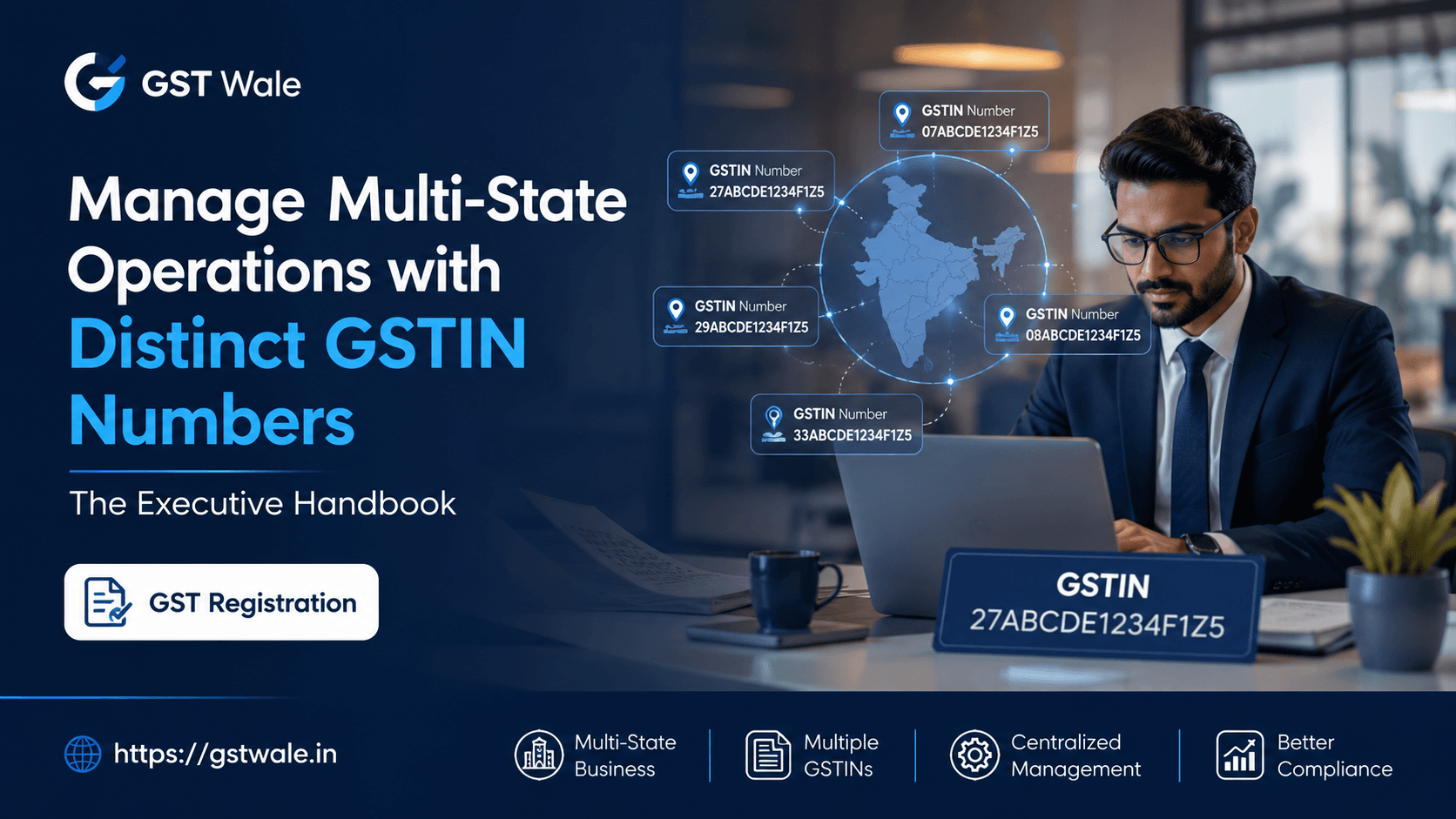
The Executive Handbook on Managing Multi-State Operations Under Distinct GSTIN Numbers
The Executive Handbook on Managing Multi-State Operations Under Distinct GSTIN Numbers
Managing a business that spans across different states in India is an exciting milestone, but it brings a unique set of regulatory challenges. As you expand, you will inevitably deal with the requirement of obtaining a separate gstin number for each state where you have an active business presence. At GST Wale, we have helped countless entrepreneurs navigate this landscape, and we understand that keeping your tax house in order is just as important as growing your sales. If you are just starting your expansion journey, you might want to look into our professional GST Registration services to ensure your initial setup is compliant from day one.
The complexity of handling multiple registrations often feels overwhelming. However, with the right structure, it can be a seamless part of your operations. Let’s break down how to effectively manage these distinct entities.
Understanding the Need for a Unique GSTIN Number
Under the current Goods and Services Tax (GST) framework, registration is state-specific. If you operate in Maharashtra and Karnataka, you cannot use a single registration for both. You must obtain a separate gstin number for each state.
This is not just a bureaucratic hurdle; it is a fundamental shift in how you handle accounting. Each gstin number acts as a distinct identity for your business in that jurisdiction. Consequently, every state registration must file its own GSTR-1, GSTR-3B, and other mandatory returns. If you have five state registrations, you are effectively managing five different tax entities.
Implementing Centralized ERP Tax Settings
One of the biggest mistakes we see business owners make is trying to manage multi-state operations using disjointed manual spreadsheets. To stay efficient, you need a centralized erp tax setting that can handle multiple registrations under a single master account.
A robust ERP setup allows you to:
Map your product HSN codes consistently across all branches.
Automate the calculation of IGST, CGST, and SGST based on the "Place of Supply."
Maintain a unified view of your input tax credit (ITC) across the country.
When you configure your software, ensure that each gstin number is mapped to the correct state code. This prevents the nightmare of "cross-billing" errors, where tax is collected under the wrong state entity.
Navigating the Rules for Transferring Stock Across States
Many business owners are confused about transferring stock across states. Under GST, even a movement of goods between your own branches (e.g., from your Delhi office to your Haryana warehouse) is considered a "supply."
Because these are two different branches under different registrations, you must issue a tax invoice for this transfer. This is a critical point:
Valuation: The value of the stock transfer must be declared correctly.
IGST Implication: When you move stock across state lines, you must charge IGST.
ITC Recovery: The receiving branch can claim this IGST as input tax credit.
Failure to document these internal transfers properly often leads to red flags during a multi-location compliance audit. Keep your stock transfer notes, e-way bills, and invoices perfectly synced with your gstin number records.
Mastering IGST Billing Rules for Inter-State Sales
When selling to customers outside your state, the igst billing rules kick in. The primary rule is simple: if the location of the supplier and the place of supply are in different states, IGST applies.
However, the "Place of Supply" can be tricky. For example, if you are a services company, the location of the recipient is often the deciding factor. If you hold a gstin number in the same state as the customer, you may need to charge CGST/SGST instead. Always verify the customer’s GST registration status to ensure your invoices are compliant.
Strategies for a Smooth Multi-Location Compliance Audit
When a tax officer visits or a notice arrives, having a clean audit trail is your best defense. A multi-location compliance audit is much easier to manage if you maintain a digital document repository for each gstin number.
Reconcile regularly: Ensure your GSTR-2B matches your purchase registers for every state.
Segment your records: Never mix the expenses of one branch with another.
Annual return filing: Treat each state’s GSTR-9 filing as an independent project with its own deadline and documentation.
Frequently Asked Questions (FAQs)
Do I need a separate gstin number for a warehouse in a new state?
Yes, if you store goods in a state, you are generally required to register that location, as it constitutes a "place of business" under GST law.
Can I share input tax credit between two different states?
No, you cannot directly transfer ITC from one gstin number to another. Each registration is treated as a distinct legal entity for the purpose of credit utilization.
What is the most common error in multi-state GST filing?
Misclassifying the "Place of Supply" and incorrect inter-branch invoicing are the two most common issues we see at GST Wale.
How do I consolidate my reports if I have 10+ registrations?
The best approach is to utilize an ERP that supports multi-branch consolidation, allowing you to pull a single report while filtering by specific state codes.
Managing operations across India is a sign that your business is thriving. While the compliance requirements associated with each gstin number can seem daunting, they are manageable with the right systems and expert guidance. By focusing on centralized erp tax setting, staying disciplined with igst billing rules, and preparing for your multi-location compliance audit proactively, you can focus on what you do best: running your business.
 Previous