


Ready Reference Guide: The GST New Rate List for the Printing and Paper Packaging Industry
Ready Reference Guide: The GST New Rate List for the Printing and Paper Packaging Industry
Navigating the complexities of indirect taxes can be a daunting task for business owners in the printing and paper packaging sector. At GST Wale, we understand that staying updated with the latest compliance requirements is not just a legal obligation but a necessity for maintaining healthy cash flows. If you are struggling to keep up with these evolving norms or need professional assistance with your GST Registration, we are here to simplify the process for you.
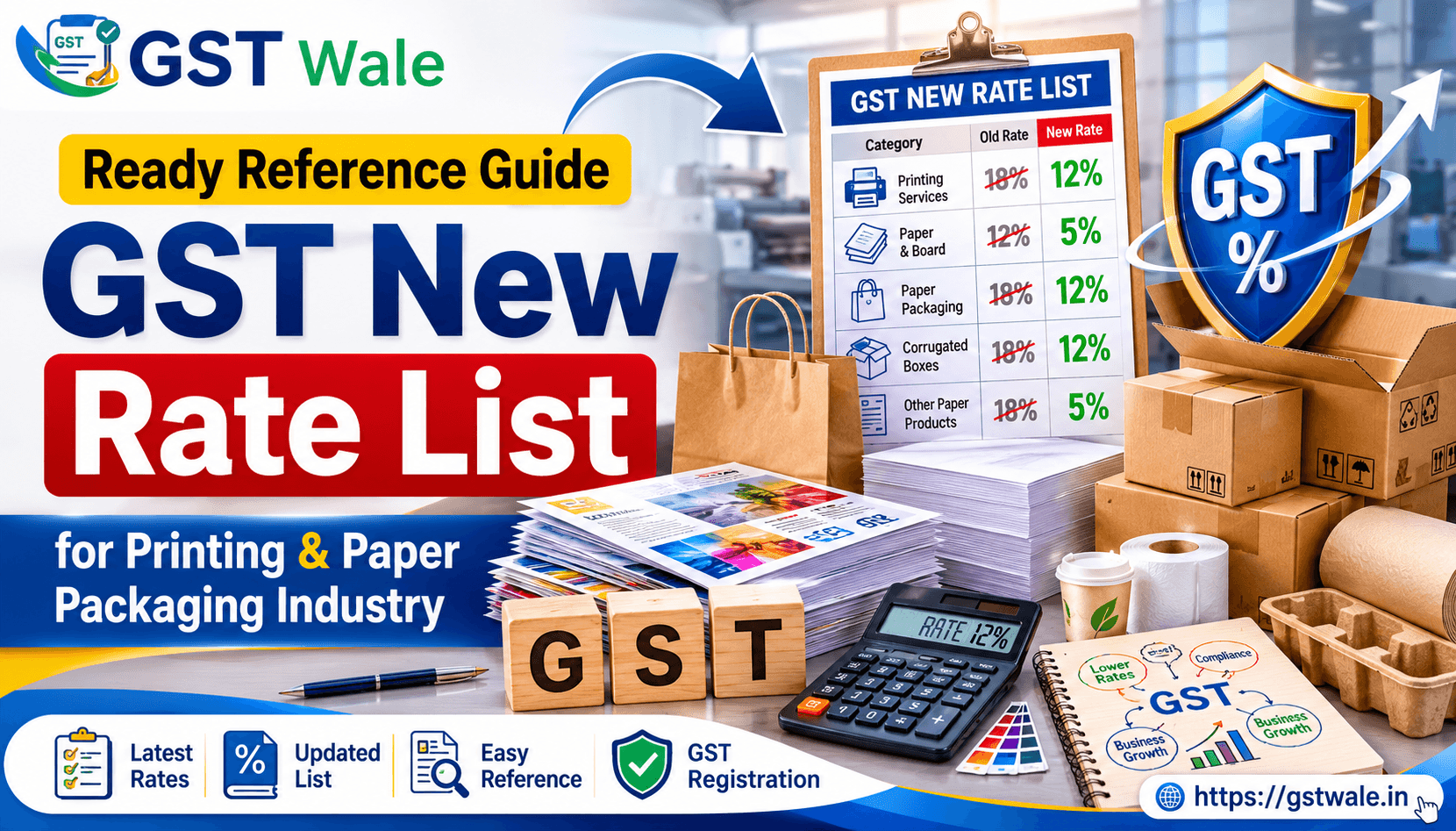
Understanding the gst new rate list is critical for printers, packaging manufacturers, and stationery businesses today. Following the significant rationalization of tax slabs, clarity on the gst new rate applicable to your products can help you avoid costly classification errors and ensure you are optimizing your Input Tax Credit (ITC) correctly.
Decoding the GST New Rate List for the Industry
The government has streamlined the tax structure to reduce the burden on essential supplies while categorizing luxury and specialized items under higher slabs. For our clients in the paper and printing industry, here is a breakdown of how the gst new rate list impacts your daily operations.
Key Changes in Paper and Packaging Slabs
The recent adjustments have brought much-needed relief to certain segments of the industry, particularly for packaging manufacturers:
Packaging Materials: Corrugated boxes, cartons, and cases—which were previously taxed at higher slabs—have seen a reduction in the tax burden. Most of these now fall under the 5% category, significantly easing the cost for businesses involved in transit packaging.
A4 and Copier Paper: High-volume items like A4 copier paper now attract a 5% GST, making them more affordable for office operations and commercial printing.
Paper Pulp: A positive shift has been observed for paper pulp produced from recovered waste. These have been moved to the 5% slab to encourage sustainable recycling practices.
Printed Materials and Educational Stationery
It is essential to distinguish between commercial printing and educational materials to apply the correct gst rates on your invoices.
Exercise Books Exempt: One of the most important takeaways for stationery dealers is that exercise books, graph notebooks, and lab notebooks are now exempt from GST (0% tax). This ensures that essential educational tools remain cost-effective for students.
Printed Materials Tax Cut: General printed materials, including books and newspapers, continue to enjoy the exempt status. However, remember that commercial advertising materials and brochures often attract an 18% rate, so proper classification is vital to prevent audit discrepancies.
The Impact of the GST New Slab Structure
With the shift toward a simplified gst new slab system, the industry is seeing a consolidation of rates into 5%, 18%, and 40% categories. While this simplifies filing, it has led to a paperboards tax hike in specific categories where items were previously taxed at lower rates.
For instance, certain specialized paperboards and non-educational printing papers have been realigned to the 18% slab. Furthermore, the wood pulp gst classification has become more granular; while basic pulp is treated favorably, dissolving-grade chemical wood pulp now attracts an 18% rate. We advise all our clients to verify their HSN codes periodically to ensure their tax outflow matches these current updates.
Expert Tips for GST Compliance
As your partners at GST Wale, we suggest keeping these three points in mind:
HSN Code Accuracy: Never guess your HSN code. Use the official government portal or consult an expert to confirm the code for every product category in your inventory.
Monitor Input Tax Credit: With the variation in output rates, ensure you are reconciling your GSTR-2B regularly. If you are selling at 5% but purchasing raw materials at 18%, your working capital will be tied up in refunds—managing this is key.
Invoicing Discipline: Always mention the correct HSN code and the specific tax percentage on every invoice to avoid disputes during verification.
Frequently Asked Questions
What is the current GST rate on exercise books?
Exercise books, graph notebooks, and laboratory notebooks are currently exempt from GST (0%).
Has the GST on paperboard packaging changed?
Yes, the government has rationalized rates for paper-based packaging. Many corrugated boxes and cartons now fall under the 5% slab, offering significant relief.
Do I need to update my GST registration if my product rates change?
No, you do not need to update your registration for rate changes. However, you must update your software and billing systems to reflect the gst new rate list to avoid charging customers incorrectly.
Can I claim ITC on printing machinery?
Yes, you can claim Input Tax Credit on the purchase of printers, scanners, and other machinery used for business operations, provided they are purchased with a valid GST invoice.
How does the 18% slab affect my business?
The 18% slab is the standard rate for most commercial printing services and specialized paper products. If your product does not fall under the exempt (0%) or lower-tier (5%) lists, it is likely taxed at 18%.
Staying compliant shouldn't be a hurdle in your path to growth. Whether you are dealing with a paperboards tax hike or simply want to ensure your business remains on the right side of the law, the team at GST Wale is here to support you. Let us handle the complexities of your tax filings so you can focus on what you do best—growing your business. Reach out to us today for expert guidance!
 Previous