


Masterclass: How to Handle Debit and Credit Notes in GST R 1
Masterclass: How to Handle Debit and Credit Notes in GST R 1
Masterclass: How to Handle Debit and Credit Notes in GST R 1
Filing gst r 1 correctly is one of the most important responsibilities for every registered taxpayer. While issuing invoices is straightforward, handling debit notes and credit notes often creates confusion. Many businesses make mistakes while reporting these documents, leading to mismatches, notices, or incorrect tax liability.
If you have recently completed your GST Registration, understanding how debit and credit notes are reported in gst r 1 will help you stay compliant from the very beginning. At GST Wale, we regularly assist businesses in correcting filing mistakes and ensuring their GST records remain accurate.
In this masterclass, we explain everything you need to know about debit and credit notes in gst r 1, along with practical examples, filing procedures, common mistakes, and professional tips.
Understanding Debit Notes and Credit Notes in GST R 1
Before learning the filing process, it is important to understand what these documents actually represent.
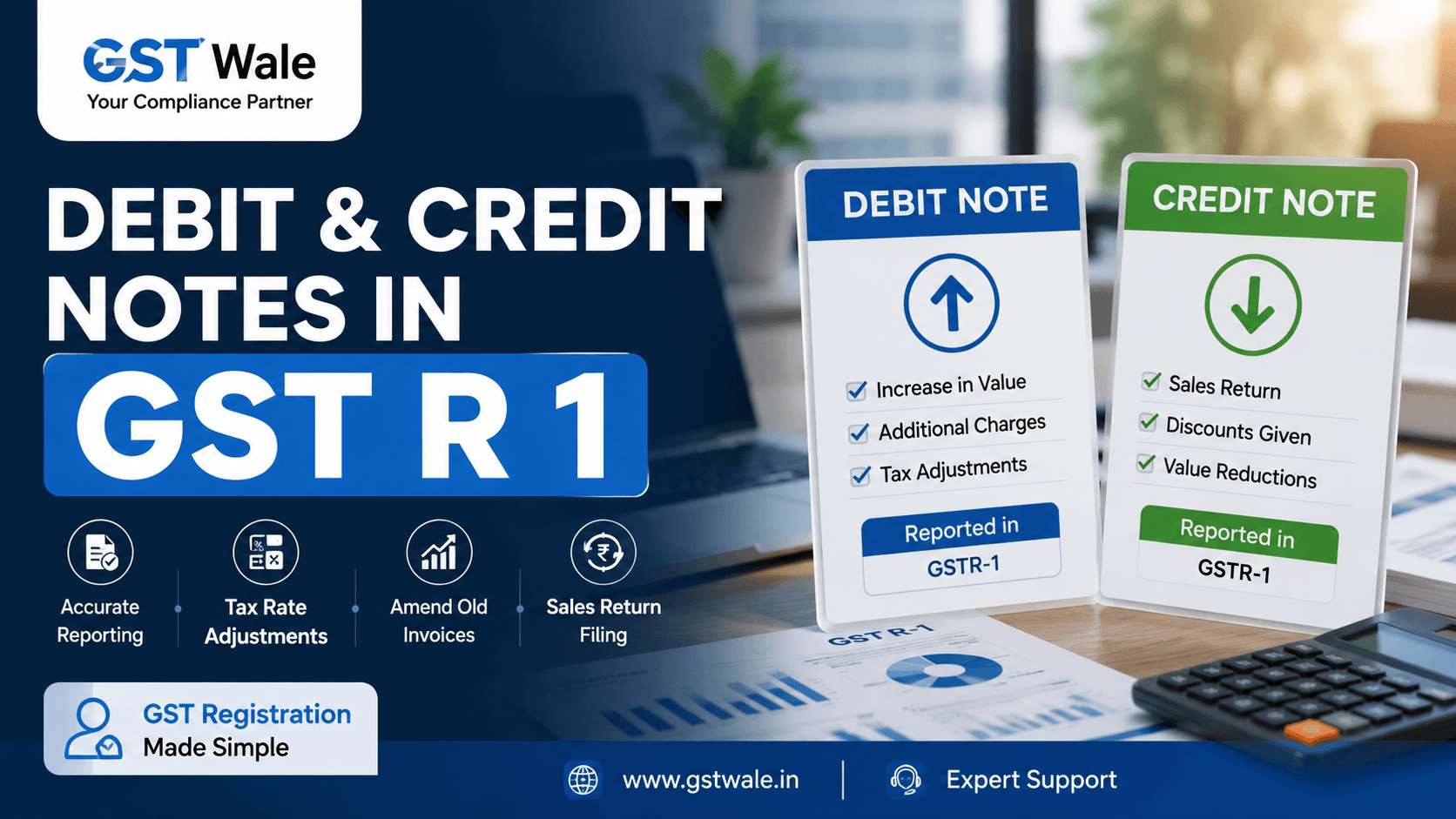
A debit note is issued when the taxable value or GST charged in an invoice needs to be increased after the original invoice has been issued.
A credit note is issued when the taxable value or GST liability needs to be reduced due to reasons such as:
- Sales return filing
- Discount offered after sale
- Goods returned by customers
- Cancellation of supply
- Reduction in taxable value
- Tax rate adjustments
Every debit note and credit note must be reported accurately in gst r 1 because these documents directly impact your tax liability as well as your customer's Input Tax Credit (ITC).
Why Proper Reporting in GST R 1 Matters
Incorrect reporting of debit or credit notes can create several issues including:
- GST notices from the department
- Mismatch with GSTR-3B
- Customer ITC mismatch
- Incorrect turnover reporting
- Delay in reconciliation
- Additional interest or penalties
Accurate gst r 1 filing helps maintain consistency between invoices, returns, and books of accounts.
Situations Where Debit Notes Are Issued
A debit note is generally issued in the following situations.
Increase in Product Price
Suppose you supplied machinery worth ₹1,00,000 but later discovered that ₹10,000 was omitted from the invoice. A debit note is issued for the additional amount.
Tax Rate Adjustments
Sometimes an invoice may be issued using an incorrect GST rate. If the correct rate is higher, the supplier can issue a debit note for the differential tax.
Additional Quantity Supplied
If extra goods are supplied after the original invoice without issuing a fresh invoice, a debit note may be used wherever applicable.
Situations Where Credit Notes Are Issued
A credit note is commonly issued under the following circumstances.
Sales Return Filing
One of the most common reasons for issuing a credit note is sales return filing. When customers return goods, the supplier reduces the taxable value using a credit note.
Post-Sale Discounts
If additional discounts are agreed upon after the invoice has been issued, a credit note helps reduce the tax liability.
Goods Found Defective
If damaged or defective goods are returned, the supplier can issue a credit note against the original invoice.
Order Cancellation
When an order is cancelled after invoicing but before completion, a credit note may be required.
How to Report Debit and Credit Notes in GST R 1
The GST portal provides a dedicated section for reporting debit and credit notes.
Follow these steps while filing gst r 1.
- Login to the GST Portal.
- Select the relevant tax period.
- Open the Debit/Credit Note section.
- Enter the original invoice details.
- Mention the note number and date.
- Select debit note or credit note.
- Enter revised taxable value.
- Verify GST amount.
- Save the details.
- Submit and file the return.
Always ensure that the original invoice details match the records available in your books.
Understanding Table 9 GSTR 1
Many taxpayers become confused while reporting amendments and corrections.
One important section is table 9 gstr 1.
This table is mainly used for:
- Amending old invoices
- Correcting previously filed invoice details
- Revising taxable value
- Updating tax amounts
- Correcting customer GSTIN
- Rectifying earlier reporting mistakes
If you have made an error in earlier returns, table 9 gstr 1 becomes extremely useful for making legitimate corrections.
Amending Old Invoices Without Errors
Businesses often need amending old invoices because mistakes may be identified after filing the return.
Common reasons include:
- Wrong GSTIN entered
- Incorrect invoice number
- Wrong taxable value
- Incorrect tax amount
- Invoice reported under wrong tax period
Whenever amending old invoices, always verify that:
- Original invoice exists
- Amendment belongs to the correct period
- Debit or credit note references are accurate
- Supporting documents are maintained
Proper documentation avoids unnecessary disputes during GST audits.
Continuous Supply of Goods and Debit Notes
Businesses involved in continuous supply of goods often raise invoices periodically instead of after every delivery.
Examples include:
- Infrastructure contracts
- Long-term manufacturing contracts
- Monthly industrial supplies
- Regular raw material supply agreements
During continuous supply of goods, price revisions may occur due to escalation clauses or revised agreements.
In such situations:
- Debit notes increase taxable value.
- Credit notes reduce taxable value.
- Every revision must be reflected correctly in gst r 1.
Maintaining proper contract documentation becomes extremely important for such businesses.
Practical Example
ABC Traders supplied electrical goods worth ₹2,00,000 with GST.
Later:
- Customer returned goods worth ₹20,000.
- Supplier issued a credit note.
- Taxable value reduced accordingly.
Another month:
- Freight charges worth ₹5,000 were omitted.
- Supplier issued a debit note.
- Additional GST became payable.
Both transactions must be reported accurately in gst r 1 during the relevant return period.
Common Mistakes Businesses Make
GST Wale frequently notices these errors during return reviews.
- Reporting wrong invoice reference
- Incorrect debit note date
- Wrong GST rate
- Duplicate reporting
- Missing credit notes
- Incorrect taxable value
- Not updating table 9 gstr 1
- Ignoring tax rate adjustments
- Delaying sales return filing
- Filing amendments in the wrong tax period
Avoiding these mistakes significantly reduces compliance risks.
Best Practices for Accurate GST R 1 Filing
Professional taxpayers follow a disciplined filing process.
Some useful practices include:
- Reconcile invoices every month.
- Verify debit and credit notes before filing.
- Match books with GST portal data.
- Maintain supporting documents.
- Review amended invoices carefully.
- Cross-check tax calculations.
- File returns before the due date.
- Conduct periodic GST reconciliations.
These habits make gst r 1 filing smooth and error-free.
Frequently Asked Questions
Is it mandatory to report debit notes in GST R 1?
Yes. Every debit note affecting taxable value or GST liability must be reported correctly in gst r 1.
Can a credit note reduce GST liability?
Yes. A valid credit note issued according to GST provisions can reduce the supplier's tax liability, subject to applicable conditions.
Where should amendments be reported?
Corrections relating to earlier returns are generally reported through table 9 gstr 1, depending on the nature of the amendment.
Can I issue multiple credit notes against one invoice?
Yes. Multiple credit notes can be issued if required, provided proper records are maintained and each document is reported correctly in gst r 1.
How can businesses avoid mistakes while filing GST R 1?
Regular reconciliation, maintaining proper documentation, reviewing debit and credit notes, and filing returns on time are the best ways to avoid errors in gst r 1.
Handling debit notes and credit notes correctly is essential for accurate gst r 1 filing. Whether the transaction involves sales return filing, tax rate adjustments, amending old invoices, table 9 gstr 1, or continuous supply of goods, every entry should be supported with proper documentation and reported in the correct tax period.
At GST Wale, we help businesses simplify GST compliance through expert guidance, accurate return filing, reconciliations, amendments, and practical solutions for complex GST issues. If you want your gst r 1 filings to be accurate, timely, and completely compliant, connect with GST Wale today and let our experienced professionals manage your GST responsibilities with confidence.
 Previous