


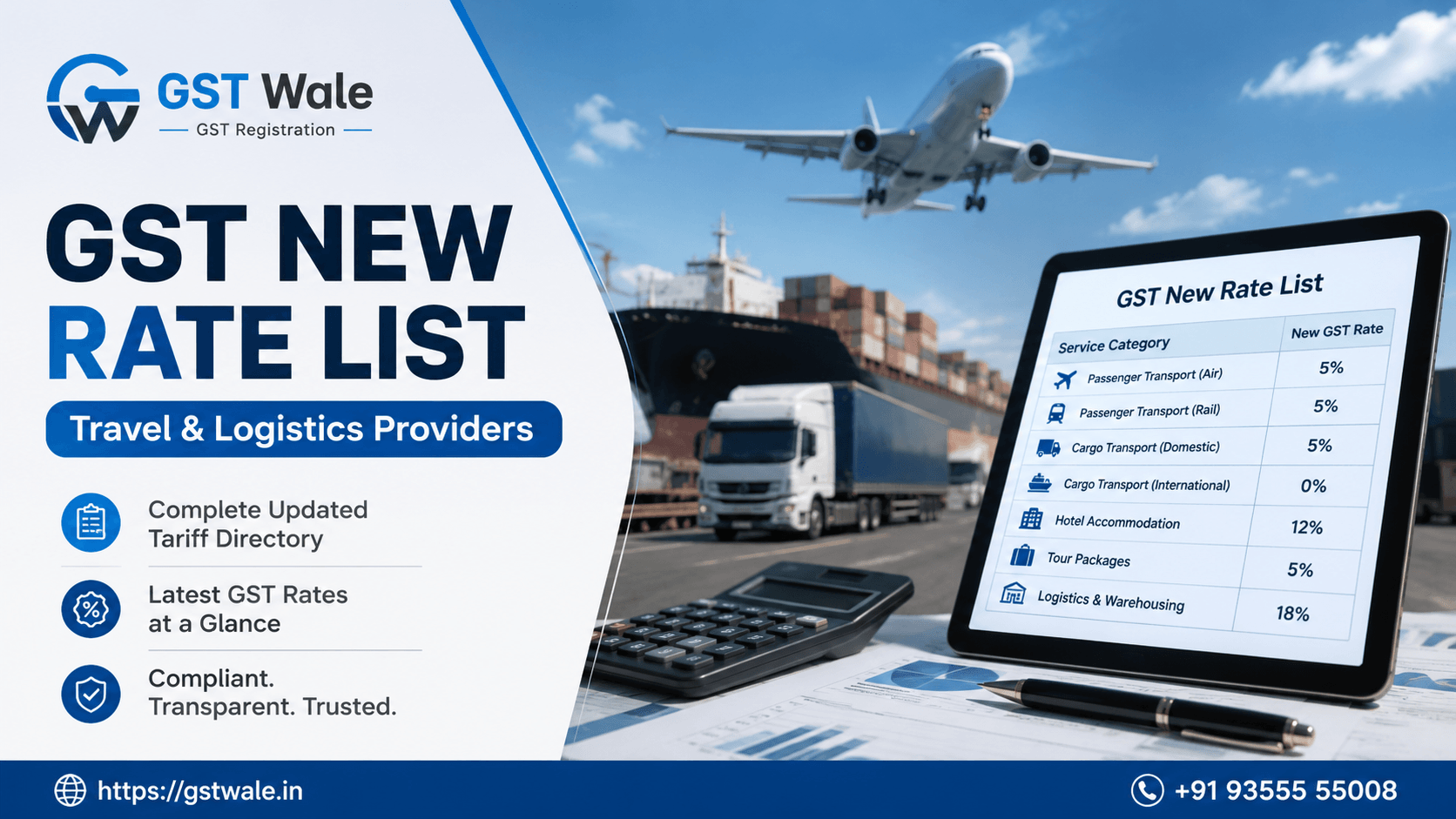
Complete Updated Tariff Directory: The GST New Rate List for Travel and Logistics Providers
Complete Updated Tariff Directory: The GST New Rate List for Travel and Logistics Providers
Understanding the ever-changing landscape of indirect taxes in India can feel like navigating a maze, especially for those in the fast-paced travel and logistics sector. As a Chartered Accountant, I often see business owners struggling to keep up with the latest amendments, which is why having an accurate, up-to-date gst new rate list is vital for maintaining compliance and avoiding unnecessary penalties. If you are just starting or looking to streamline your operations, you might also find our professional GST Registration services helpful to ensure your business foundation is rock-solid from day one.
In this guide, we at "GST Wale" will break down the current tax structure for 2026 so you can bill your clients with confidence and manage your input tax credits effectively.
Decoding the GST New Rate List for 2026
The government has focused on simplifying the tax structure to reduce the compliance burden on small and medium enterprises. The gst new rate list reflects a move toward rationalization, largely shifting away from the old four-slab structure to a more streamlined system. For logistics and travel providers, this means clear-cut distinctions between taxable, exempt, and concessional services.
It is crucial to understand that your tax liability often hinges on whether you opt for Input Tax Credit (ITC) or choose a lower tax rate without it. Let's look at how this applies to different transport modes.
Goods Transport and Logistics: What You Need to Know
For businesses involved in moving goods, the Goods Transport Agency (GTA) remains a significant point of discussion. Under the current rules, the gst new rate list provides two main paths for GTAs:
The 5% Route (No ITC): Ideal for smaller operators who prefer lower tax outflows and minimal compliance complexity.
The 18% Route (With Full ITC): Best suited for logistics firms with high operational expenses (fuel, vehicle maintenance, tires) as it allows you to claim credit on your business inputs, thereby lowering your overall tax cost.
Important Exclusions and Exemptions
Not every shipment attracts GST. The government has kept several essential goods outside the tax net to ensure affordability for the end consumer. Transport services for the following remain exempt:
Agricultural produce (wheat, paddy, fruits, vegetables).
Milk, salt, and food grains like flour, pulses, and rice.
Organic manure and newsprint.
Relief materials meant for disaster-hit areas.
Passenger Transport: A Closer Look at Rates
Travel and tourism service providers must be meticulous with their billing, as the gst new rate list categorizes travel modes quite differently.
Air Travel and Luxury Services
Economy Class: These tickets generally attract a 5% GST rate without the benefit of ITC.
Business Class: To reflect the premium nature of these services, they are taxed at 18%, and importantly, businesses can often claim this as an Input Tax Credit if the travel is for work purposes.
Luxury Cruise Liners Billing: These are considered high-end services and typically fall under the 18% slab. Operators must ensure accurate HSN coding to avoid classification disputes.
Rail and Road Transport
Railways: Freight services are generally taxed at 5%. For passengers, AC and First-Class tickets attract 5% GST, while sleeper and general class, along with Metro services, remain exempt.
Taxis and Cabs: Whether you operate a fleet or use an app-based aggregator, the standard rate for AC taxi services is 5% (without ITC). However, if you rent out cars with a driver, you may opt for either 5% (no ITC) or 18% (with ITC), depending on your business model.
Expert Advice: Managing Your Compliance
At "GST Wale," we often advise our clients that compliance is about more than just paying the right percentage. Here are three tips to keep your logistics or travel business audit-ready:
HSN/SAC Code Accuracy: Always verify your Service Accounting Codes (SAC). Using the wrong code is the quickest way to get a notice from the tax department.
RCM Vigilance: If you are a business receiving GTA services, don't forget your Reverse Charge Mechanism (RCM) obligations. In many cases, the liability to pay GST falls on you, not the transporter.
ITC Reconciliation: Regularly match your purchase register with GSTR-2B. If you are operating under the 18% slab, missing out on even a small amount of ITC can hurt your bottom line.
Frequently Asked Questions
Is the 12% GST slab still applicable for transport services?
No, the 12% slab has largely been phased out in the new rationalized structure. Most services have migrated to either the 5% or 18% slabs depending on ITC eligibility.
Can I change my GST payment option for GTA services mid-year?
Generally, no. The option to pay under forward charge (5% or 18%) must be exercised at the beginning of the financial year and remains locked for the entire period.
Are economy flight ticket tax rates the same for everyone?
Yes, the 5% rate for economy air travel is standard. However, businesses can claim ITC on air travel used for official purposes, provided they have a valid tax invoice.
Do I need to register for GST if I am a small taxi operator?
If your aggregate turnover is below the threshold limit (typically ₹20 lakh for services), you are generally not required to register. However, once you cross this limit, registration becomes mandatory.
Partner with GST Wale
Staying updated with the gst new rate list is a continuous process. Laws change, and your business needs to adapt quickly to remain competitive and compliant. Whether you need help with filings, SAC code classification, or navigating the complexities of ITC, we are here to support you.
 Previous