


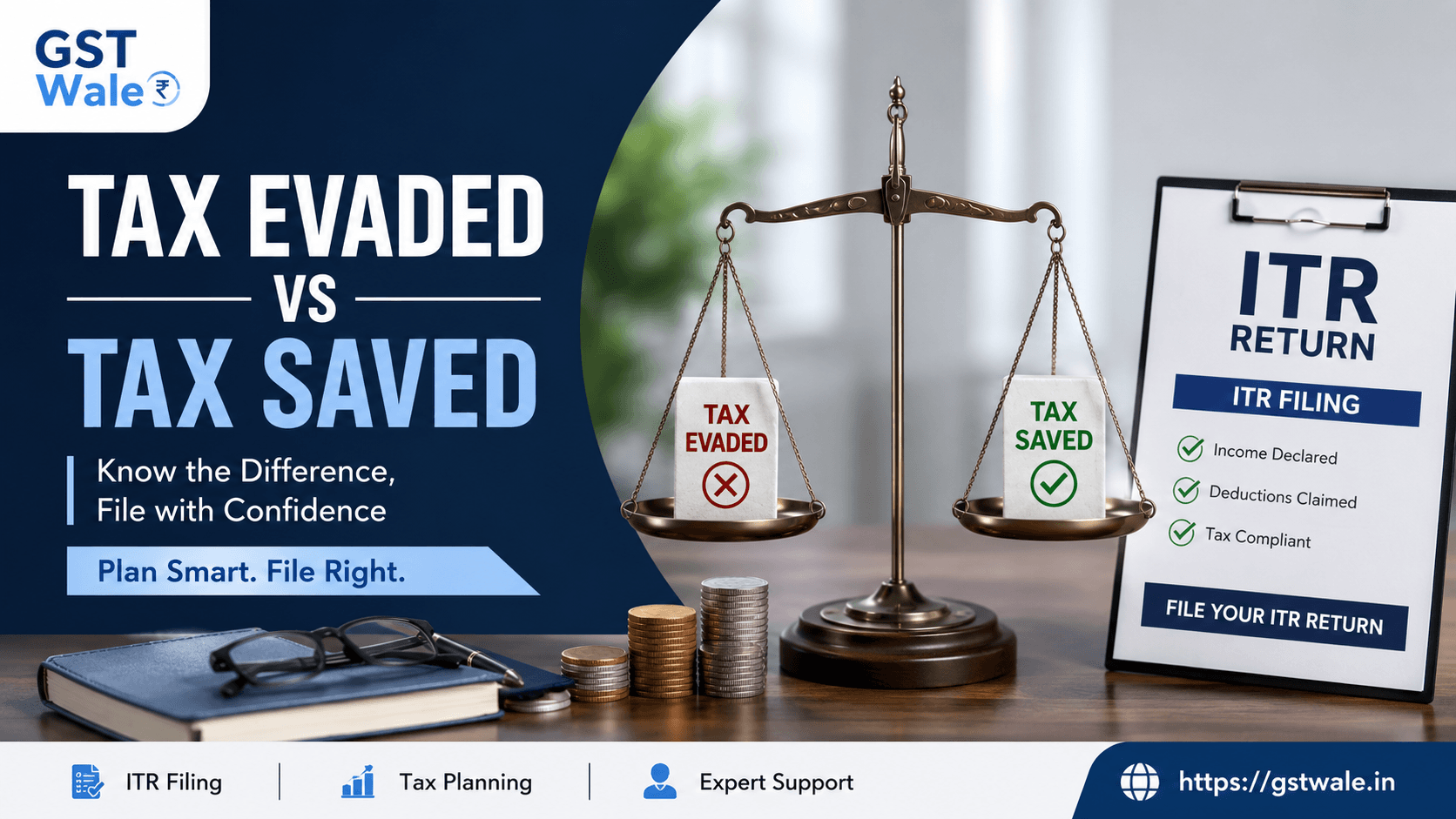
Understanding the Difference Between Tax Evaded vs Tax Saved When Planning Your ITR Return
Understanding the Difference Between Tax Evaded vs Tax Saved When Planning Your ITR Return
As tax season approaches, many business owners and salaried individuals find themselves walking a fine line. It is common to feel the pinch when looking at your tax liability, but the way you approach your ITR return can be the difference between a peaceful financial year and a stressful encounter with the Income Tax Department. At GST Wale, we believe that staying compliant shouldn't feel like a punishment. If you are looking for professional support, you can explore our ITR Filing services to ensure your documents are handled with precision and care.
When preparing your ITR return, it is crucial to understand the thin, yet distinct, boundary between smart financial planning and illegal practices. Let’s break down these concepts in simple, everyday language.
The Fine Line: Tax Avoidance vs. Tax Evasion
The most common mistake taxpayers make is confusing "tax saving" with "tax evasion." While both aim to keep more money in your pocket, the methods—and the consequences—are poles apart.
What is Tax Saving?
Tax saving is the cornerstone of ethical financial planning. It involves utilizing the provisions provided by the government to reduce your total tax liability. When you invest in PPF, claim HRA, or utilize health insurance premiums under Section 80D, you are engaging in legal tax planning. The government encourages this because it channels money into specific sectors like infrastructure, retirement funds, and healthcare.
What is Tax Evasion?
Tax evasion is a criminal act. It involves intentionally misrepresenting your financial affairs to the tax authorities. This includes hiding income, inflating expenses, or failing to report certain assets. When you are filing your ITR return, choosing to hide cash sales or claiming fake invoices to lower your profit margins is a direct violation of income tax guidelines.
Why Smart Taxpayers Choose Legitimate Tax Saving Deductions
The beauty of the Indian tax system is that it offers plenty of legitimate tax saving deductions for those who plan ahead. Instead of trying to "outsmart" the system, focus on maximizing your benefits legally:
Chapter VI-A Deductions: Familiarize yourself with sections like 80C, 80D, and 80G. These sections are specifically designed to reward taxpayers for savings and contributions.
Business Expenses: If you are a business owner, ensure that all your business-related expenses are documented properly. Genuine expenses are your best tool to lower your taxable income before you file your ITR return.
Capital Gains Planning: Understand how long-term vs. short-term capital gains work. Holding assets for the right duration can significantly change your tax outcome.
The Consequences of Evasion: Is It Worth the Risk?
In the digital era, the Income Tax Department uses advanced data analytics and AI-driven tools to track high-value transactions. Every credit card swipe, property purchase, or large cash deposit is linked to your PAN.
When you choose evasion over compliance, you aren't just risking a penalty; you are risking your peace of mind. Under the current income tax guidelines, penalties for under-reporting or misreporting income can range from 50% to 200% of the tax sought to be evaded. Furthermore, repeat offenders may face prosecution and jail time. Simply put, the cost of being "clever" is far higher than the tax you were trying to save.
How to Approach Your ITR Return with Confidence
Transitioning from a mindset of evasion to one of planning requires a proactive approach. Here is how you can ensure your ITR return is both compliant and optimized:
Maintain Accurate Records: Keep your invoices, bank statements, and investment proofs organized throughout the year.
Stay Updated: Tax laws change frequently. Keep an eye on budget announcements or subscribe to updates from reliable sources like GST Wale.
Consult a Professional: If you are unsure about whether an expense is deductible, ask a Chartered Accountant. It is always better to pay a small fee for professional advice than a heavy fine to the government later.
Frequently Asked Questions
Is it legal to structure my salary to reduce tax?
Yes, structuring your salary (like including food coupons, internet reimbursements, or transport allowances) is a form of legitimate tax planning allowed under the law.
Can I claim personal expenses as business expenses?
No. Only expenses incurred wholly and exclusively for the purpose of your business can be deducted. Mixing personal and business expenses is a red flag for the tax department.
What happens if I make a mistake in my ITR return?
If you discover an error after filing, you can always file a "Revised Return" within the prescribed time limits to rectify the mistake and avoid unnecessary scrutiny.
Does the government track small cash transactions?
While small, occasional cash transactions might go unnoticed, the aggregation of these transactions is monitored. It is always best to maintain a clean trail of all your financial dealings.
Secure Your Financial Future with GST Wale
At the end of the day, your ITR return is a reflection of your financial discipline. By embracing ethical financial planning and making full use of legitimate tax saving deductions, you can minimize your liability while staying well within the bounds of the law.
Don't let the complexity of tax laws hold you back. At GST Wale, we simplify the process, ensuring that your compliance is perfect and your tax savings are maximized. Ready to file your returns the right way? Contact our team today and let us handle the paperwork while you focus on growing your business.
 Previous