


Ultimate Guide to ITR 3: Tax Filing for Businesses and Professionals
Ultimate Guide to ITR 3: Tax Filing for Businesses and Professionals
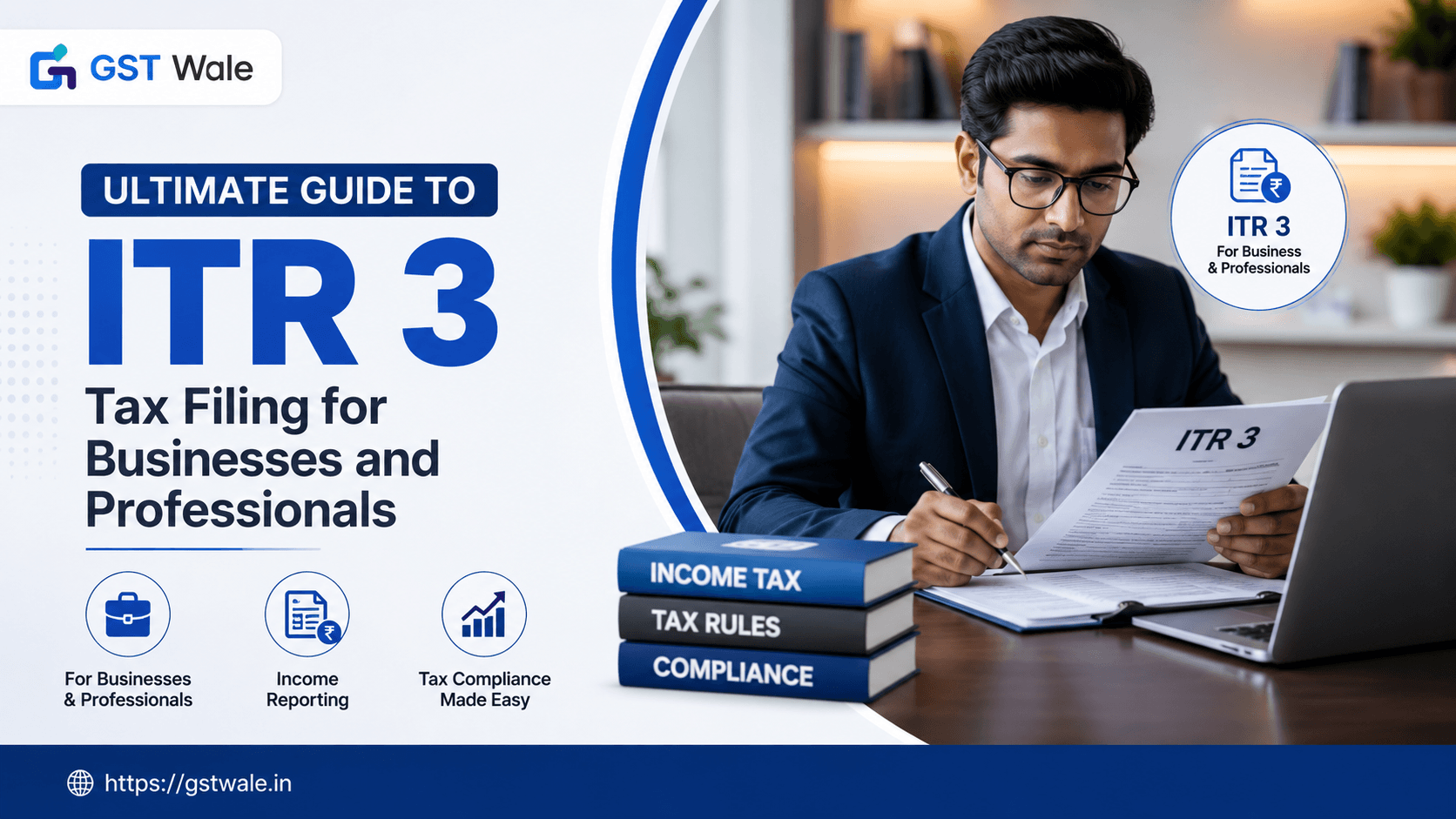
Managing taxes can often feel like solving a complex puzzle, especially when you are running a business or practicing as a professional. Every year, taxpayers struggle to choose the right form, and if you fall under specific categories of business income, you must file itr 3. We understand that navigating the Income Tax department's portal can be daunting, which is why at GST Wale, we make your ITR Filing process seamless, transparent, and hassle-free. Let us break down everything you need to know to ensure your compliance is top-notch.
Who is Eligible to File ITR 3?
The itr 3 is considered the most comprehensive among all income tax return form varieties. It is specifically designed for individuals and Hindu Undivided Families (HUFs) who earn income from a business or profession. Unlike simpler forms, this itr form allows for the reporting of income from multiple heads.
You are required to use this form if:
You are an individual or HUF having income from a proprietary business or profession.
You are a partner in a firm, and your income includes your share of profit from the firm.
Your income includes salary, house property, capital gains, or income from other sources along with business or professional income.
You have opted for the presumptive taxation scheme under section 44AD or 44ADA but choose to declare income lower than the prescribed limits.
Why is ITR 3 Different from Other Forms?
Many clients often ask us why they cannot use a simpler form like ITR 1 or ITR 2. The fundamental difference lies in the nature of your income. While ITR 1 is for salaried individuals and ITR 2 is for those without business income, itr 3 is built to capture the intricacies of trade, manufacturing, or service-based earnings.
When you file it returns online, the department expects a detailed breakdown of your business expenses, balance sheets, and profit & loss accounts. Using an incorrect form can lead to a "defective return" notice, which is why it is critical to get your classification right from the start.
Essential Documents for Filing ITR 3
To ensure an error-free filing experience when you incometax return online, you need to organize your paperwork beforehand. As an experienced CA, I always advise my clients to keep the following documents ready:
Financial Statements: Your Profit & Loss Account and Balance Sheet.
Bank Statements: All business and personal bank accounts for the financial year.
TDS Certificates: Form 16A or Form 26AS to verify the tax already deducted.
Investment Proofs: Details of deductions under Chapter VI-A (like 80C, 80D, etc.).
GST Returns: Your filed GSTR-1 and GSTR-3B summaries to reconcile turnover.
Step-by-Step Guide to Filing ITR 3 Online
The process of filing can be structured into these simple phases:
Preparation and Reconciliation: Before you even log into the portal, reconcile your business income with the figures appearing in your AIS (Annual Information Statement) and TIS (Taxpayer Information Statement).
Portal Login: Visit the official Income Tax portal and log in using your PAN/Aadhaar credentials.
Form Selection: Select the assessment year and choose itr 3 from the list of available forms.
Schedule Filling: Fill in the various schedules provided in the form, such as Schedule BP (Business/Profession), Schedule CG (Capital Gains), and Schedule CYLA (Current Year Loss Adjustment).
Tax Computation: Calculate your total tax liability, including advance tax and self-assessment tax paid.
Verification: Once the details are verified, use your Aadhaar OTP or EVC to complete the e-verification process.
Common Mistakes to Avoid
Even seasoned professionals sometimes miss a detail or two. When managing your itr 3, avoid these pitfalls:
Mismatch in Turnover: Your reported turnover in ITR must match the turnover declared in your GST returns.
Ignoring Depreciation: Ensure you have correctly calculated and claimed depreciation as per the Income Tax Act rules.
Reporting Personal Expenses: Never mix personal expenses with business expenses in your P&L account.
Frequently Asked Questions
Is it mandatory to audit my books for ITR 3?
If your business turnover exceeds ₹1 crore (or ₹10 crores if 95% of receipts/payments are digital), or if you are a professional with gross receipts over ₹50 lakhs, a tax audit is mandatory.
Can I change my ITR form after submission?
If you realize you made a mistake, you can file a revised return under section 139(5) before the end of the assessment year or before the completion of assessment, whichever is earlier.
What happens if I file ITR 3 late?
Filing after the deadline may attract late fees under section 234F, and you may lose the right to carry forward certain business losses.
Can I file ITR 3 if I have salary income too?
Absolutely. One of the biggest advantages of itr 3 is that it consolidates income from all heads, including salary, into one return.
Filing your itr 3 is a significant responsibility that impacts your financial health and business compliance. While the process may seem technical, understanding the requirements is the first step toward tax efficiency. At GST Wale, we believe that every business owner deserves expert guidance to save on unnecessary tax burdens and penalties. Don't let the complexity of tax compliance keep you awake at night—let our team of Chartered Accountants handle your filings with precision and care. Contact GST Wale today to streamline your tax journey!
 Previous