


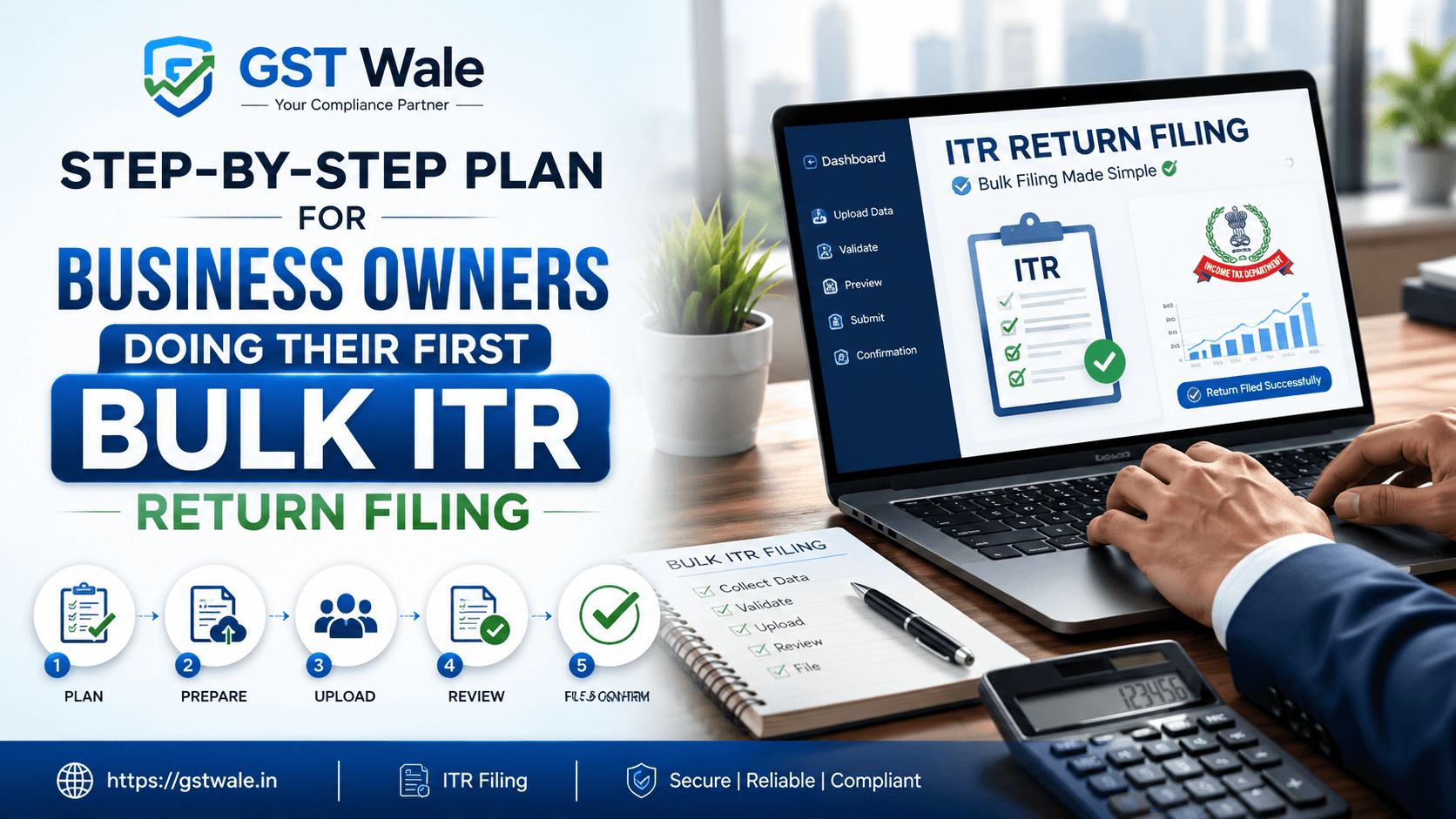
Step-by-Step Plan for Business Owners Doing Their First Bulk ITR Return Filing
Step-by-Step Plan for Business Owners Doing Their First Bulk ITR Return Filing
Managing the finances of a growing business is exciting, but as the tax season approaches, many entrepreneurs feel the heat. If you are preparing for your first bulk ITR return filing, you aren't alone. It is a significant milestone that marks your transition into a more organized, compliant corporate entity. At GST Wale, we believe that tax season shouldn't be a source of stress. Whether you need professional assistance with ITR Filing or simply need to understand the nuances of ITR return filing for your team, we are here to simplify the process.
Transitioning from individual tax compliance to handling corporate bulk tax filing requires a shift in mindset. You are no longer just looking at your own income; you are now responsible for the tax integrity of your business ecosystem. Let’s break down the essential steps to make this process seamless.
Getting Started: Preparing for Bulk ITR Return Filing
Before you even log into the Income Tax portal, the foundation must be laid. Business owners often make the mistake of rushing into the filing phase without proper documentation.
1. Data Collection and Reconciliation
The backbone of any business tax accounting strategy is clean data. Ensure you have the following ready:
PAN and Aadhaar: Verify these for all stakeholders and employees.
Form 16/16A: Essential for employee tax processing.
Bank Statements: Reconcile these with your ledger to ensure no discrepancies exist.
GST Data: Your GST filings should match your income records. Mismatches are a red flag for the tax department.
2. Streamlining Employee Tax Processing
When you move to a bulk model, managing your team’s data is the biggest hurdle. You need to create a structured business ITR flow. This means collecting investment declarations, rent receipts, and medical bills from employees well in advance. If your business has a large headcount, consider implementing a centralized payroll system that automates the generation of tax reports.
Implementing a Corporate Compliance Calendar
One of the biggest lessons I teach my clients at GST Wale is the importance of a corporate compliance calendar. Tax filing is not a one-day event; it is a year-long discipline.
Q1 (April - June): Begin documentation and internal audits.
Q2 (July - September): Execute bulk ITR return filing for employees and entities.
Q3 (October - December): Handle revisions and tax audits if applicable.
Q4 (January - March): Plan for the next financial year’s tax projections.
By adhering to this schedule, you avoid the last-minute rush, which is where most clerical errors occur. Errors lead to notices, and notices lead to unnecessary expenses.
The Technical Execution: How to File Efficiently
When dealing with high volumes, you cannot rely on manual entry for every single record. You must leverage bulk upload utilities provided by the Income Tax Department.
Why Automation Matters
Manual entry is prone to human error. Using XML or JSON utilities allows you to upload multiple records simultaneously. This is the gold standard for corporate bulk tax filing. Ensure that your accounting software is updated to the latest schema provided by the CBDT. If your business is scaling, it might be time to move away from Excel sheets and toward integrated tax software that generates these files automatically.
Reviewing the Final Data
Never hit "submit" without a comprehensive review. In my experience at GST Wale, the most common issues arise from small mistakes—like an incorrect bank account number or a mismatched TDS credit. Perform a "pre-flight check" by comparing the summary generated by the utility against your final balance sheet and profit-and-loss statement.
Frequently Asked Questions
Is it mandatory to use a professional for bulk ITR return filing?
While not legally mandatory, it is highly recommended for businesses. The complexity of business tax accounting and the potential for penalties make professional oversight a wise investment.
How do I handle tax discrepancies during the bulk upload?
If the system flags an error during the upload, do not force the file. Check the specific error code against the income tax department's help manual. Often, it is a simple mismatch in the PAN or a missing TDS entry.
Can I file late returns if I miss the deadline?
Yes, you can file a belated return, but you will be liable to pay interest under Section 234A and potentially a late filing fee. It is always cheaper and safer to stay within the timelines of your corporate compliance calendar.
How does GST Wale assist with the filing process?
At GST Wale, we provide end-to-end support, from consolidating your employee tax processing data to final validation and submission, ensuring your business stays compliant without the headache.
Your first bulk ITR return filing experience will set the tone for your business’s financial future. By prioritizing accuracy, staying organized, and following a structured business ITR process, you ensure that your business remains a clean, compliant entity in the eyes of the law.
Don't let the complexity of tax compliance hinder your growth. At GST Wale, we are passionate about helping businesses like yours master the art of compliance. If you find the process overwhelming or simply want to ensure that every decimal point is in the right place, reach out to us today. Let us handle the numbers so you can focus on scaling your business.
 Previous