


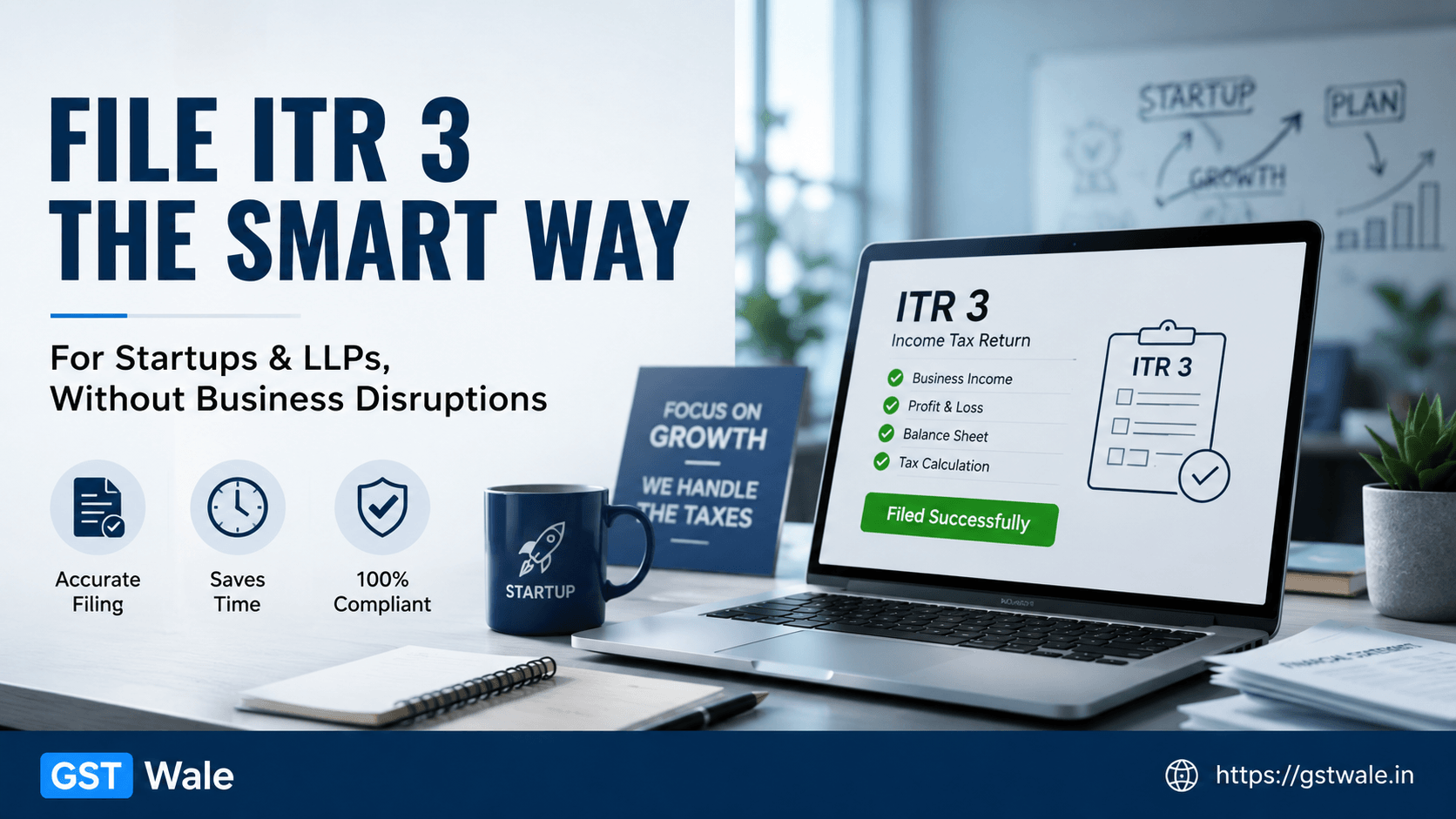
How Startups and LLPs Can Smoothly File ITR 3 Without Disrupting Business
How Startups and LLPs Can Smoothly File ITR 3 Without Disrupting Business
Running a business is a whirlwind of tasks, from managing operations to handling client demands. As an entrepreneur or a partner in an LLP, the last thing you want is a compliance roadblock stopping your momentum. Many business owners reach out to us at GST Wale, worried about the complexities of their annual tax obligations. If you are navigating your business financials, understanding the nuances of your ITR Filing is the first step toward a stress-free tax season. Today, we’re breaking down how to manage your itr 3 filing without letting it disrupt your daily hustle.
Understanding the Importance of ITR 3 for Your Business
When you are running a proprietorship or are a partner in an LLP, your income sources often span multiple categories—business profits, professional fees, capital gains, and even rental income. This is where the itr 3 comes into the picture. Unlike simpler forms like ITR-1 or ITR-4, the itr 3 is designed specifically for individuals and Hindu Undivided Families (HUFs) who have income from a profession or a proprietary business.
Think of it as a comprehensive report card of your financial health. Because it covers such a wide array of income sources, it requires careful preparation. If you don't file your itr 3 correctly, you risk inviting scrutiny from the Income Tax Department, which is definitely not the kind of attention any growing startup needs.
Why Proactive Planning Matters
Many business owners treat their taxes as a last-minute chore. By the time the deadline approaches, they are scrambling to find invoices, bank statements, and salary records. This reactive approach is exactly what leads to business disruption.
At GST Wale, we always advise our clients to treat tax compliance as a continuous process. When you maintain your books of accounts throughout the year rather than waiting for the year-end, filing your itr 3 becomes a simple, mechanical process rather than a stressful event.
Step-by-Step Guide to a Smooth Filing Process
To ensure your itr 3 filing goes through without a hitch, follow this structured approach:
1. Gather Your Financial Data Early
Before you even log into the income tax portal, ensure you have these documents ready:
Profit & Loss Statement and Balance Sheet: These are the backbone of your business disclosure.
Bank Statements: All business accounts must be reconciled.
Form 26AS and AIS/TIS: These documents from the Income Tax Department are crucial. They reflect the taxes deducted on your behalf (TDS) and other financial transactions. Always cross-check these with your own records.
2. Categorize Your Income Correctly
The itr 3 has various schedules for different income heads. Whether it is salary income, capital gains from selling shares, or business profits, ensure you are reporting them in their respective schedules. Mismatches here are a common reason for receiving "Defective Return" notices.
3. Leverage Professional Assistance
Let’s be honest: your time is better spent growing your business. Tax laws in India are dynamic, and small errors in an itr 3 filing—like incorrect depreciation calculation or missing out on a deduction—can lead to unnecessary tax outgo. Hiring a professional service provider allows you to focus on your vision while we handle the intricacies of your incometax return online.
Common Pitfalls to Avoid in Your ITR 3
Even experienced entrepreneurs can slip up if they aren't careful. Here are some traps to watch out for:
Ignoring the "New Tax Regime" vs. "Old Tax Regime": Always calculate which regime lowers your tax liability. It is a strategic decision that can save you significant money.
Forgetting to E-Verify: This is the most common mistake. Filing your return is only 50% of the job. You must e-verify your itr 3 using your Aadhaar OTP or net banking within the stipulated 30 days to complete the process.
Mismatched Data: Ensure that your turnover and profit figures match what you have reported in your GST filings (if applicable). The systems are now integrated, and discrepancies are flagged instantly.
Frequently Asked Questions
Is ITR 3 mandatory for all business owners?
Not necessarily. If you are eligible for the Presumptive Taxation Scheme under sections 44AD or 44ADA, you might be able to file the simpler ITR-4. However, if your business accounts are audited or your income structure is complex, itr 3 is the required income tax return form.
What happens if I file an incorrect ITR 3?
If you realize you made a mistake, you can file a "Revised Return" before the deadline or before the assessment is completed. However, it is always better to get it right the first time to avoid interest and penalty implications.
Can I file ITR 3 without maintaining books of accounts?
If you are declaring income under a presumptive scheme, you might have some flexibility. But for a full-scale business reporting in itr 3, maintaining proper books is not just a legal requirement—it is a best practice for business longevity.
How does TDS impact my ITR 3?
Any TDS deducted on your business receipts should be claimed as a credit in your itr 3. Ensure your Form 26AS is updated before you file to avoid refund delays.
Filing your itr 3 doesn't have to be a source of anxiety. With proper documentation, a clear understanding of your income sources, and a systematic approach, you can complete your annual it filing obligations without losing a single hour of productive business time. Remember, the goal of tax compliance is not just to pay what is due, but to optimize your financials so your business can thrive.
If you are looking for a partner to simplify the complexities of your itr form submissions, the team at GST Wale is here to help. Our experts specialize in making the process of filing itr 3 transparent, accurate, and completely hassle-free.
 Previous