


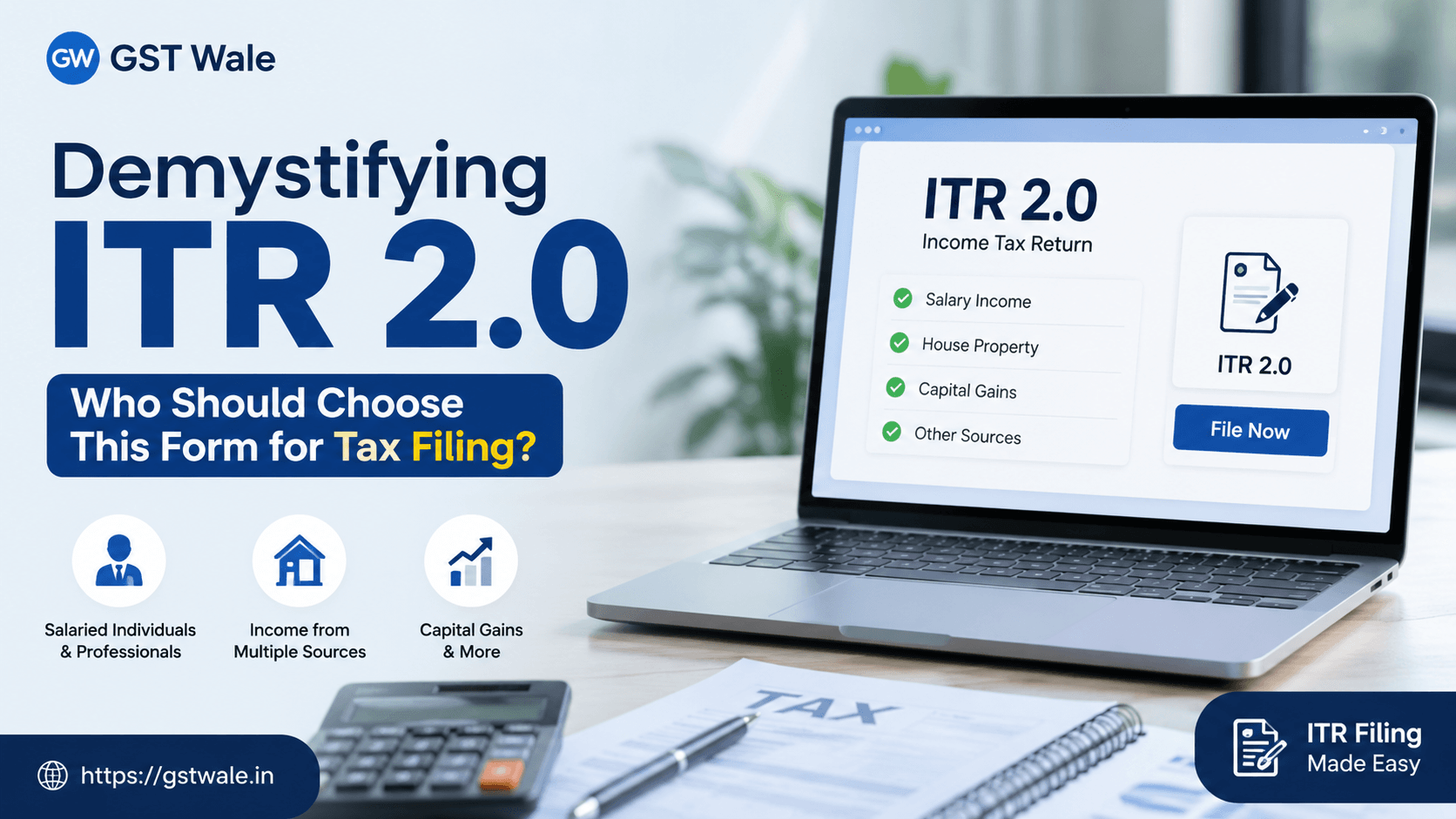
Demystifying ITR 2.0: Who Should Choose This Form for Tax Filing?
Demystifying ITR 2.0: Who Should Choose This Form for Tax Filing?
Navigating the landscape of Indian taxation can often feel like solving a complex puzzle, especially when you are trying to determine which form suits your financial profile. At GST Wale, we frequently receive queries about the nuances of tax forms, and lately, the term itr 2.0 has been gaining a lot of traction among taxpayers. While many taxpayers are familiar with the standard forms, understanding when to move to a more detailed return is crucial. If you have been searching for professional guidance on the subject, we offer comprehensive ITR Filing services to ensure your compliance is handled with precision.
Understanding the Need for ITR 2.0
When we talk about the evolution of tax compliance, the term itr 2.0 often arises in professional circles to describe the current, more structured nature of the ITR-2 form. Unlike the simpler ITR-1, which is meant for basic salary and house property income, the ITR-2 is a more sophisticated vehicle designed for individuals and Hindu Undivided Families (HUFs) who have a broader spectrum of income sources but do not fall under the category of business or professional income.
As a Chartered Accountant, I often tell my clients that choosing the right form is half the battle won in avoiding scrutiny from the tax department. Misfiling your returns can lead to unnecessary notices, and that is exactly what we want to avoid.
Who Exactly Should Choose ITR 2.0?
You might be wondering if your specific financial situation mandates the use of itr 2.0. Generally, this form is applicable if you meet any of the following criteria:
Income from Capital Gains: If you have sold shares, mutual funds, or real estate and earned a profit (or incurred a loss), you are required to use this form.
Multiple House Properties: While ITR-1 covers a single house property, if you own more than one and derive rental income from them, you must step up to the ITR-2.
Foreign Income or Assets: Individuals who have foreign bank accounts, financial assets, or income generated outside India are mandated to file using this form.
Directorships and Investments: If you are a director in any company or hold unlisted equity shares at any point during the financial year, this is the form for you.
High Agricultural Income: If your agricultural income exceeds ₹5,000, you are ineligible for the simpler forms and must utilize this one.
Income from Other Sources: This includes winnings from lotteries, horse races, or other betting/gambling activities, which often require detailed reporting.
Why Accuracy Matters in Your Tax Return
Many taxpayers make the mistake of attempting to file their returns in a hurry. When you use itr 2.0, the complexity of the data required is higher. You need to be meticulous with your capital gains statements, foreign asset disclosures, and details regarding your directorships.
A common pitfall we see at GST Wale is the failure to reconcile the Annual Information Statement (AIS) with the data being keyed into the form. The tax department’s systems are highly automated now, and any mismatch between your reported income and the data they hold can trigger a flag.
Frequently Asked Questions
Is there a difference between ITR-2 and ITR 2.0?
In professional tax parlance, "itr 2.0" is often used colloquially to refer to the current, updated version of the ITR-2 form that accommodates modern financial complexities like crypto assets and enhanced foreign asset reporting. It is effectively the same as the standard ITR-2 form.
Can I file ITR 2.0 if I have business income?
No. If you have income under the head "Profits and Gains of Business or Profession," you cannot use ITR-2. You would need to file ITR-3 or ITR-4, depending on the nature and structure of your business.
Is the deadline for filing ITR 2.0 the same as others?
Generally, for individual taxpayers not subject to an audit, the deadline for filing is July 31st of the assessment year. However, it is always wise to keep an eye on official announcements for any extensions.
What documents do I need to prepare?
You will typically need your Form 16, Form 26AS, your Annual Information Statement (AIS), capital gains statements from your broker, and details of any foreign investments or bank accounts.
Expert Advice from GST Wale
Tax compliance is not just about filing; it’s about strategic planning. Whether you are dealing with complex capital gains or managing multiple income streams, the right documentation is key. Using itr 2.0 correctly ensures that you are transparent with the authorities and protects you from future litigation.
If you are unsure about your eligibility or feel overwhelmed by the technicalities of the forms, you don't have to do it alone. At GST Wale, we specialize in simplifying taxes. Our team of experts is ready to help you navigate your obligations and ensure that your tax filing process is smooth and stress-free. Let us take the burden of compliance off your shoulders. Reach out to GST Wale today and ensure your financial records are in expert hands!
 Previous