


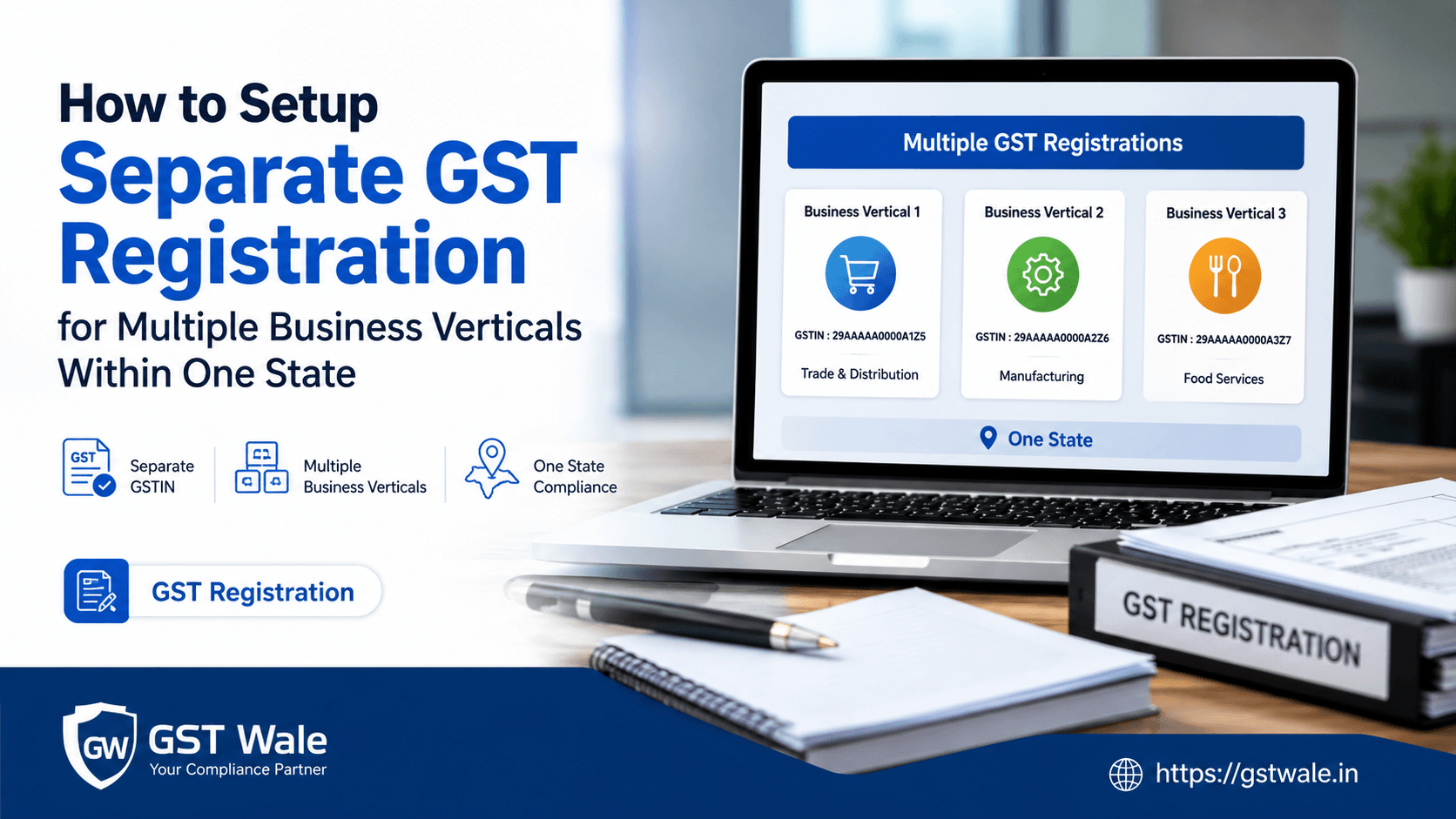
How to Setup a Separate GST Registration for Multiple Business Verticals Within One State
How to Setup a Separate GST Registration for Multiple Business Verticals Within One State
Managing multiple business lines under a single roof is an exciting milestone for any entrepreneur in India, but it brings specific tax complexities. Many business owners assume they must operate everything under one roof for tax purposes, but the law actually offers more flexibility. If you are looking to streamline your operations, understanding the nuances of gst registration is your first step. At GST Registration, we help businesses navigate these hurdles daily, ensuring your compliance is as sharp as your business strategy.
In this guide, we will break down the process of obtaining a separate gst registration for multiple business verticals within the same state, a move that can simplify your accounting and tax compliance significantly.
Understanding Business Verticals Under GST
Before diving into the technicalities, let’s clarify what the law considers a "business vertical." According to the CGST Act, a business vertical is a distinguishable component of an enterprise that is engaged in the supply of individual goods or services, or a group of related goods or services, and is subject to risks and returns that are different from those of the other business components.
For example, if you run a textile manufacturing unit and also operate a high-end restaurant within the same state, these are distinct business verticals. You may choose to consolidate them or treat them as separate legal entities under the GST framework.
Why Opt for Separate GST Registration?
Many clients ask us at GST Wale, "Why go through the hassle of extra paperwork" The answer often lies in the ease of business vertical accounting. When you maintain separate registrations for different verticals, you gain several advantages:
Distinct Compliance: Each vertical can manage its own inward and outward supplies, keeping data clean.
Segmented Reporting: It becomes much easier to track the profitability and tax liability of a specific unit without mixing it with your other ventures.
Audit Efficiency: During an audit, having distinct records prevents the "mingling" of expenses and credits, which is a common source of disputes with tax authorities.
When you hold multiple GSTIN single PAN accounts, remember that these are considered distinct persons under GST. This creates a legal requirement for you to treat transactions between these units carefully.
Step-by-Step: Obtaining Additional Registration
If you have decided that separate registrations are the right move for your company, the process for gst registration follows a specific path on the GST portal.
1. Verification of Eligibility
First, ensure that your business lines qualify as distinct verticals. The GST officer may verify whether these verticals have independent risk profiles and revenue streams.
2. The Application Process
Log in to the GST Portal: Use your existing PAN-based login credentials.
Form GST REG-01: Navigate to the registration section. You will need to file a new application (Form GST REG-01) for the additional place of business/vertical.
Select "Additional Registration": Indicate that you already hold a registration in the state and are applying for an additional one under the same PAN.
Separate Documentation: Even though you are the same entity, you must provide separate proof of address for the new vertical and clearly define the nature of the business activity.
3. Verification and Approval
Once submitted, the jurisdictional officer will verify your application. They might ask for clarifications regarding why separate goods and services tax registration is required. Be ready to provide your internal accounting documents as proof of the distinct nature of the verticals.
Important Considerations: The Cross Charge Mechanism
Once you possess separate registrations for different verticals within one state, you must be hyper-aware of the cross charge mechanism.
Since these units are treated as distinct persons under GST, any transfer of goods or services between them—even if it is just a head office allocating administrative costs to a branch—is considered a "supply." You are legally obligated to issue tax invoices for these internal transfers and pay the applicable GST. Failure to account for these transactions often leads to notices from the department.
Frequently Asked Questions (FAQs)
Q: Can I have multiple GST numbers in the same state? A: Yes, the GST law allows for a separate gst registration for each business vertical within the same state, provided they meet the definition of a business vertical.
Q: Is it mandatory to have separate registrations? A: No, it is entirely optional. It is a strategic business decision based on your need for better business vertical accounting.
Q: Do I need a separate PAN for every GSTIN? A: No. You will have multiple GSTIN single PAN, meaning the registration is linked to your existing PAN, but each unit gets a unique GST identification number.
Q: How does the cross charge mechanism affect my cash flow? A: It requires you to pay tax on internal supplies. However, since the recipient unit can generally claim this as an Input Tax Credit (ITC), the net impact is usually neutral, though it requires precise documentation.
Navigating the complexities of gst registration for multiple verticals can feel like a maze, but it doesn't have to be. Whether you are dealing with distinct persons under GST or simply trying to streamline your tax filings, professional guidance ensures you remain on the right side of the law.
At GST Wale, we specialize in making compliance simple. If you are unsure whether your business qualifies for a separate registration or need help managing your tax filings across multiple verticals, our team of expert CAs is here to help. Don't let tax confusion stall your business growth.
 Previous