


How to Report B2C Sales in GST R 1: A Simple Practical Guide
How to Report B2C Sales in GST R 1: A Simple Practical Guide
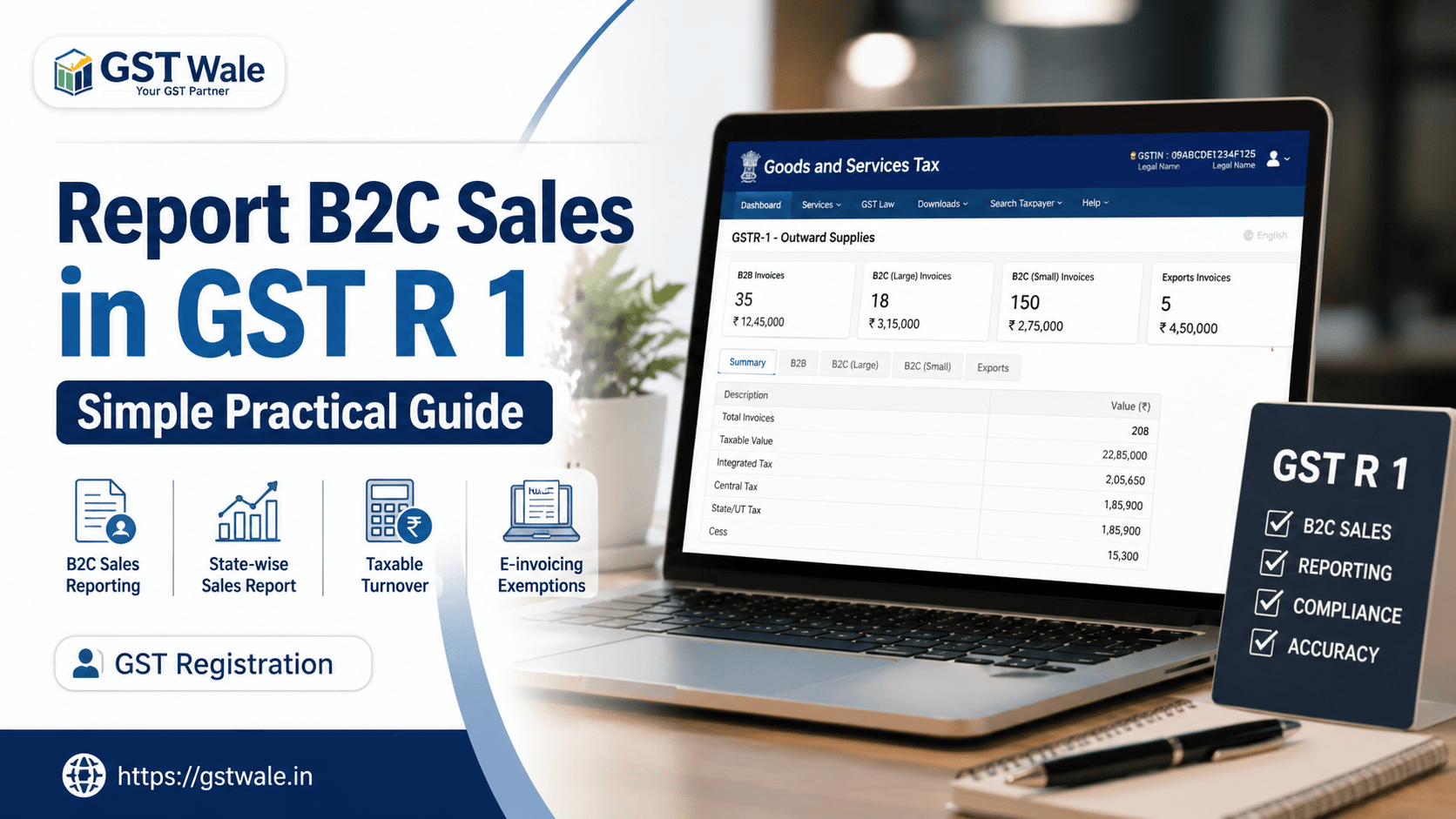
Filing gst r 1 correctly is one of the most important responsibilities for every registered business under GST. While many taxpayers understand how to report B2B invoices, reporting B2C sales often creates confusion. Questions such as whether invoices should be reported individually, how interstate sales are treated, and when state-wise reporting is required are common among business owners.
If you are a new taxpayer or planning your GST Registration, understanding gst r 1 from the beginning can help you avoid unnecessary notices and filing errors later. In this practical guide, GST Wale explains the complete process of reporting B2C sales in a simple and easy-to-understand manner.
Understanding B2C Sales in gst r 1
B2C (Business-to-Consumer) sales refer to transactions where goods or services are supplied directly to the final consumer who is not registered under GST.
When filing gst r 1, these sales are reported differently from B2B invoices because the buyer does not claim Input Tax Credit (ITC). Therefore, GST requires businesses to summarize or report these transactions based on prescribed rules instead of uploading every invoice in many cases.
Correct reporting ensures:
- Accurate GST liability
- Smooth reconciliation
- Better compliance
- Reduced chances of departmental notices
Why Accurate gst r 1 Reporting Matters
Incorrect reporting of B2C sales can lead to several problems including:
- GST mismatch with tax liability
- Wrong taxable turnover calculation
- Notices from the GST department
- Interest and penalties
- Difficulties during GST audits
A few extra minutes spent reviewing your gst r 1 can save significant time and money later.
B2C Large vs Small in gst r 1
One of the biggest areas of confusion is b2c large vs small reporting.
B2C Small
B2C Small transactions generally include:
- Intra-state sales to unregistered customers
- Smaller value interstate sales that qualify for summary reporting under applicable GST rules
These are usually reported in a consolidated manner without uploading each invoice individually.
B2C Large
B2C Large transactions generally involve higher-value interstate supplies to unregistered persons where invoice-level reporting is required as per the applicable GST provisions.
Businesses should always verify the latest GST notifications because reporting thresholds may change over time.
Understanding b2c large vs small correctly helps ensure proper compliance while filing gst r 1.
Step-by-Step Process to Report B2C Sales in gst r 1
Step 1: Separate B2B and B2C Transactions
Before filing, classify all sales into:
- B2B invoices
- B2C sales
- Exports
- Nil-rated supplies
- Exempt supplies
This reduces filing mistakes.
Step 2: Identify Interstate and Intrastate Sales
Separate sales based on:
- Within your state
- Outside your state
This becomes important while preparing the state-wise sales report.
Step 3: Calculate Taxable Value
Prepare the correct taxable turnover calculation by excluding:
- GST amount
- Exempt turnover
- Nil-rated supplies
- Non-GST supplies where applicable
The taxable value should exactly match your accounting records.
Step 4: Prepare State-wise Details
For applicable B2C interstate transactions, prepare a proper state-wise sales report including:
- State
- Taxable value
- Applicable GST
- Invoice details wherever required
Step 5: Upload Details in gst r 1
Log in to the GST portal and:
- Select the return period.
- Open the relevant B2C reporting section.
- Enter invoice-wise or consolidated details as applicable.
- Verify tax values.
- Save the information.
- Preview the return.
- Submit and file using DSC or EVC.
Reviewing everything before final submission is always recommended.
How State-wise Sales Report Helps
A proper state-wise sales report helps businesses:
- Maintain accurate GST records
- Match accounting data
- Identify reporting errors
- Improve reconciliation
- Simplify future audits
Many businesses prepare monthly state-wise summaries before filing gst r 1, making the process much easier.
Reporting E-commerce Sales in gst r 1
Businesses selling through online marketplaces often ask about e-commerce sales gstr 1.
If you sell through an e-commerce operator:
- Maintain separate records of portal sales.
- Match your data with TCS statements wherever applicable.
- Report sales under the appropriate GST tables.
- Reconcile portal reports with your books.
Proper reporting of e-commerce sales gstr 1 reduces future mismatches and improves GST compliance.
Taxable Turnover Calculation Made Simple
Correct taxable turnover calculation forms the foundation of accurate GST filing.
For example:
Suppose your monthly sales are:
- Taxable sales: ₹8,50,000
- Exempt sales: ₹1,20,000
- GST collected: ₹1,53,000
Only the taxable value should be considered while preparing the relevant sections of gst r 1. Mixing exempt turnover with taxable turnover can result in incorrect reporting.
Always reconcile:
- Sales register
- GST liability
- Accounting software
- Bank receipts
before filing.
E-invoicing Exemptions and Their Impact
Many small businesses worry about e-invoicing exemptions.
Businesses covered under applicable e-invoicing exemptions may not need to generate e-invoices, but they are still required to report eligible sales correctly in gst r 1.
Being exempt from e-invoicing does not remove the obligation to file GST returns accurately.
Therefore, understand whether your business qualifies for e-invoicing exemptions before preparing invoices.
Common Mistakes While Filing gst r 1
Avoid these common errors:
- Reporting B2B sales as B2C
- Wrong GST rate selection
- Incorrect taxable turnover calculation
- Missing interstate transactions
- Ignoring the state-wise sales report
- Duplicate invoice reporting
- Incorrect reporting of e-commerce sales gstr 1
- Filing without reconciliation
Small mistakes can result in unnecessary notices and corrections later.
Practical Example
Consider a retail electronics store located in Delhi.
During one month, it makes:
- Local customer sales worth ₹9,20,000
- Interstate consumer sales worth ₹1,40,000
- Marketplace sales through an e-commerce platform worth ₹2,10,000
The business first separates local sales, prepares the required state-wise details for applicable interstate transactions, reconciles the marketplace data, verifies the taxable turnover calculation, checks whether any e-invoicing exemptions apply, and finally files gst r 1 after matching the figures with its accounting software.
This simple workflow significantly reduces filing errors.
Best Practices for Accurate gst r 1 Filing
Follow these practical tips:
- Maintain daily sales records.
- Reconcile books every month.
- Verify GST rates.
- Review customer classifications.
- Prepare a state-wise sales report before filing.
- Cross-check marketplace transactions.
- Verify taxable turnover calculation.
- File returns before the due date.
- Keep supporting documents safely.
Following these habits makes gst r 1 filing much easier throughout the year.
Frequently Asked Questions
Is invoice-wise reporting required for all B2C sales?
No. Reporting depends on the nature of the transaction and the applicable GST rules. Certain transactions are reported in summary form, while others require invoice-level details.
What is the difference between B2C Large and B2C Small?
The distinction in b2c large vs small depends on factors such as the place of supply and applicable reporting requirements. Understanding the correct classification ensures accurate GST reporting.
Are e-commerce sales reported differently?
Yes. Proper reporting of e-commerce sales gstr 1 requires reconciliation with marketplace records and reporting under the relevant GST return sections.
Why is taxable turnover calculation important?
An accurate taxable turnover calculation ensures that the GST payable matches your actual business transactions and reduces the risk of notices or amendments.
Do e-invoicing exemptions remove the need to file GST returns?
No. Businesses covered under e-invoicing exemptions must still file gst r 1 correctly and report all eligible taxable supplies.
Accurate filing of gst r 1 is essential for every GST-registered business. Understanding B2C reporting, maintaining a proper state-wise sales report, performing an accurate taxable turnover calculation, correctly reporting e-commerce sales, and knowing the applicable e-invoicing exemptions can help you stay compliant and avoid costly mistakes.
At GST Wale, we help businesses simplify GST compliance with practical guidance, accurate return filing, and expert support. Whether you are a startup, trader, manufacturer, service provider, or growing enterprise, our experienced professionals are ready to help you file your GST returns confidently and correctly. Contact GST Wale today and make your GST compliance simple, accurate, and stress-free.
 Previous