


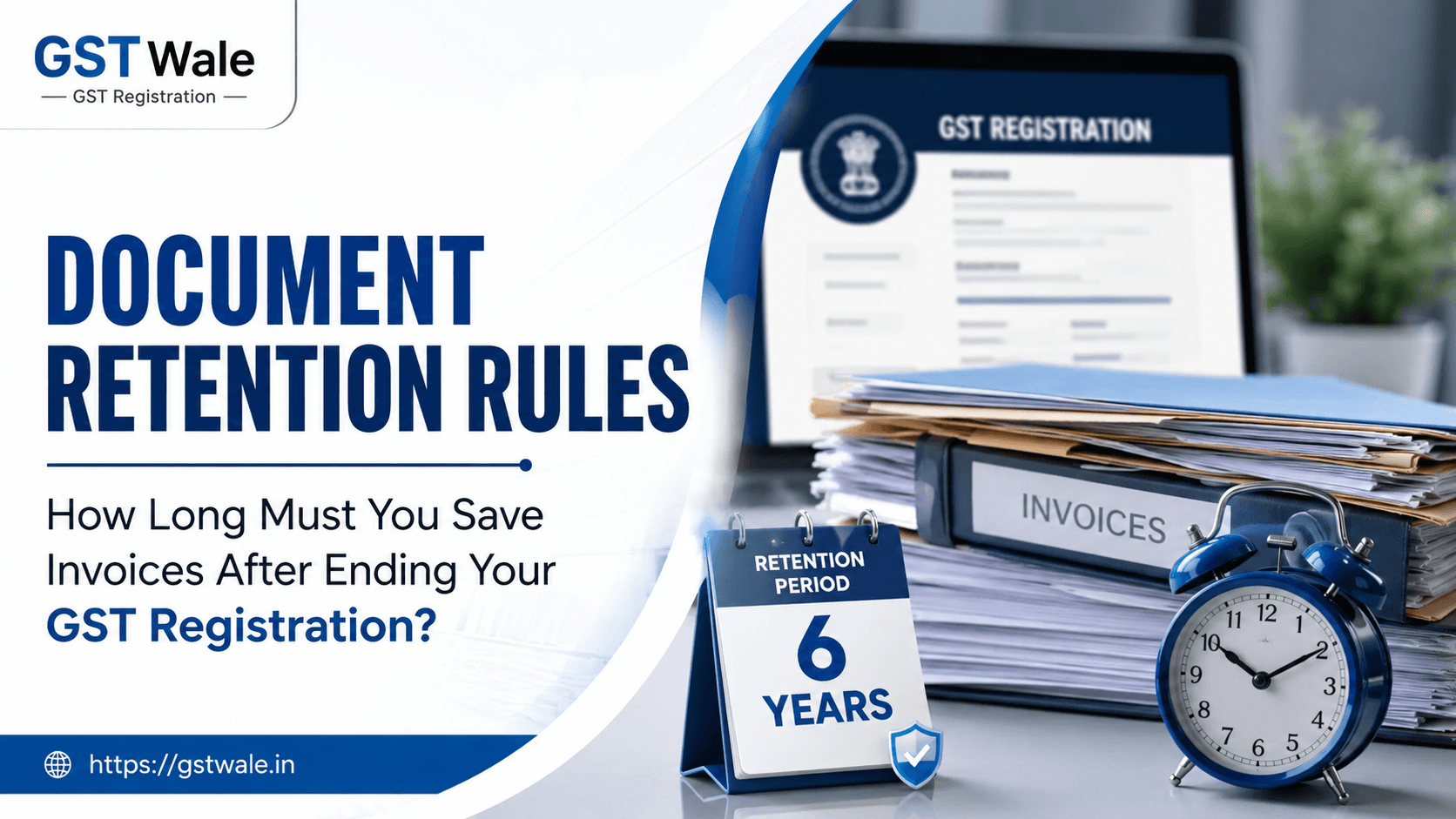
Document Retention Rules: How Long Must You Save Invoices After Ending Your GST Registration?
Document Retention Rules: How Long Must You Save Invoices After Ending Your GST Registration?
So, you have finally decided to close your business or perhaps you’ve simply hit the threshold where you no longer need to be part of the tax net. You have applied for cancellation, received the confirmation, and are now looking forward to a life free from monthly compliance. However, there is one nagging question most business owners ask us: "Do I just throw away all my old files now" If you are worried about what happens to your paperwork after ending your gst registration registration, you aren't alone. Many taxpayers assume that once the GSTIN is cancelled, their liability vanishes into thin air. As professionals at GST Wale, we want to ensure you stay on the right side of the law. If you are just starting out or need expert help managing your GST Registration, we are here to support your journey from day one.
Understanding the Legal Obligation for Record Keeping
Under the Goods and Services Tax laws, the end of your business activity does not immediately signal the end of your record-keeping duties. The law is quite specific about the duration for which you must maintain your statutory books of accounts. Even if you have successfully completed the process of cancelling your gst registration registration, the tax authorities retain the right to audit your past transactions.
According to Section 36 GST record keeping guidelines, every registered person is required to maintain accounts and other records for a specific period. But what happens when that registration is no longer active? The law mandates that you keep your records for a minimum of 72 months (six years) from the due date of filing the Annual Return for the relevant financial year.
Why Should You Maintain Records Post-Cancellation?
You might wonder why the government insists on holding onto paperwork for years after you’ve stopped trading. The primary reason is the tax audit timeline. GST authorities can initiate an assessment or audit into your past business dealings years after you’ve stopped your operations. If they come knocking and you don’t have your invoices, e-way bills, or credit/debit notes, you could face hefty penalties.
Here is why cancelled GSTIN maintenance is critical:
Audit Readiness: Authorities may select your case for a scrutiny assessment based on discrepancies flagged by the system.
Legal Disputes: If there are pending litigations, your records serve as your primary defense.
Input Tax Credit (ITC) Verification: If the department doubts the validity of the ITC you claimed during your active years, you must be able to produce the original invoices.
Practical Tips for Managing Your Documentation
We know that keeping physical files for six years is a massive headache. Here at GST Wale, we suggest moving toward a digital-first approach. Here is how you can manage your data effectively after your gst registration registration is formally closed:
1. Digitize Everything
Don't rely on paper alone. Thermal paper invoices often fade over time, making them unreadable. Scan all your purchase and sales invoices, GSTR-1, GSTR-3B filings, and payment receipts. Store these in a cloud-based folder with a proper naming convention (e.g., Year_Month_DocumentType).
2. Maintain a Physical Backup
While digital is great, keep a physical folder of critical documents like original tax invoices, audit reports, and correspondence with the GST department. Label these folders clearly with the financial year.
3. Archive System Data
If you used accounting software (like Tally or Zoho Books), export your trial balance, ledgers, and final accounts into Excel or PDF formats. Keep these backups in an external hard drive stored in a safe place.
Frequently Asked Questions
How long should I keep records after cancelling my GSTIN?
You must retain all tax-related documents for at least 72 months from the due date of the annual return for the financial year to which the records pertain.
Does the cancellation of my gst registration registration absolve me from past tax liabilities?
Absolutely not. You remain liable for any tax, interest, or penalty that relates to the period when your registration was active, even if you are no longer registered today.
Can I destroy my records if the audit period has passed?
Once the 72-month period as per Section 36 is completed, you are generally safe to discard them. However, if there is a pending court case or ongoing investigation, you must hold onto those records until the matter is fully resolved.
Is digital storage legally valid for GST purposes?
Yes, the GST law accepts electronic records as valid evidence, provided they are maintained in a manner that ensures their integrity and accessibility if the department requests them.
Closing a business is a major step, but don't let your guard down on compliance just yet. Whether you are dealing with a fresh gst registration registration or winding up your operations, your documentation is your best defense against unexpected notices. The tax audit timeline is long, and being prepared is always better than facing a tax demand without proof.
At GST Wale, we believe that being a responsible taxpayer doesn't end with a cancelled GSTIN. If you need guidance on how to organize your records or need help with any other taxation matters, reach out to our team today. Let us help you stay compliant, stress-free, and always audit-ready!
 Previous